
How to Build Multiple Streams of Income in India — A Practical Guide for Salaried Professionals 2026
How to build multiple income streams as a salaried Indian professional in 2026 — 5 streams ranked by time to first income, realistic ₹ numbers, the build sequence, and tax rules for each.
Priya Nair16 May 202628 min read
Key Takeaways
- A single salary is a financial vulnerability — it requires your time every month to exist, and disappears entirely if your job ends
- You do not need to replace your salary — a ₹20,000/month side income covering fixed expenses transforms job loss from a crisis into a manageable transition
- Freelancing is fastest to ₹10,000/month — first client often within 30–90 days for professionals with in-demand skills and consistent outreach
- Dividend income requires capital, not time — meaningful passive income (₹5,000+/month) needs ₹7.5–₹10 lakh in invested corpus
- Digital products are highest leverage, slowest start — 9–18 months to meaningful income, but zero ongoing time once built
- All income combines and is taxed at slab rate — no separate lower rate for side income; claim all legitimate business expenses to reduce taxable freelance income
What are multiple income streams? Multiple income streams are recurring sources of money that operate independently of your primary salary — such as freelancing, investment dividends, rental income, or digital product sales — designed to reduce financial dependency on a single employer.
If You Want to Start This Week
| Your profession | First action | Why this first |
|---|---|---|
| Software engineer | Offer architecture review calls to 3 startups | High hourly rate, immediate demand |
| Finance / CA | Build one FP&A or tax planning template | Sell once, sell repeatedly |
| Designer | Create one Figma UI kit or brand sprint package | Portfolio asset + recurring sales |
| Marketing / content | Offer LinkedIn content strategy to one SME | Immediately monetisable expertise |
| Product manager | Offer a 2-hour product audit to a startup | High-value, low-time, testable |
This table exists because the best first action is always the one you can take today — not the one that will theoretically produce the most income eventually.
- Why one income stream is a financial vulnerability
- 5 income streams ranked by time to first income
- Freelancing — fastest path to ₹10,000/month
- Dividend income — the truly passive stream
- Rental income — high capital, stable return
- Digital products — highest leverage, slowest start
- P2P lending and debt instruments
- The realistic income timeline — all 5 streams compared
- The salaried professional's build sequence
- The financial resilience threshold — how much is enough?
- Why most side incomes fail within 12 months
- Best side income by profession
- Income streams that are usually overhyped
- Who should NOT try multiple income streams yet
- Tax rules for multiple income sources
- People also ask
- Frequently asked questions
Why One Income Stream Is a Financial Vulnerability
Rohan, 34, senior software engineer at a Bengaluru startup. CTC: ₹28 lakh. Savings: ₹4.5 lakh emergency fund. Investments: ₹12 lakh in mutual funds.
In March 2025, his company was acquired. Entire team let go. Notice period: 30 days.
For 4 months, Rohan's ₹28 lakh salary became ₹0. His SIPs were paused. ₹2 lakh of emergency fund consumed. His mutual funds — down 15% from a market correction that conveniently coincided — had to be partially redeemed at a loss.
A ₹25,000/month freelance income stream he had built over the previous 18 months covered his rent and groceries throughout. The transition was uncomfortable but not catastrophic.
Counterintuitive truth: Multiple income streams don't need to make you rich. They need to make your primary income optional — or at least survivable to lose.
The NASSCOM Gig Economy Report 2025 found that Indian professionals with at least one active income stream outside their primary employment reported materially lower financial stress during job transitions, and greater ability to delay accepting the next role — allowing for better career decisions rather than desperation-driven ones.
Before you start — is this the right time?
If your goal is quick money → this is the wrong article. None of these streams produce meaningful income in under 60 days without prior setup. If your goal is financial resilience → this works, on a 12–24 month horizon. If your goal is replacing your salary in 6 months → unrealistic for most. If your goal is reducing career dependency over 5 years → exactly what this is designed for.
Which stream fits your income level?
| Salary band | Best first stream | Why |
|---|---|---|
| ₹5–₹10 LPA | Freelancing | Highest ROI on existing skill, zero capital needed |
| ₹10–₹20 LPA | Freelancing + aggressive SIP | Enough surplus to compound; freelance funds investment |
| ₹20–₹40 LPA | Digital products or consulting | Existing expertise is highly monetisable at this level |
| ₹40L+ | Advisory / angel investing | Network leverage matters more than time-for-money |
5 Income Streams — Ranked by Time to First Meaningful Income
What is an income stream? An income stream is a recurring source of money that operates independently of your primary salary — such as freelancing, investment dividends, rental income, or digital product sales. The goal is not to replace your salary immediately but to build enough recurring income that your primary job becomes a choice rather than a necessity.
Which stream fits your situation?
| If you have… | Start with… | Why |
|---|---|---|
| No capital, marketable skills | Freelancing | Highest ROI per hour, zero upfront cost |
| Time but no capital | Digital products | Long setup, but zero marginal cost once live |
| ₹5L+ saved to deploy | REITs or debt instruments | Immediate return, no time input |
| Strong professional network | Advisory or consulting | High rates, minimal marketing needed |
| Minimal free time | SIP investment acceleration | Automates itself, no ongoing attention |
"Meaningful" is defined as ₹5,000+/month sustained — not a one-off.
| Income stream | Time to ₹5,000/month | Capital required | Time/week | Scales without time? |
|---|---|---|---|---|
| Freelancing | 1–3 months | Low (₹0–₹20K setup) | 5–15 hrs | No — time = income |
| Dividend income | 3–5 years (corpus build) | High (₹7.5L+ corpus) | ~0 | Yes |
| Rental income | Immediate (if you own property) | Very high (₹30L+) | Low | Yes |
| Digital products | 9–18 months | Medium (time investment) | ~0 post-launch | Yes |
| P2P lending | 1–3 months | Medium (₹1L+ to start) | Low | Partially |
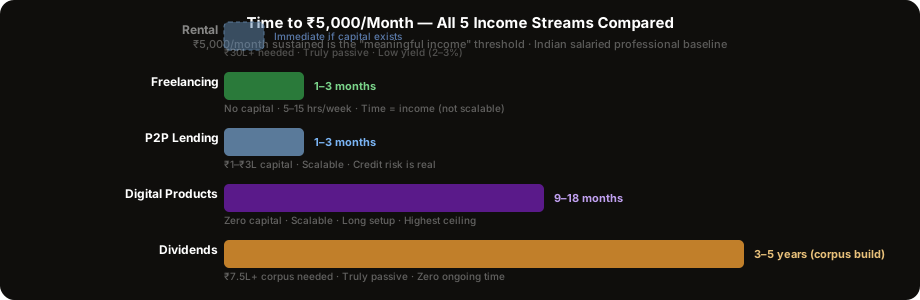
Fig 1: Time to ₹5,000/month from each income stream. Freelancing and P2P are fastest to start; dividends and rental are slowest to build but require no ongoing time. Digital products have the highest ceiling once established.
Freelancing — The Fastest Path to ₹10,000/Month
Freelancing is the most accessible income stream for salaried professionals because it monetises skills you already have — typically the same skills your employer pays for.
Most in-demand freelancing domains in India 2026:
- Technology: software development, data engineering, ML/AI consulting, cloud architecture
- Finance: financial modelling, FP&A consulting, GST/tax advisory, startup CFO-as-a-service
- Design: UI/UX, product design, brand identity, video editing
- Content: technical writing, SaaS copywriting, SEO content, marketing strategy
- Business: project management, operations consulting, HR advisory
Realistic rates for experienced professionals:
| Experience | Hourly rate | Monthly income (10 hrs/month) |
|---|---|---|
| 2–4 years | ₹800–₹2,000 | ₹8,000–₹20,000 |
| 4–7 years | ₹2,000–₹5,000 | ₹20,000–₹50,000 |
| 7+ years | ₹5,000–₹15,000 | ₹50,000–₹1,50,000 |
Where to find first clients: LinkedIn (post case studies from your current work), AngelList (startup advisory), Upwork and Toptal (global clients), Truelancer and Freelancer.in (Indian market), and direct outreach to startups in your domain.
Timeline: Professionals with in-demand skills and consistent outreach often secure their first client within 30–90 days, though timelines vary substantially by domain and market conditions. Consistent ₹10,000–₹20,000/month recurring income is achievable within 3–6 months for most professionals — but is not guaranteed.
Moonlighting and legality: Indian employment contracts vary enormously. Many permit external work outside core employment obligations, but some companies prohibit any paid outside work regardless of domain — and others have broad confidentiality or IP assignment clauses that affect freelance work. Before accepting any freelance engagement, review your employment agreement, moonlighting policy, confidentiality clauses, and any conflict-of-interest terms. When in doubt, consult an employment lawyer. The income must be declared in your ITR regardless of the amount or whether your employer knows.
Section 44ADA allows professionals within notified eligible categories (doctors, lawyers, engineers, accountants, architects, and others) with annual gross receipts below ₹75 lakh to use presumptive taxation. Eligibility for salaried professionals starting a freelance stream — particularly those in tech, consulting, or content — is subject to notified profession definitions and evolving interpretation. Consult a CA to confirm applicability before using 44ADA. The simplest tax structure for eligible professionals: declare 50% of gross receipts as profit, no books required.
The AI effect on freelancing in 2026: AI is compressing rates for commodity writing, generic design, and templated code — while dramatically increasing leverage for domain experts. A financial analyst using AI tools can deliver equivalent modelling work in significantly less time, increasing effective hourly rates without reducing client value. Freelancers who use AI to multiply their domain expertise are capturing more income than those competing on commodity output.
The Highest-ROI Side Income in 2026: AI-Amplified Expertise
This is distinct from the "AI automation agency" hype. The opportunity is not selling AI services — it is using AI to multiply the output of skills you already have, in your existing domain:
| Professional | AI-amplified offering | What it replaces |
|---|---|---|
| CA / Finance | Tax research service, FP&A model packs | Junior analyst team |
| Product manager | Product strategy audits, spec writing | Agency retainers |
| Lawyer | Contract review workflows, SOP templates | Junior associate hours |
| Designer | Brand sprint packages, UI kit libraries | 2–3 person design team |
| Software engineer | Architecture reviews, code audit retainers | Consultant firm |
A domain expert with 5+ years experience using AI tools can now produce output that previously required a small team — and price accordingly. This is not a temporary arbitrage; the gap between AI-enabled domain experts and those who have not adapted will widen over the next 3–5 years.
Dividend Income — The Truly Passive Stream
Dividend income is the only genuinely passive income stream available to salaried professionals — it requires no ongoing time after the investment is made.
The honest numbers:
| Instrument | Typical yield | Annual income on ₹10L portfolio |
|---|---|---|
| Indian large-cap stocks | 1–2% | ₹10,000–₹20,000 |
| REITs (e.g. Embassy, Mindspace) | 5–8% | ₹50,000–₹80,000 |
| Dividend-focused mutual funds | 1.5–3% | ₹15,000–₹30,000 |
| Debt mutual funds (income option) | 6–8% (not dividend — appreciation) | ₹60,000–₹80,000 |
The important caveat: Chasing high-dividend stocks at the expense of capital growth is a wealth-destruction strategy. A company paying 6% dividend but growing at 3% annually underperforms an index fund growing at 12% and paying 1.5% dividend — total return is what matters, not yield alone.
The correct approach: Build your SIP → accumulate corpus → dividends are the natural output of a large portfolio. Do not sacrifice CAGR for yield in the accumulation phase.
Timeline to ₹5,000/month: At a 2% average portfolio yield, you need ₹30 lakh invested. At 6% (REITs + dividend-focused allocation), you need ₹10 lakh. The realistic timeline for most salaried professionals starting from zero: 5–8 years of disciplined SIP investment.
Tax: Dividends are taxable as income at your full slab rate — no preferential treatment.
Rental Income — High Capital, Stable Return
Rental income is immediate once you own the property — but the capital requirement makes it inaccessible to most salaried professionals in the accumulation phase.
Realistic yields:
| Property type | Typical yield | Monthly income on ₹50L property |
|---|---|---|
| Residential (metro 1BHK) | 2–3% annual | ₹8,000–₹12,500 |
| Commercial (small office) | 5–8% annual | ₹20,000–₹33,000 |
| Parking space (metro) | High yield on low capital | ₹2,000–₹8,000/space |
| REITs (listed, accessible) | 6–8% annual | ₹5,000–₹6,700 on ₹10L |
The honest assessment: Residential real estate in Indian metros yields 2–3% annually on property value — after maintenance, vacancy periods, and tenant management. An equity index fund returning 12% CAGR is a structurally superior investment on a pure return basis. Real estate's argument is leverage (home loan magnifies returns on equity deployed) and inflation hedge — not yield.
What rental income content typically omits:
- Liquidity: You cannot sell 10% of your flat when you need cash. Property is illiquid in ways equity is not.
- Concentration risk: A ₹50L flat is 100% of that investment in one location, one asset, one tenant relationship.
- Legal and tenant friction: Eviction of non-paying tenants in India is a multi-year legal process. Bad tenant selection is an expensive lesson.
- Transaction costs: Stamp duty (5–7%) and registration fees (1%) on purchase reduce effective returns further. Brokerage on sale adds another 1–2%.
- Maintenance: 0.5–1% of property value annually in maintenance costs are often unaccounted for in yield calculations.
REITs are the accessible alternative: You can invest in REITs (Real Estate Investment Trusts) from ₹10,000–₹15,000 — gaining real estate income exposure without buying physical property. Embassy Office Parks REIT and Mindspace Business Parks REIT have had distribution yields that have often ranged between 6–8% annually with quarterly distributions. Yields vary by period and are not guaranteed.
Tax on rental income: Taxable under "Income from House Property." Standard deduction of 30% of Net Annual Value is allowed. Interest on home loan is deductible under Section 24(b) up to ₹2 lakh for self-occupied property (no cap for let-out property). File ITR-2 if you have rental income.
Digital Products — Highest Leverage, Slowest Start
Digital products (courses, templates, ebooks, tools, SaaS) are created once and sold repeatedly — the economics are near-zero marginal distribution cost once the product and channel exist.
Audience businesses — slow but powerful: A distinct category within digital products is the audience-first model: build a trusted following first, monetise later. YouTube channels, newsletters (Substack, beehiiv), and podcast communities fall here. The compounding cycle is long — typically 18–36 months before meaningful monetisation — but the economics at maturity are exceptional. The critical principle: audience trust is the asset, not the product. Content creators who build genuine domain authority first and monetise later typically outperform those who launch a course before building an audience.
Most viable for Indian professionals in 2026:
- Online courses: Professionals teaching career-relevant skills on Udemy, Teachable, or YouTube + Gumroad. Finance, data analysis, product management, UI/UX, digital marketing.
- Templates and tools: Excel financial models, Notion templates, Figma UI kits, PowerPoint pitch deck templates. Low creation effort, consistent passive sales.
- Technical ebooks/guides: PDF guides for professional development, certification prep, domain-specific how-to guides.
- SaaS micro-tools: Small software products solving specific professional problems — typically requires technical skills.
Realistic income ranges:
| Product type | Time to create | Monthly income range (after establishment) |
|---|---|---|
| Udemy course (professional domain) | 40–80 hrs | ₹5,000–₹1,50,000 |
| Excel template pack | 8–20 hrs | ₹3,000–₹25,000 |
| Ebook (professional guide) | 20–40 hrs | ₹2,000–₹15,000 |
| SaaS tool | 200–500 hrs | ₹10,000–₹5,00,000+ |
The realistic distribution: Most first-time course creators earn ₹3,000–₹15,000/month after 12–18 months of iteration. A small proportion — those with strong distribution and high-value domain expertise — earn substantially more. Zero marketing = near-zero sales regardless of quality.
Timeline: 3–6 months to create, 6–18 months to meaningful recurring income. Requires active promotion in the first year — it does not become passive until the product and distribution channel are established.
P2P Lending and Debt Instruments
P2P lending connects individual lenders to borrowers through RBI-regulated platforms. It is an accessible starting point but carries genuine credit risk.
Current landscape (2026):
| Instrument | Expected return | Risk level | Minimum investment |
|---|---|---|---|
| P2P lending (RBI-regulated) | 10–18% | Medium-High (defaults occur) | ₹50,000 |
| NCDs (A-rated corporate) | 9–12% | Medium | ₹10,000 |
| High-yield debt funds | 7–9% | Low-Medium | ₹1,000 SIP |
| Senior secured bonds | 9–13% | Medium | ₹10,000 |
P2P risk is real — and more severe than most platforms communicate: Defaults on P2P platforms are not rare — they are expected and structurally built into the return model. The stated return (10–18%) is a gross figure before defaults. Net return to lenders after defaults is typically 8–12% for well-diversified portfolios. Capital loss is possible — not just deferred. Recoveries on defaulted loans can take years through legal processes. Platform risk also exists: several Indian fintech platforms have faced operational difficulties unrelated to underlying loan quality.
Critical nuance: RBI regulation governs platform operations and processes — not return guarantees or capital protection. A platform being RBI-regulated does not mean your money is safe. Diversify across 50+ borrowers. Cap P2P at 10–15% of investable assets. Treat it as a high-yield debt instrument with credit risk — not as a savings account alternative.
Liquidity: Many P2P investments are not easily liquidated before borrower repayment schedules complete. Unlike a liquid fund or FD, you cannot exit on demand — your money is committed for the loan tenor, which can range from 3 to 36 months depending on the platform and borrower profile.
The low-friction alternative: High-yield debt mutual funds and NCDs from highly-rated issuers offer 8–12% returns with significantly lower credit risk and better liquidity than P2P platforms — they are often overlooked in favour of the higher headline P2P rates.
Tax: All P2P and debt instrument interest is taxable as income at slab rate. No preferential treatment.
The Realistic Income Timeline
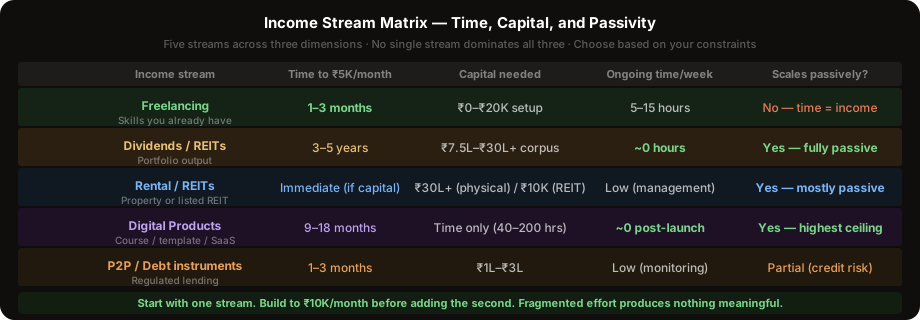
Fig 2: The income stream matrix — time to ₹5,000/month vs capital required vs time input ongoing. Freelancing dominates the "fastest and cheapest" quadrant. Dividends dominate the "truly passive" quadrant once corpus exists.
The critical insight most income-diversification content misses: you cannot build all five simultaneously. Attempting to start freelancing, build a course, invest in REITs, and set up P2P accounts in the same month produces four mediocre starts and no meaningful income from any of them.
The Salaried Professional's Build Sequence
A sequenced approach that works across income levels:
Phase 1 (Month 1–6): One freelance client Start one client relationship in your professional domain. Target: ₹8,000–₹15,000/month from 5–8 hours/month. Use this income entirely for SIP top-up — do not let lifestyle absorb it.
Phase 2 (Month 6–24): Stabilise freelance, invest surplus Grow to 2–3 regular clients: ₹20,000–₹40,000/month. Direct 80% to SIP acceleration. The investment portfolio begins compounding seriously. Begin identifying a digital product opportunity in your domain.
Phase 3 (Year 2–4): Create one digital product One well-positioned course or template pack in your domain. Invest 3–4 months of weekend time. Even at ₹5,000–₹10,000/month, this income is genuinely passive after launch.
Phase 4 (Year 4+): Portfolio income becomes material With 4 years of aggressive SIP investment (supplemented by freelance surplus), a ₹25–₹40 lakh portfolio generates ₹3,000–₹8,000/month in dividends and distributions. Combined with digital product income, the portfolio now covers 30–50% of fixed expenses.
At this point, your salary dependency reduces materially — career flexibility increases significantly. Not because you're rich, but because your fixed expenses are substantially covered by sources that don't require your primary employer to exist.
The Financial Resilience Threshold — How Much Is Enough?
Most content on multiple income streams targets the wrong goal: full salary replacement. The actual target is far more achievable: survival income — the amount that makes job loss survivable rather than catastrophic.
| Monthly fixed expenses | Side income survival target | What it covers |
|---|---|---|
| ₹25,000 | ₹10,000–₹15,000 | Rent + groceries — buys 6–12 months of career optionality |
| ₹50,000 | ₹20,000–₹30,000 | Rent + groceries + EMIs — job loss becomes a transition, not a crisis |
| ₹75,000 | ₹30,000–₹45,000 | 50% expense coverage — take risks on career that were previously impossible |
| ₹1,00,000 | ₹40,000–₹60,000 | Majority of fixed costs — career flexibility increases significantly |
The insight: You do not need to replace your salary. You need to cover your fixed expenses. A ₹28 lakh CTC professional with ₹25,000/month in side income and a 6-month emergency fund is more financially resilient than a ₹40 lakh professional with zero side income and a 1-month buffer.
People search for "how much passive income is enough" expecting a number like "₹5 crore corpus." The honest answer is structural: enough to make your current job optional, not enough to never work again. The first milestone is achievable within 2–3 years. The second takes a decade or more.
The hidden cost of multiple income streams: Income diversification has a cognitive load that most articles ignore. A side income that destroys sleep, erodes primary-job performance, or creates chronic stress is financially self-defeating — the damage to your primary income (still 90%+ of total earnings in Phase 1) typically exceeds the side income gained. Protect your primary income first. Build side income within the cognitive capacity that remains.
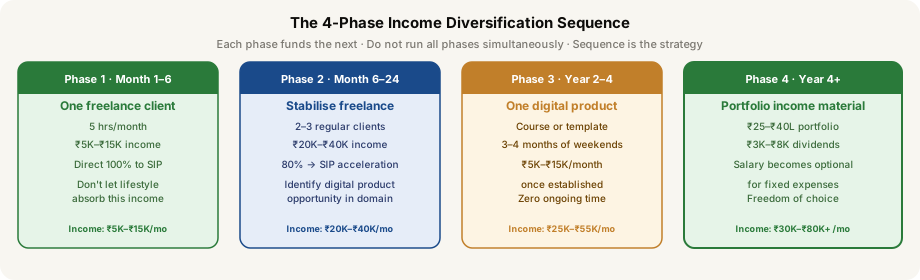
Fig 3: The 4-phase income diversification sequence. Each phase funds the next. Attempting all phases simultaneously produces fragmented effort and no meaningful income from any stream.
Why Most Side Incomes Fail Within 12 Months
Understanding why people fail operationally is more useful than another list of promising income ideas.
1. Trying 3–5 streams simultaneously — the most common failure. Attention fragments, none reaches the quality threshold for client retention or recurring revenue.
2. Underpricing from the start — fear of rejection leads to rates 40–60% below market. Low rates attract low-quality clients and signal low value, making it harder — not easier — to land good work.
3. No distribution plan for digital products — a course with no marketing audience earns zero regardless of content quality. Most first-time creators spend 90% of time on creation and 10% on distribution. The ratio should be closer to 50-50.
4. Tax and admin fatigue — invoicing, GST registration, advance tax calculations, and ITR-3 filing create friction that erodes motivation. Solution: separate bank account for side income from day one, and a CA consultation in the first 3 months.
5. No clear time boundaries — side income bleeds into primary job performance, family time, and sleep. Without explicit time blocks (e.g. 7–9am weekdays, Saturday mornings only), the cognitive load becomes unsustainable within 4–6 months.
6. Burning out in Phase 1 — the first 3 months of freelancing are the hardest: client acquisition, onboarding, scope creep, and late payments all cluster at the start. Most people who quit do so in months 2–4, before reaching the recurring income phase where the work becomes easier.
Best Side Income by Profession — India 2026
| Profession | Best first stream | Why it works for this profile |
|---|---|---|
| Software engineer | Consulting / architecture advisory | Highest hourly rates (₹3K–₹10K/hr), startup demand is strong |
| CA / Finance | Template packs, advisory retainers | Already trusted for financial work; AI multiplies output |
| Designer (UI/UX) | Figma UI kits, brand sprints | Passive sales + high freelance rates |
| Product manager | Product audits, spec writing | Domain scarce outside large cos; AI multiplies output |
| Lawyer | Contract review retainers | High value, time-bounded, repeatable |
| Doctor | Paid community, CME content | High-trust expertise with underdeveloped monetisation |
| Marketing / content | LinkedIn strategy, content retainers | Direct to SME market; low barrier to first client |
Income Streams That Are Usually Overhyped
Credibility requires saying what does not work alongside what does. These income streams are heavily marketed to Indian professionals in 2026 — and consistently underdeliver:
Dropshipping: Requires significant product sourcing, logistics management, customer service, and paid marketing. Net margins after platform fees (Amazon, Meesho) and returns are typically 5–15% — on a business that requires ongoing management. Not passive.
Random affiliate marketing: Works for creators with existing large audiences. For someone starting from zero, earning meaningful affiliate income requires 12–24 months of content creation before any meaningful traffic. Not a side income — it is a second career.
Day trading / options selling: SEBI-mandated disclosures from Indian brokers consistently show that the large majority of active F&O traders report net losses over multi-year periods. Not a side income — structurally negative expected value for most practitioners without significant capital, expertise, and time. Requires full-time attention even for those who are profitable.
"AI automation agencies": A 2026 buzzword for selling AI prompt services or automation workflows to small businesses. Commoditising rapidly. High client acquisition cost, low retention. The economics are unlikely to remain defensible as competition increases and clients build in-house capability.
Instagram theme pages: Brand-building as an income strategy works for genuine content creators. Nameless theme pages (travel quotes, motivation) have near-zero monetisation in the Indian market.
The test for any income opportunity: Income diversification is highly dependent on income level, available time, and existing expertise. Can you name three specific people you know personally who earn ₹20,000+/month from this, consistently, for 18+ months? If not, treat it as unproven at your income level and time availability.
Who Should NOT Try Multiple Income Streams Yet
Multiple income streams are not always the right priority. Avoid starting a side income if:
- Total EMI burden exceeds 40% of take-home — debt reduction produces a better guaranteed return than most side income streams
- Emergency fund is below 3 months — side income instability (client delays, platform issues) without a buffer creates financial anxiety
- Primary job performance is at risk — a ₹28 lakh job is worth more than a ₹5,000/month side income; protect the primary before adding the secondary
- You have revolving credit card debt — at 36–42% APR, credit card debt elimination outperforms any side income strategy by an enormous margin
The correct sequence: Emergency fund → clear revolving debt → protect primary income performance → then build income diversification.
Tax Rules for Multiple Income Sources
All income — regardless of source — combines into your Gross Total Income and is taxed at applicable slab rates. There is no preferential rate for side income.
Key rules by stream:
| Stream | Income head | Key tax rule |
|---|---|---|
| Freelancing | PGBP (Profits & Gains of Business/Profession) | Section 44ADA: declare 50% of receipts as profit if income below ₹75L. No books required. |
| Dividends | Other sources | Fully taxable at slab. TDS by company if >₹5,000/year. |
| Rental | House property | 30% standard deduction on NAV. Home loan interest deductible under 24(b). |
| Digital products | PGBP | Normal business income. Claim platform fees, equipment, software as expenses. |
| P2P / debt interest | Other sources | Fully taxable at slab. No preferential treatment. |
Advance tax: If total tax liability exceeds ₹10,000 in a year, advance tax payment is required — typically quarterly (June, September, December, March). Salaried professionals with significant side income must calculate and pay advance tax to avoid interest charges under Sections 234B and 234C.
ITR form: File ITR-3 (not ITR-1) if you have freelance or digital product income under PGBP. ITR-1 is for salary and other sources only.
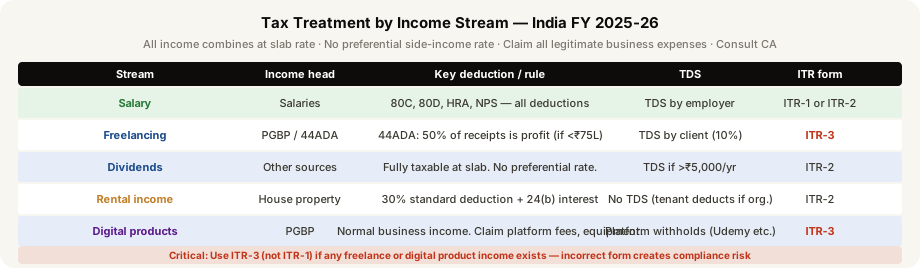
Fig 4: Tax treatment by income stream. The most important rule: file ITR-3 (not ITR-1) if any freelance or digital product income exists. Using the wrong ITR form creates compliance risk regardless of actual tax liability.
People Also Ask
What is the best passive income source for salaried employees in India?
Dividend income from a growing equity portfolio is the most genuinely passive — it requires no ongoing time after the initial investment. But meaningful monthly amounts (₹5,000+) require ₹10–₹30 lakh in corpus depending on yield. REITs are the most accessible high-yield passive option — accessible from ₹10,000–₹15,000 and yielding 6–8% annually. For faster income without capital requirements, freelancing in your professional domain is the most practical starting point.
Can I do freelancing (moonlighting) while employed in India?
It depends on your specific employment contract — not on a general rule. Many Indian employment agreements permit external work outside core employment obligations, but some prohibit any paid outside work regardless of domain. Some contracts have broad IP assignment or confidentiality clauses that effectively restrict freelance work even in unrelated areas. Always review your employment agreement, moonlighting policy, and conflict-of-interest terms before taking freelance clients. When in doubt, consult an employment lawyer. All freelance income must be declared in your ITR regardless of amount.
How much can I earn from dividends on ₹10 lakh invested?
At 1.5–2% average dividend yield (Indian large-cap equity portfolio): ₹15,000–₹20,000/year (₹1,250–₹1,667/month). At 6–8% yield (REIT-focused allocation): ₹60,000–₹80,000/year (₹5,000–₹6,667/month). Dividend income requires a large corpus to generate meaningful monthly amounts — it is not an early-stage income strategy.
Is P2P lending safe in India?
P2P lending through RBI-regulated platforms is legal and regulated. It is not safe in the sense of being risk-free — defaults are common and expected. The strategy to manage risk: invest in tranches across 50+ borrowers, cap P2P at 10–15% of total investable assets, and use a reputable large platform. Net returns after defaults are typically 8–12% for well-diversified portfolios — meaningful but not the headline 18% often advertised.
What is the Section 44ADA scheme for freelancers?
Section 44ADA is a presumptive taxation scheme for notified eligible professions (doctors, lawyers, engineers, accountants, architects, and others) with annual gross receipts below ₹75 lakh. Under it, you declare 50% of gross receipts as taxable profit — the other 50% is assumed to cover expenses — without maintaining detailed books of accounts. Eligibility for salaried professionals starting freelance work depends on your specific profession category and evolving CBDT guidance. Confirm applicability with a CA before using 44ADA; incorrect usage carries compliance risk.
Frequently Asked Questions
Start with one outside your salary. Build it to ₹10,000–₹20,000/month before adding a second. Two well-developed income streams are more valuable than five early-stage attempts. The NASSCOM data shows professionals with 1–2 active non-salary streams have significantly higher financial resilience than those with zero or those spreading effort across five simultaneously underdeveloped streams.
In order of immediate potential: (1) freelance software consulting or architecture advisory for startups at ₹3,000–₹10,000/hour, (2) technical course creation on Udemy or YouTube, (3) open-source project monetisation, (4) micro-SaaS tools solving specific professional problems. Engineers have unusually high hourly rates and strong digital product opportunities.
Freelancing requires the least capital — your existing professional skills are the product. Identify the most valuable skill in your domain that clients outside your employer would pay for. Build a simple portfolio (3–5 case studies from your current work, anonymised). Reach out to 10 potential clients on LinkedIn. One yes from ten outreach messages is a realistic first-month expectation.
Data Sources and Disclaimer
NASSCOM Gig Economy figures sourced from NASSCOM India Gig Economy Report 2025. Tax rules based on Income Tax Act 1961 as applicable for FY 2025-26. Section 44ADA eligibility and gross receipt limits — verify current applicability with a CA as limits change. All income and tax figures are illustrative. Consult a SEBI-registered advisor and Chartered Accountant for personalised guidance.
Also read — Rivo Personal Finance Series:
- Why Indians Live Paycheck to Paycheck — The Behavioural Science
- How to Start Investing With ₹500/Month
- 10 Legal Tax Deductions for Salaried Employees — India 2026
- FIRE Movement for Indian Middle Class — Is It Realistic?
- Index Funds vs Mutual Funds vs Stocks — Which Builds Wealth?
- Debt Avalanche vs Debt Snowball — Which Pays Off Debt Fastest?
More from the journal
Personal Finance