
How to Start Investing With ₹500/Month in India — A Complete Beginner's Guide 2026
You can start investing in India with ₹500/month. This step-by-step guide covers which platform, which fund, and which order — for salaried beginners with no prior investing experience. Takes 15 minutes to set up.
Priya Nair12 May 202615 min read
Key Takeaways
- ₹500/month at 12% CAGR over 30 years = ₹17.6 lakh — the amount is not the point, the start date is
- The single most important investment decision is the date you begin — not which fund, not which platform
- A Nifty 50 index fund in Direct Plan is the correct first investment for 95% of Indian beginners
- Direct Plans earn 0.5–1.5% more per year than Regular Plans — over 20 years on ₹10,000/month SIP, this compounds to ₹15–25 lakh
- The 5-year delay cost: starting at 30 instead of 25 with ₹500/month loses ₹7.1 lakh in final corpus — equal to 14 years of the investment itself
- Never invest before: credit card debt is cleared + 3 months emergency fund is in place
Table of Contents
- Why ₹500/month is not too small
- The correct order — what to do before investing
- Your first investment: Nifty 50 index fund explained
- Direct Plan vs Regular Plan — the choice that costs lakhs
- Which platform to use
- What to invest at ₹500, ₹1,000, ₹2,000, ₹5,000/month
- How SIP step-up works — capturing every increment
- Tax on equity mutual funds in 2026
- The 15-minute setup checklist
- Common beginner mistakes
- People also ask
- Frequently asked questions
How to Start Investing in India With ₹500/Month — Quick Answer
Open a direct mutual fund account on Groww, Kuvera, or Zerodha Coin. Complete KYC with Aadhaar and PAN (10 minutes). Search for "Nifty 50 index fund direct plan growth." Set up a ₹500/month SIP with the debit date 2 days after your salary credit. Done. The entire process takes 15 minutes for someone with KYC already complete.
Before you invest, in this order:
- Clear any revolving credit card balance (42% APR beats any equity return)
- Build 3 months of expenses in an SFB savings account or liquid fund
- Then start your first SIP
Why ₹500/Month Is Not Too Small
Ananya, 26, junior software engineer in Hyderabad. Salary: ₹6.5 lakh/year. Convinced herself that investing "properly" means starting with ₹5,000/month — something she'll do after the next appraisal.
At 26, ₹500/month in a Nifty 50 index fund at 12% CAGR:
- At 36 (10 years): ₹1.16 lakh
- At 46 (20 years): ₹4.99 lakh
- At 56 (30 years): ₹17.6 lakh
If she waits until 31 to start at "the right amount" of ₹5,000/month:
- Loses 5 years of compounding on that ₹500
- The 5-year delay on ₹500/month alone costs ₹7.1 lakh in final corpus
Counterintuitive truth: The 5-year delay costs more than the 14 years of ₹500/month SIPs she would have made. The date is the investment.
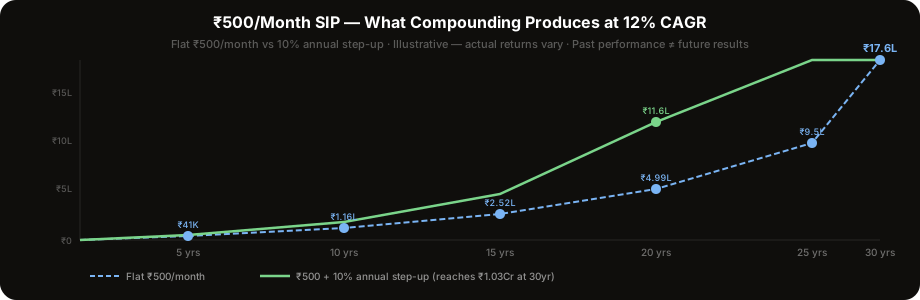
Fig 1: ₹500/month SIP at 12% CAGR. Total invested at 30 years: ₹1.8 lakh. Corpus: ₹17.6 lakh. The gap between invested and corpus is compounding at work — it widens exponentially in the final decade.
The Correct Order — What to Do Before Investing
Most investing guides skip this. The sequence matters enormously.
Step 1: Clear revolving credit card debt first A credit card balance at 36–42% APR is a guaranteed negative return at that rate. No equity investment reliably beats 36% annually. Clear revolving card debt completely before any investment. See Debt Avalanche vs Debt Snowball for the fastest path.
Step 2: Build a 3-month emergency fund Without a liquid buffer, any market volatility will force you to redeem your SIP at a loss to cover expenses. Build 3 months of expenses in an SFB savings account or liquid fund before investing in equity.
Step 3: Start your SIP Only now. With debt cleared and an emergency buffer in place, a market correction is just volatility — not a crisis that forces you to sell.
Your First Investment: Nifty 50 Index Fund
What it is: A mutual fund that holds all 50 companies in the Nifty 50 index (Reliance, Infosys, HDFC Bank, TCS, ICICI Bank...) in exact proportion to their index weight. When the Nifty 50 rises, your fund rises by the same amount. When it falls, your fund falls by the same amount. No fund manager makes decisions — the fund is entirely rules-based.
Why this first, not an active fund:
The S&P SPIVA India Scorecard 2025 — the most rigorous study of Indian mutual fund performance — found that 88% of large-cap actively managed funds underperformed the Nifty 50 over 10 years, after accounting for their higher expense ratios.
This means if you had picked a random large-cap active fund 10 years ago, there was an 88% chance a simple Nifty 50 index fund would have made you more money.
Why it works:
- Expense ratio: 0.05–0.20% vs 0.5–2.0% for active funds
- No fund manager risk — cannot underperform its own index
- No decisions required after setup
- Automatic diversification across 50 large Indian companies
Which Nifty 50 index fund: Any from a major AMC is fine — HDFC Nifty 50 Index Fund, Nippon India Index Fund, ICICI Prudential Nifty 50 Index Fund, UTI Nifty 50 Index Fund, SBI Nifty 50 Index Fund. They are structurally near-identical. The primary differentiator is expense ratio — choose the lowest.
Direct Plan vs Regular Plan — The Choice That Costs Lakhs
Every mutual fund exists in two versions: Direct Plan and Regular Plan. This is the most important choice most beginners don't know they're making.
| Direct Plan | Regular Plan | |
|---|---|---|
| Distributor commission | None — you invest directly | 0.5–1.5%/year paid to agent/bank |
| Expense ratio | 0.05–0.20% (index) | 0.5–2.5% (includes commission) |
| Returns | Higher | Lower by commission amount |
| Available at | Direct platforms (Groww, Kuvera, Coin) | Banks, agents, distributor apps |
The 20-year compounding impact on ₹10,000/month SIP:
| Plan type | 20-year corpus (12% gross return) |
|---|---|
| Direct Plan (0.1% ER) | ₹98.9 lakh |
| Regular Plan (1.5% ER) | ₹80.4 lakh |
| Difference | ₹18.5 lakh |
₹18.5 lakh — the cost of clicking the wrong button once. Always choose Direct Plan.
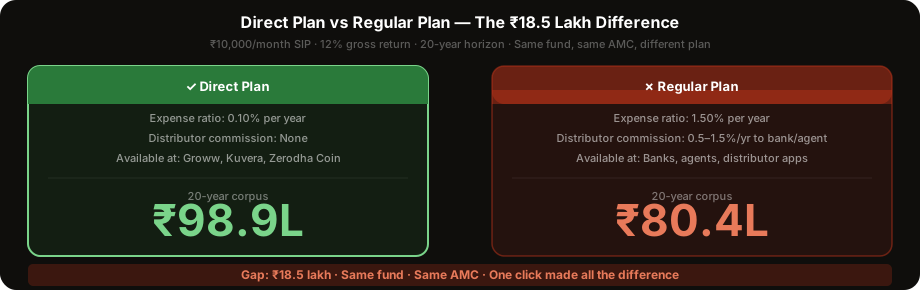
Fig 2: Direct vs Regular Plan — the hidden cost. The 1.4% expense ratio difference compounds to ₹18.5 lakh over 20 years. The Regular Plan doesn't give you better advice — it gives your bank or agent a commission.
Which Platform to Use
All the platforms below are SEBI-regulated, offer Direct Plans, and have zero transaction commission:
| Platform | Best for | KYC process |
|---|---|---|
| Kuvera | Purists — clean, goal-based, no clutter | DigiLocker / Aadhaar OTP |
| Groww | Beginners — most intuitive UX | Aadhaar OTP + selfie |
| Zerodha Coin | Existing Zerodha users | Uses Zerodha account KYC |
| Paytm Money | Existing Paytm users | Aadhaar-based |
| ET Money | Goal-based investing with insights | Aadhaar + PAN |
| MF Central | Direct AMFI platform | Aadhaar-based |
Do not invest through your bank's app or a relationship manager — they will almost certainly put you in Regular Plans that pay them commission.
What to Invest at Each Monthly Amount
The rule: do not diversify before you have something meaningful to diversify.
A ₹500/month portfolio split across 5 funds is not diversification — it is fragmentation. Concentrate until each holding is significant.
| Monthly amount | Allocation |
|---|---|
| ₹500–₹1,000 | 100% Nifty 50 index fund (Direct) |
| ₹1,000–₹2,000 | 80% Nifty 50 + 20% Nifty Next 50 index |
| ₹2,000–₹5,000 | 60% Nifty 50 + 20% Nifty Midcap 150 index + 20% ELSS (if 80C headroom) |
| ₹5,000–₹10,000 | Add 10–15% international index (Nasdaq or global) |
| ₹10,000+ | Consider adding active mid/small-cap fund (top-quartile, 10-year track record) |
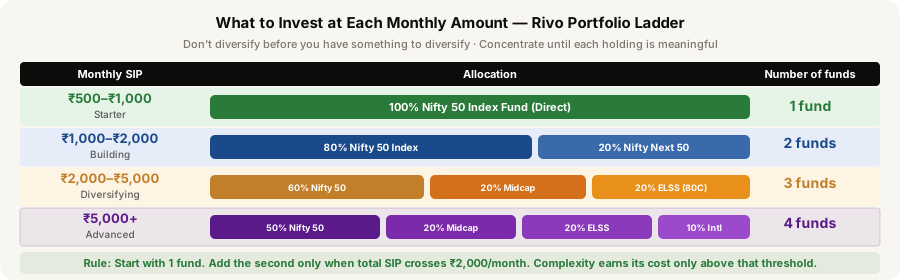
Fig 3: Recommended allocation at each monthly investment level. Complexity only earns its complexity cost above ₹2,000/month. Below that, a single Nifty 50 index fund is both sufficient and optimal.
How SIP Step-Up Works — Capturing Every Increment
Most investors start a SIP and forget to update it as their salary grows. This is a structural mistake — lifestyle inflation captures the entire increment.
The step-up rule: Every time your salary increases, immediately increase your SIP by 50% of the increment. On the same day. Before the new salary feels "normal."
Example:
- Salary: ₹60,000 → ₹70,000 (+₹10,000)
- Step-up SIP by: ₹5,000/month (50% of increment)
- Lifestyle gains: ₹5,000/month (the other 50%)
The compounding impact of step-up:
₹500/month flat for 30 years at 12% CAGR = ₹17.6 lakh ₹500/month with 10% annual step-up for 30 years at 12% CAGR = ₹1.03 crore
The step-up is not a small optimisation — it is a 5.8× difference in final corpus.
Most direct MF platforms allow you to set an automatic annual step-up percentage when configuring the SIP. Set it to 10% at setup. It takes 30 seconds.
Tax on Equity Mutual Funds in 2026
| Holding period | Tax rate |
|---|---|
| Less than 1 year (STCG) | 20% on gains |
| More than 1 year (LTCG) | 12.5% on gains above ₹1.25 lakh/year |
For most ₹500–₹2,000/month SIP investors: You will not trigger meaningful LTCG tax for several years. The ₹1.25 lakh annual exemption means your first ₹1.25 lakh of realised gains each year is tax-free.
ELSS for 80C: ELSS (Equity Linked Savings Scheme) funds are the only equity mutual funds that qualify for Section 80C deduction — up to ₹1.5 lakh/year. They have a 3-year lock-in (shortest among 80C instruments). If you have 80C headroom beyond EPF contributions, ELSS is the recommended way to fill it — you get equity returns and a tax deduction. See 10 Legal Tax Deductions for Salaried Employees for the full deduction picture.
The 15-Minute Setup Checklist
| Step | Action | Time | Notes |
|---|---|---|---|
| 1 | Complete KYC on your chosen platform | 10 min | Aadhaar OTP + PAN + selfie |
| 2 | Search "Nifty 50 index direct plan growth" | 2 min | Any major AMC — HDFC, Nippon, ICICI, UTI, SBI |
| 3 | Confirm: Direct Plan (not Regular) | 30 sec | If it says "Direct" in the plan name, you're right |
| 4 | Enter ₹500 (or your amount) | 1 min | Round numbers are fine |
| 5 | Set SIP date to 2nd of every month | 30 sec | 2 days after salary — before spending starts |
| 6 | Set annual step-up to 10% | 30 sec | Available in most platforms |
| 7 | Set up bank mandate (NACH) | 2 min | One-time bank approval |
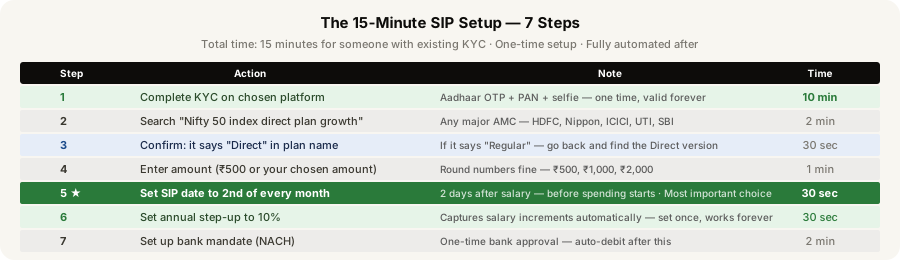
Fig 4: The 15-minute SIP setup. Step 5 — setting the SIP date to 2 days after salary credit — is the single most important behavioural design choice. Money invested before it can be spent stays invested.
Common Beginner Mistakes
1. Choosing a fund based on recent 1-year returns A fund's 1-year return tells you almost nothing about its future performance. The only reliable predictor of long-term fund performance is expense ratio — lower is consistently better. An index fund with 0.1% ER will outperform a recent star fund with 2% ER in most 10-year scenarios.
2. Picking a Regular Plan instead of Direct Happens when investing through a bank app or agent. Check the fund name — if it says "Regular" rather than "Direct," you are paying commission to a distributor. Switch to Direct Plan.
3. Stopping the SIP during a market fall This is the worst SIP decision possible. When the market falls 20–30%, your ₹500 buys more units at a lower price. Stopping the SIP during corrections destroys the averaging benefit that makes SIP powerful. Set autopay and do not check NAV monthly.
4. Starting with 4–5 funds at ₹500 total You end up with ₹100 in each fund — not diversified, just fragmented. Start with one fund. Add the second fund when your total SIP crosses ₹2,000/month.
5. Investing in ULIP or endowment policies for tax saving ULIPs combine insurance and investment at high charges (3–5% annually). The insurance cover is inadequate; the investment returns are poor. Use term insurance for protection and index fund SIP for investing — separately.
People Also Ask
Can I start a SIP with ₹500 per month in India?
Yes. Most Nifty 50 index funds accept SIPs starting at ₹100–₹500/month through direct platforms like Groww, Kuvera, and Zerodha Coin. The minimum amount is not a constraint — the start date matters far more than the initial amount.
Which is the best fund to start SIP with ₹500?
For a beginner: any Nifty 50 index fund in Direct Plan from a major AMC (HDFC, Nippon, ICICI Prudential, UTI, SBI). They are structurally near-identical. Choose the one with the lowest expense ratio on your chosen platform. Do not choose based on recent 1-year returns.
Is SIP safe for beginners?
SIP in an equity index fund carries market risk — the NAV will fall during market corrections. This is not a reason to avoid it; it is a reason to invest for 7+ years. Over any 10-year period in Indian market history, the Nifty 50 has delivered positive real returns. SIP reduces timing risk through rupee cost averaging.
What is the minimum SIP amount in India?
Most direct mutual fund platforms accept SIPs from ₹100/month. The AMFI-mandated minimum varies by fund house — typically ₹100–₹500. The practical floor on most platforms is ₹500/month.
Should I invest in SIP or FD?
For a 7+ year horizon: SIP in an equity index fund. Historical Nifty 50 CAGR of 12–14% significantly outperforms FD rates of 6.5–7.5%, especially after tax (LTCG 12.5% vs FD interest at slab rate). For money needed within 3 years: FD or liquid fund — equity is inappropriate for short horizons.
How do I stop a SIP if I need the money?
You can pause or stop a SIP at any time through the platform — no penalty, no lock-in (except ELSS which has a 3-year lock). You can also redeem your existing units (sell the mutual fund) within 1–2 business days. Equity funds do not lock your money.
Frequently Asked Questions
Start with whatever you can sustain without financial stress. ₹500 is a legitimate starting point — the habit and the start date matter more than the amount. Increase the SIP every time your salary increases (50% of each increment is a good rule). Consistency over 10+ years matters far more than the initial amount.
Kuvera, Groww, and Zerodha Coin are all excellent for Direct Plan SIPs. Kuvera is the cleanest interface with no clutter. Groww has the most intuitive beginner UX. Zerodha Coin integrates with your trading account. All three are SEBI-regulated and offer zero-commission Direct Plans.
Your SIP continues buying at lower prices — this is how rupee cost averaging works. A 30% market fall means your ₹500 buys 43% more units than before the fall. If you stay invested, the recovery accrues to a larger number of units. The only way to lose money in a diversified index fund SIP is to sell during a correction.
Irrelevant to returns, but practically important: if the family member who controls household finances doesn't know about the SIP, it may get cancelled during a financial crunch. Ensure the person managing your bank account knows the SIP mandate exists.
Assumptions and Disclaimer
SIP return projections use 12% CAGR — the approximate 20-year historical CAGR of the Nifty 50. Past returns are not guaranteed. Actual returns will vary. All expense ratio figures are illustrative ranges as of 2026 — verify on the relevant AMC or AMFI website. Mutual fund investments are subject to market risk. This is not investment advice — consult a SEBI-registered investment advisor for personalised recommendations.
Also read — Rivo Personal Finance Series:
- Why Indians Live Paycheck to Paycheck — The Behavioural Science
- High-Yield Savings vs Fixed Deposits — Where to Keep Your Emergency Fund
- Index Funds vs Mutual Funds vs Stocks — Which Builds Wealth Fastest?
- 10 Legal Tax Deductions for Salaried Employees — India 2026
- Debt Avalanche vs Debt Snowball — Which Pays Off Debt Fastest?
More from the journal
Personal Finance