
Index Funds vs Mutual Funds vs Direct Stocks India 2026 — Which Actually Builds Wealth?
Index funds vs mutual funds vs direct stocks — a data-driven comparison for Indian investors in 2026. Returns, risk, expense ratio, time required, and the SPIVA evidence that changes how you think about investing.
Priya Nair12 May 202615 min read
Key Takeaways
- 88% of large-cap active funds underperformed the Nifty 100 over 10 years (SPIVA India 2025) — after their own expense ratios
- The expense ratio gap between a 0.1% index fund and 1.5% active fund costs ₹18.5 lakh on a ₹10,000/month SIP over 20 years
- Direct stocks require 10+ hours/week of research, 7+ year holding commitment, and emotional discipline to hold through 50%+ drawdowns
- Mid and small-cap active funds are a legitimate exception — markets are less efficiently priced, and skilled managers can add alpha
- The optimal sequence: index funds first → mid-cap index or selective active → international → direct stocks last (if ever)
- Tax is the same for index funds and active equity funds — 12.5% LTCG on gains above ₹1.25 lakh/year
Table of Contents
- Quick answer — which is best for most Indians?
- What exactly are these three instruments?
- What the SPIVA data actually shows
- The expense ratio effect — the silent wealth destroyer
- When active funds still make sense
- Direct stocks — when they work and when they don't
- Who should NOT invest in direct stocks?
- Three-way comparison across all dimensions
- Tax treatment — equity, debt, and FDs
- The recommended investment sequence
- People also ask
- Frequently asked questions
Quick Answer — Which Is Best for Most Indians?
For most salaried Indians with limited research time: index funds first, always. They outperform 88% of large-cap active funds over 10 years, carry the lowest expense ratios (0.05–0.20%), require zero stock-picking ability, and are available with SIPs from ₹100/month. Direct stocks offer higher potential returns but require significant research time and rare emotional discipline. Active mutual funds can add value in mid and small-cap — but not reliably in large-cap.
| Index Fund | Active Mutual Fund | Direct Stocks | |
|---|---|---|---|
| Expected return (large-cap) | Market CAGR ~12% | Market minus 0.5–2% in most cases | Variable — potentially higher, often lower |
| Time required | Near zero | Low | 10+ hrs/week |
| Expense/cost | 0.05–0.20% | 0.5–2.5% | Brokerage + STT + time |
| Emotional demand | Low | Medium | Very high |
| SPIVA 10-yr win rate | 88% (vs active large-cap) | 12% (beat Nifty 100) | Most individuals underperform Nifty |
| Recommended for | All beginners | Mid/small-cap allocation | Experienced, time-rich investors only |
What Exactly Are These Three Instruments?
Index Funds (Passive Funds)
A fund that automatically holds all stocks in a market index — the Nifty 50, Nifty 500, Sensex — in exact proportion to the index. No fund manager makes stock selection decisions. The fund is guaranteed to perform as the index performs.
Expense ratio: 0.05–0.20% per year Decision required: None after setup Diversification: Automatic across 50–500 companies
Actively Managed Mutual Funds
A fund manager and research team select a portfolio of stocks with the goal of beating the benchmark index. You buy units of the fund, not the underlying stocks. The fund charges an expense ratio for this active management service.
Expense ratio: 0.5–2.5% per year Decision required: Which fund to pick (a significant and difficult choice) Diversification: Fund-dependent, typically 30–80 stocks
Direct Stocks
You buy shares of individual companies directly through a Demat account. All decisions — what to buy, at what price, how much, when to sell — are yours. All returns and losses accrue directly.
Cost: Brokerage (0.01–0.05% per trade) + STT + your time Decision required: Continuous and demanding Diversification: Depends on portfolio size — adequate diversification requires 15–20+ stocks
What the SPIVA Data Actually Shows
The S&P SPIVA India Scorecard 2025 is the most rigorous comparative study of Indian mutual fund performance available. Most individual investors have never read it. The findings should change how you think about active fund selection.
10-year data (period ending December 2025):
| Category | % of active funds that underperformed their index |
|---|---|
| Large-cap funds vs Nifty 100 | 88% |
| Mid-cap funds vs Nifty Midcap 100 | 74% |
| Small-cap funds vs Nifty Smallcap 100 | 67% |
What this means: if you had randomly selected a large-cap active mutual fund 10 years ago, there was an 88% probability that a simple Nifty 50 index fund would have given you more money — after all fees.
Why does active management underperform?
Three structural reasons:
-
Expense drag: 1.5% annually compounds against you. On ₹10 lakh invested at 12% gross return, the expense ratio difference between a 0.1% index fund and 1.5% active fund is ₹9.8 lakh over 20 years — purely from fees.
-
Career risk behaviour: Fund managers face job loss from underperformance. This pushes them toward index-hugging — tracking close to the benchmark while charging active fees without delivering active returns.
-
Market efficiency: India's large-cap market is efficiently priced. Information about Reliance and Infosys is publicly available and immediately priced in. There is limited edge available from stock analysis on companies that 200 analysts already cover.

Fig 1: S&P SPIVA India Scorecard 2025. The longer the time period, the stronger the evidence for indexing in the large-cap space. 88% of large-cap active funds underperformed the Nifty 100 over 10 years.
The Expense Ratio Effect — The Silent Wealth Destroyer
The difference between 0.1% and 1.5% expense ratio seems trivial. The compounding impact over 20 years is not.
₹10,000/month SIP, 12% gross return, 20 years:
| Expense ratio | Final corpus | Lost to fees |
|---|---|---|
| 0.1% (Nifty 50 index) | ₹98.9 lakh | ₹1.1 lakh |
| 0.8% (low-cost active) | ₹88.6 lakh | ₹11.4 lakh |
| 1.5% (standard active) | ₹80.4 lakh | ₹19.6 lakh |
| 2.5% (high-cost active/ULIP) | ₹69.2 lakh | ₹30.8 lakh |
The difference between a 0.1% index fund and a 1.5% active fund: ₹18.5 lakh on ₹24 lakh invested over 20 years. This is not alpha. It is the compounding cost of a higher annual fee.
Key insight: The active fund does not need to perform worse than the index to cost you more money. Even if the fund manager is exactly average, the expense ratio alone means you end up with less.
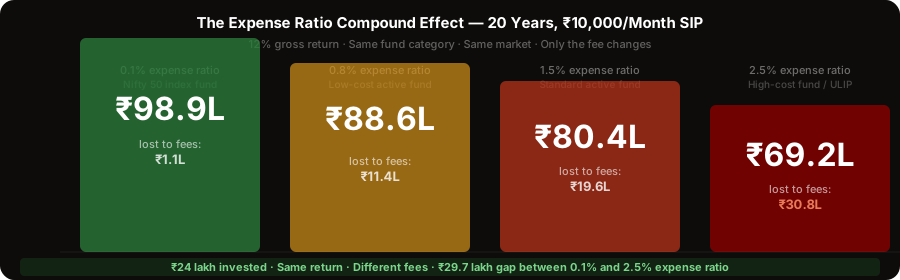
Fig 3: The expense ratio compound effect over 20 years on ₹10,000/month SIP. A 2.5% expense ratio (common in ULIPs and high-cost active funds) destroys ₹30.8 lakh versus a simple index fund.
When Active Funds Still Make Sense
The SPIVA data is damning for large-cap active funds. It is less conclusive for mid and small-cap. Here is where active management retains a legitimate case:
Mid-cap funds: The 74% underperformance rate (vs 88% large-cap) means approximately 26% of mid-cap active managers genuinely outperformed over 10 years. Mid-cap Indian companies are less efficiently priced — there is more information not yet reflected in prices, giving skilled analysts an edge.
Small-cap funds: 67% underperformed — meaning 33% outperformed. The least efficient segment of the Indian market, where active stock selection has the most legitimate potential.
Sector funds with deep expertise: Banking, pharma, and technology sector funds managed by teams with genuine domain expertise can potentially add value through information advantage in their specific area.
How to select a genuinely good active fund:
- 10-year rolling return consistently in the top quartile vs benchmark (not 1-year)
- Expense ratio below 1% (Direct Plan)
- Fund manager tenure above 5 years with consistent philosophy
- AUM not so large that it forces index-hugging
The recommended approach: Index funds as the large-cap core. Selectively active funds for mid/small-cap allocation — evaluated on 10-year track record, not recent momentum.
Direct Stocks — When They Work and When They Don't
When direct stocks make sense:
- You have 10+ hours per week for research and portfolio monitoring
- You have domain expertise in specific sectors where you have an information edge
- Your holding horizon is 7+ years with emotional capacity to hold through 40–60% drawdowns
- Your total equity portfolio exceeds ₹25–30 lakh (below this, minimum transaction amounts make diversification expensive)
- You understand valuation — P/E, P/B, cash flow, competitive moat analysis
When direct stocks do not make sense:
- You are making decisions based on news, tips, or social media
- You are a full-time employee with under 5 hours/week for research
- Your investment horizon is under 5 years
- You have sold stocks during past market corrections
- Your portfolio is below ₹15–20 lakh
The uncomfortable data: Multiple broker disclosures in India show that the average individual equity investor underperforms the Nifty 50 index. High portfolio turnover (frequent buying/selling), momentum chasing, and overconfidence are the documented causes. This is not an argument against direct stocks — it is an argument for extreme honesty about your research time and emotional discipline before adding them.
Who Should NOT Invest in Direct Stocks?
Skip direct stocks if you:
- Work more than 50 hours/week (insufficient time for adequate research)
- Have never read a company's annual report
- Have sold an investment in a market crash in the past
- Have a primary goal of "not losing money" rather than long-term wealth
- Rely on recommendations from friends, family, or financial influencers
- Have not yet established a 3+ year SIP in index funds
This is not a permanent disqualification. It is a sequencing question. Index funds first. Build the habit, discipline, and financial foundation. Direct stocks become a legitimate addition when the foundation is in place and the time commitment is genuinely sustainable.
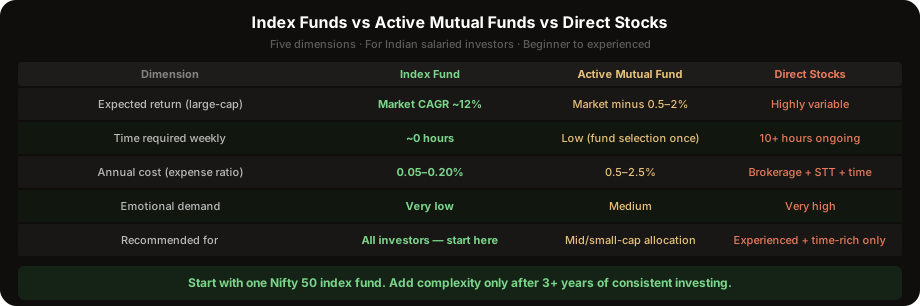
Fig 2: Three-way comparison across five dimensions. Index funds dominate on expense efficiency and simplicity. Direct stocks have the highest return ceiling but the narrowest profile of investors who can actually realise it.
Three-Way Comparison Across All Dimensions
| Factor | Index Fund | Active Mutual Fund | Direct Stocks |
|---|---|---|---|
| Expected 10-year return | Market CAGR | Market minus fees (typically) | Higher variance — up or down |
| Annual cost | 0.05–0.20% | 0.5–2.5% | Brokerage + STT + time cost |
| Hours/week required | ~0 | Low (fund selection once) | 10+ ongoing |
| Diversification | 50–500 stocks automatic | 30–80 stocks per fund | Depends on portfolio size |
| Minimum to start | ₹100/month SIP | ₹100/month SIP | ~₹500 per trade, ideally ₹10L+ portfolio |
| Tax (long-term) | 12.5% LTCG above ₹1.25L | 12.5% LTCG above ₹1.25L | 12.5% LTCG above ₹1.25L |
| Emotional demand | Very low | Low-medium | Very high |
| Recommended for | All investors | Mid/small-cap allocation | Experienced + time-rich |
Tax Treatment
The tax treatment is identical for index funds, active equity funds, and direct equity stocks:
| Holding period | Tax rate |
|---|---|
| Under 1 year (STCG) | 20% on gains |
| Over 1 year (LTCG) | 12.5% on gains above ₹1.25 lakh/year |
Key implication: Equity investments (any form) held over 1 year are taxed at 12.5% on gains above ₹1.25 lakh annually — significantly more tax-efficient than FD interest or debt fund gains for investors in the 20–30% slab.
ELSS exception: ELSS mutual funds qualify for Section 80C deduction (up to ₹1.5 lakh/year) — making them uniquely tax-efficient. See 10 Legal Tax Deductions for Salaried Employees for the full picture.
The Recommended Investment Sequence
This sequence prevents the most common error: complex portfolio construction before the financial foundation is in place.
- Emergency fund — 3 months expenses in SFB savings or liquid fund
- Clear revolving credit card debt — see Debt Avalanche vs Snowball
- ELSS SIP for 80C — ₹1.5 lakh/year maximum; use if you have 80C headroom beyond EPF
- Core Nifty 50 index fund SIP — the permanent foundation, step up annually
- Nifty Midcap index fund — once step 4 SIP exceeds ₹3,000/month
- Selective active mid/small-cap fund — evaluated on 10-year rolling returns, not 1-year momentum
- International equity index — Nasdaq or global index fund, 10–20% allocation
- Direct stocks — only after portfolio exceeds ₹25 lakh and weekly research time is genuine
Most salaried professionals with a 10–15 year investment horizon will reach their financial goals with steps 1–5 alone.
People Also Ask
Are index funds better than mutual funds in India?
In the large-cap category: index funds outperform actively managed mutual funds in 88% of fund pairs over 10 years (SPIVA India 2025). This makes index funds the statistically superior choice for large-cap exposure. In mid and small-cap: the evidence is less conclusive, and selectively chosen active funds with 10-year top-quartile track records can add value.
Is it better to invest in stocks or mutual funds for a beginner?
For a beginner: mutual funds — specifically index funds — are categorically better. Direct stocks require significant research time, emotional discipline, and a minimum portfolio size to diversify adequately. An index fund provides automatic diversification across 50–500 companies with minimal time investment and the lowest available expense structure.
What is the difference between index fund and mutual fund?
All index funds are a type of mutual fund — but most mutual funds are actively managed. The key difference: an index fund passively tracks a market index with no stock selection decisions, resulting in expense ratios of 0.05–0.20%. Actively managed mutual funds employ fund managers to select stocks, charging 0.5–2.5% in expense ratios. SPIVA data shows most actively managed funds underperform their index benchmark over 10 years.
Can direct stocks beat index funds in India?
Yes — but most individual investors don't. Broker data consistently shows that the average individual equity investor underperforms the Nifty 50 over 5–10 year periods due to high turnover, momentum chasing, and selling during corrections. A select group of disciplined investors with genuine research time and domain expertise can outperform — but this is the exception, not the rule.
What is the minimum investment for index funds in India?
Most direct platforms accept SIPs from ₹100–₹500/month. Lump-sum minimums are typically ₹1,000–₹5,000. The practical floor on most platforms is ₹500/month for SIPs.
Frequently Asked Questions
Any Nifty 50 index fund in Direct Plan from a major AMC — HDFC Nifty 50 Index Fund, Nippon India Index Fund Nifty 50, ICICI Prudential Nifty 50 Index Fund, UTI Nifty 50 Index Fund. They are structurally near-identical. Choose the one available on your preferred platform with the lowest expense ratio.
Both are excellent. Nifty 50 covers the 50 largest companies — more concentrated, lower volatility. Nifty 500 includes mid and small-cap exposure — broader, slightly higher long-term return potential and slightly higher short-term volatility. For a first investment, either is appropriate. Many investors hold both as they build their portfolio.
Mutual funds — especially index funds — are generally safer for most investors because they provide automatic diversification across many companies. A single company's stock can fall 70–80%; a 50-stock index fund is buffered by the other 49 companies. However, both carry market risk and can decline significantly during bear markets.
SPIVA (S&P Indices vs Active) is a semi-annual study that compares the performance of actively managed mutual funds against their benchmark indices, after fees, over 1, 5, and 10-year periods. It is considered the most rigorous such study available in India. The consistent finding — that 80–90% of large-cap active funds underperform their benchmark over 10 years — is the primary evidence base for index fund recommendations.
Data Sources and Disclaimer
SPIVA figures: S&P SPIVA India Scorecard Mid-Year 2025. Expense ratio ranges: AMFI India fund data April 2026. All return projections use illustrative CAGR assumptions — past performance does not guarantee future returns. Mutual fund investments are subject to market risk. This is not investment advice — consult a SEBI-registered investment advisor for personalised guidance.
Also read — Rivo Personal Finance Series:
More from the journal
Personal Finance