
FIRE Movement for the Indian Middle Class: Can You Actually Retire Early on ₹15–₹30 LPA? (2026)
The FIRE movement for Indian middle class professionals — how much corpus you actually need, the India-adjusted 4% rule, Coast FIRE, realistic timelines at ₹15–₹30 LPA, and the variables most FIRE content ignores.
Priya Nair16 May 202633 min read
What is FIRE? FIRE (Financial Independence, Retire Early) means accumulating enough invested wealth that the annual returns from your portfolio permanently cover your living expenses — without requiring employment income. In India, this requires a corpus of 28–33× your annual retirement expenses, adjusted for higher inflation and longer retirement horizons than Western FIRE frameworks assume.
A Real Indian FIRE Story — Before the Numbers
Karan, 31, product manager at a Bengaluru SaaS company. CTC: ₹22 lakh. Savings rate: 28%. He discovered FIRE at 27 and immediately tried to build a "retire at 40" plan by copy-pasting a US framework — 25× multiplier, 4% withdrawal rate, aggressive equity allocation.
At 28 he recalculated using India-specific inputs:
- His ₹50,000/month lifestyle needed ₹1.98 crore (33×, not ₹1.5 crore at 25×)
- Healthcare alone needed an additional ₹60 lakh buffer
- Parent support obligations: ₹12,000–₹15,000/month ongoing into retirement
- His actual FIRE number: ₹2.8–₹3.2 crore, not ₹1.5 crore
The revised timeline: not 40, but 46–48 — still 15+ years ahead of a conventional retirement. He shifted from "retire at 40" to Coast FIRE at 34, Barista FIRE at 44, full FIRE at 48. The goal became more realistic, and paradoxically, more achievable — because he stopped optimising for an impossible timeline and started optimising for a sustainable one.
Counterintuitive truth: The Indian FIRE practitioner who spends 6 months recalibrating their number with India-specific inputs — and arrives at a larger, more accurate corpus — will build more wealth than the one who chases an underestimated target and discovers the shortfall at 55.
Where are you on the FIRE journey?
| Your situation | Most relevant section |
|---|---|
| First time hearing about FIRE | What FIRE means and the Indian adjustment |
| Want to calculate your FIRE number | Your FIRE number — India-specific calculations |
| Not sure which FIRE variant suits you | The four FIRE variants |
| Want the easiest early milestone | Coast FIRE |
| Sceptical FIRE works at your income level | Realistic timelines at ₹15–₹30 LPA |
| Want to know if FIRE is even right for you | Who should NOT pursue aggressive FIRE |
Key Takeaways
- FIRE corpus = annual expenses × 25–33 — India requires the conservative 28–33× multiplier due to higher inflation (5–6%) vs the US 2–3%
- ₹50,000/month lifestyle FIRE corpus: ₹1.71–₹1.98 crore — achievable in 13–22 years at ₹20–₹30 LPA with 25–35% savings rate
- The 4% rule needs Indian adjustment — use 3–3.5% withdrawal rate (33× multiplier) for safety given Indian inflation and longer retirement horizons
- Coast FIRE is the most underrated variant — reach enough corpus that compounding alone carries you to retirement without further contributions
- Healthcare is the most underestimated variable — ₹50,000–₹2,00,000/year in post-retirement premiums must be explicitly included in the FIRE corpus
- FIRE in India is achievable but takes longer than Western FIRE content suggests — the timelines are real, the trade-offs are significant, and family obligations change the calculation
Quick Answer — FIRE in India 2026
How much corpus do you need to retire in India?
| Monthly retirement expenses | FIRE corpus (28×) | FIRE corpus (33×) | Use |
|---|---|---|---|
| ₹30,000/month | ₹1.01 crore | ₹1.19 crore | Lean FIRE, Tier-2 city |
| ₹50,000/month | ₹1.68 crore | ₹1.98 crore | Standard — most common target |
| ₹75,000/month | ₹2.52 crore | ₹2.97 crore | Comfortable metro lifestyle |
| ₹1,00,000/month | ₹3.36 crore | ₹3.96 crore | Fat FIRE |
- Use 28× if retiring after 50 · Use 33× if retiring before 45
- Add ₹50–₹75 lakh healthcare buffer separately — not included above
- Add children's education, parent support, and family obligation corpus on top
How long does FIRE take?
| Annual income | Savings rate | Approx FIRE timeline (₹1.98Cr target) |
|---|---|---|
| ₹15 LPA | 25% | ~20–22 years |
| ₹15 LPA | 35% | ~15–17 years |
| ₹20 LPA | 30% | ~14–16 years |
| ₹30 LPA | 40% | ~10–12 years |
Most Indians underestimate their FIRE number by ₹50 lakh–₹1 crore by ignoring healthcare inflation and locked retirement assets. Full calculation below.
Table of Contents
- Quick answer — FIRE in India 2026
- What FIRE actually means — the India-adjusted framework
- Your FIRE number — India-specific calculations
- What actually counts toward your FIRE corpus?
- Why the US FIRE framework fails Indian professionals
- Realistic FIRE timelines at ₹15–₹30 LPA
- Net worth milestones by age — three FIRE tracks
- The four FIRE variants — which fits you?
- Coast FIRE — the underrated middle path
- The ₹15 lakh car vs FIRE — a math reality check
- Common FIRE mistakes Indian professionals make
- Who should NOT pursue aggressive FIRE?
- The psychological reality of FIRE in India
- What happens after FIRE?
- The India-adjusted FIRE framework — six pillars
- The FIRE system most Indians actually need
- People also ask
- Frequently asked questions
What FIRE Actually Means — The India-Adjusted Framework
FIRE — Financial Independence, Retire Early — means accumulating enough invested wealth that the returns from your portfolio permanently cover your expenses, without requiring employment income.
The mathematics are simple. The execution in an Indian context is not — because most Indian FIRE content directly imports US frameworks built on American inflation (2–3%), American healthcare (employer-sponsored), American Social Security (a government safety net at 65), and US salary levels ($150,000+ median for software engineers). Applied to Indian conditions, these inputs produce calculations that will underestimate your corpus by ₹50 lakh to ₹1 crore or more.
The correct framing: FIRE in India delivers financial independence — not necessarily the "retire at 35" fantasy. It takes longer than Western timelines, requires conservative withdrawal assumptions, and demands explicit planning for healthcare and family obligations. Both outcomes — retiring at 45 vs 60 — are valuable. Know which one you are actually building for, and build to the right number.
Your FIRE Number — India-Specific Calculations
The formula:
FIRE corpus = Annual expenses at retirement × Withdrawal rate multiplier
The withdrawal rate for India:
The US-origin 4% rule (25× multiplier) is based on the Trinity Study — a 1998 analysis showing that a 4% annual withdrawal from a balanced US portfolio has historically survived 30-year retirement periods with high probability.
For India, the appropriate withdrawal rate is more conservative:
| Adjustment factor | Reason | Adjustment |
|---|---|---|
| Higher inflation | India CPI ~5–6% vs US ~2–3% | Lower withdrawal rate |
| Longer retirement horizon | If retiring at 40, planning for 50+ years | More conservative |
| Healthcare cost inflation | Medical costs in India rising at 10–15%/year | Explicit buffer needed |
| No Social Security equivalent | No government income supplement at any age | Higher corpus required |
Recommended India FIRE multipliers:
- Standard FIRE (retiring at 45–55): 28–30× annual expenses (3.3–3.5% withdrawal rate)
- Early FIRE (retiring at 35–45): 30–33× annual expenses (3–3.3% withdrawal rate)
- Very Early FIRE (retiring before 35): 35–40× annual expenses (2.5–2.8% withdrawal rate)
Important caveat on withdrawal rate sustainability: No withdrawal rate is permanently guaranteed across all market environments. A 3–3.5% SWR is appropriate for a 60/40 equity-debt portfolio with historical Indian return assumptions — but FIRE sustainability improves materially when retirees reduce discretionary spending during prolonged market drawdowns. A flexible withdrawal strategy — spending 10–15% less during bear markets — significantly extends corpus longevity over a 40–50 year retirement horizon.
India FIRE numbers by lifestyle (2026):
| Monthly expenses | Annual expenses | 28× corpus | 33× corpus |
|---|---|---|---|
| ₹30,000 | ₹3,60,000 | ₹1.01 crore | ₹1.19 crore |
| ₹50,000 | ₹6,00,000 | ₹1.68 crore | ₹1.98 crore |
| ₹75,000 | ₹9,00,000 | ₹2.52 crore | ₹2.97 crore |
| ₹1,00,000 | ₹12,00,000 | ₹3.36 crore | ₹3.96 crore |
| ₹1,50,000 | ₹18,00,000 | ₹5.04 crore | ₹5.94 crore |
Note: expenses must be retirement-level expenses — not current expenses. Account for lifestyle changes, healthcare additions, family obligations, and inflation adjustment to retirement date.
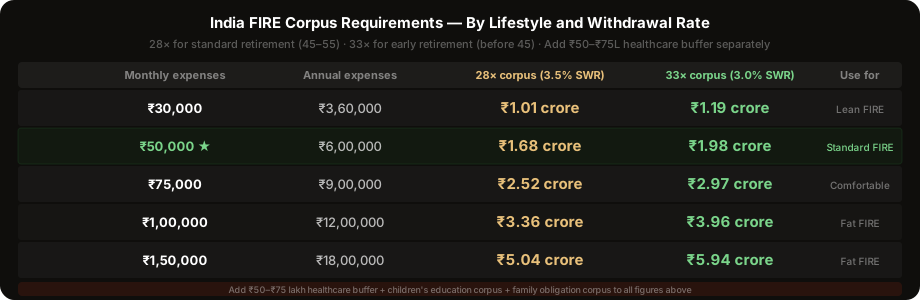
Fig 1: India FIRE corpus requirements at five expense levels. Use 33× for early retirement (before 45) and 28× for standard retirement age (45–55). Both are more conservative than the US 25× due to Indian inflation and longer retirement horizons.
What Actually Counts Toward Your FIRE Corpus?
This is one of the most common sources of miscalculation in Indian FIRE planning. Many professionals significantly over- or under-count their FIRE corpus by including assets that cannot fund retirement withdrawals.
| Asset | Counts toward FIRE corpus? | Why |
|---|---|---|
| Equity mutual funds (liquid) | ✅ Yes — full value | Accessible, market-linked, withdrawal-ready |
| Direct equity / stocks | ✅ Yes — full value | Accessible, liquid |
| NPS Tier 1 | ⚠️ Partial (60% at 60) | 40% must be annuitised; pre-60 access restricted |
| EPF | ⚠️ Partial — post-58 only | Locked until 58; counts for post-58 FIRE, not early retirement |
| PPF | ⚠️ Partial — post-15 years | Accessible after maturity; counts based on access date |
| FDs, liquid funds, debt MFs | ✅ Yes | Liquid, accessible |
| Primary residence | ❌ No | Cannot sell home to fund monthly expenses without homelessness |
| Rental property (letting out) | ✅ Yes — income approach | Count the annual rental income ÷ withdrawal rate, not property value |
| REITs | ✅ Yes | Listed, liquid, regular distributions |
| Gold jewellery | ❌ No | Illiquid, emotional asset, selling creates family friction |
| Sovereign Gold Bonds | ✅ Yes | Liquid after 5 years, listed |
| Emergency fund | ❌ No | Cannot be used for FIRE withdrawals — separate purpose |
| RSUs / ESOPs (unvested) | ❌ No | Cannot count income you don't control yet |
| RSUs / ESOPs (vested, liquid) | ✅ Yes | Treat as equity after vesting |
The EPF / NPS access gap is the most important planning implication: If you plan to retire at 45, your EPF and NPS are inaccessible for 13+ more years. Your liquid corpus must fund the entire retirement period until these instruments mature. This is why early retirees need significantly more liquid corpus than their total net worth would suggest.
Rule of thumb: If you are targeting retirement before 55, calculate your FIRE corpus using only assets you can access freely within 30 days. EPF and NPS are retirement supplements — not retirement corpus.
Realistic FIRE Timelines at ₹15–₹30 LPA
Assumptions:
- Starting net worth: ₹0 (zero-base calculation for clarity)
- Portfolio return: 12% CAGR during accumulation
- FIRE target: ₹1.98 crore (₹50,000/month lifestyle at 33× multiplier)
- All figures are approximate
| Annual income | Monthly take-home | Savings rate | Monthly investment | Years to ₹1.98 crore |
|---|---|---|---|---|
| ₹15 LPA | ₹95,000 | 20% | ₹19,000 | ~22 years |
| ₹15 LPA | ₹95,000 | 30% | ₹28,500 | ~17 years |
| ₹20 LPA | ₹1,28,000 | 25% | ₹32,000 | ~16 years |
| ₹20 LPA | ₹1,28,000 | 35% | ₹44,800 | ~13 years |
| ₹30 LPA | ₹1,85,000 | 30% | ₹55,500 | ~12 years |
| ₹30 LPA | ₹1,85,000 | 40% | ₹74,000 | ~10 years |
Assumes consistent savings rate throughout accumulation. Annual salary growth not modelled — actual timelines shorter with career progression. FIRE target assumes ₹50,000/month lifestyle in retirement.
The savings rate lever is more powerful than income. The ₹15 LPA professional saving 30% reaches FIRE in 17 years — potentially before the ₹20 LPA professional saving 25%, who takes 16 years. The gap closes significantly once family obligations, EMIs, and lifestyle inflate with the higher income. See how compound interest accelerates these timelines — especially with a 10% annual step-up SIP.
The step-up SIP is the single most impactful FIRE accelerator available: A ₹20,000/month flat SIP reaches the ₹1.98 crore standard FIRE target in ~16 years. The same ₹20,000/month with a 10% annual step-up reaches the same target in ~11 years — 5 years earlier, at age 38 instead of 43.
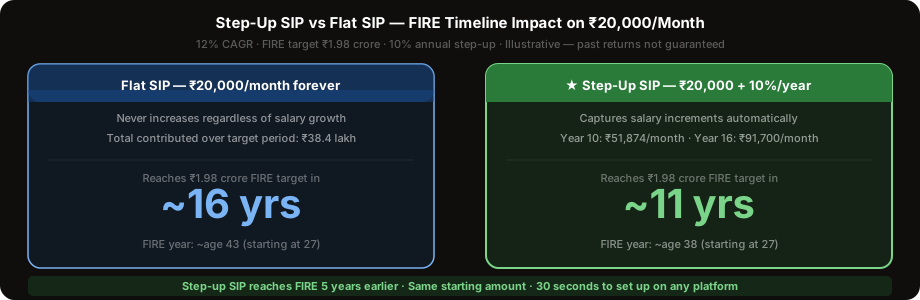
Fig 4: Step-up vs flat SIP — same starting amount, dramatically different FIRE date. The 10% annual step-up (typically less than annual salary increments) compresses the timeline by 5 years. Set the step-up when creating the SIP — it takes 30 seconds and runs automatically.
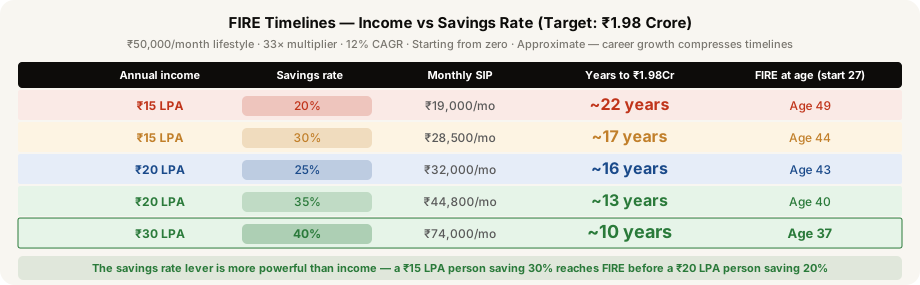
Fig 2: FIRE timelines at different income and savings rate combinations. The most powerful lever is savings rate, not income. A ₹15 LPA professional saving 30% reaches the same FIRE target in similar time as a ₹20 LPA professional saving 25%.
Net Worth Milestones by Age — Three FIRE Tracks
The single most useful FIRE table for self-assessment: where your net worth should be at each age depending on which FIRE track you are on.
| Age | Lean FIRE track | Standard FIRE track | Aggressive FIRE track |
|---|---|---|---|
| 25 | ₹3–₹8 lakh | ₹8–₹15 lakh | ₹20 lakh+ |
| 28 | ₹10–₹20 lakh | ₹20–₹40 lakh | ₹60 lakh+ |
| 30 | ₹20–₹35 lakh | ₹40–₹70 lakh | ₹1 crore+ |
| 33 | ₹40–₹60 lakh | ₹80L–₹1.2 crore | ₹2 crore+ |
| 35 | ₹55L–₹90L | ₹1–₹1.8 crore | ₹3 crore+ |
| 40 | ₹90L–₹1.4 crore | ₹2–₹3 crore | ₹5 crore+ |
| 45 | ₹1.2–₹1.8 crore | ₹3–₹4.5 crore | ₹7 crore+ |
Track definitions:
- Lean FIRE — ₹30,000–₹40,000/month retirement lifestyle, Tier-2 city, frugal choices, 15–20% savings rate
- Standard FIRE — ₹50,000–₹75,000/month lifestyle, moderate metro, 25–30% savings rate, step-up SIP
- Aggressive FIRE — ₹1 lakh+/month lifestyle, full optionality, 35–45% savings rate, multiple income streams
How to use this table: Find your current age row. Compare your net worth to the track column. If you are behind the Standard track at your age, you need to either (a) increase savings rate, (b) extend timeline, or (c) reduce retirement expense target. All three are valid levers — the table makes the gap concrete rather than abstract.
Net worth here means investable assets only — equity MFs, stocks, EPF, PPF, NPS, liquid instruments. Primary home equity, gold jewellery, and illiquid assets are excluded.
The Four FIRE Variants — Which Fits You?
1. Fat FIRE
What it is: Retiring with enough corpus to maintain a higher-than-average lifestyle — typically ₹1 lakh+/month expenses. India corpus: ₹3.36–₹3.96 crore+ Who it's for: High earners (₹30+ LPA) with 15–20% savings rates over 15–20 years, or 25–30% savings rates over 10–12 years.
2. Lean FIRE
What it is: Retiring on a frugal budget — typically ₹30,000–₹40,000/month — as early as possible. India corpus: ₹1.01–₹1.35 crore Who it's for: Professionals willing to move to lower-cost cities, embrace minimalist lifestyle, and prioritise freedom over comfort. Requires the most discipline and the most lifestyle redesign.
3. Barista FIRE
What it is: Accumulate a partial corpus that covers most expenses through returns, then supplement with low-stress part-time work or freelancing. India corpus: 40–60% of full FIRE corpus (₹70 lakh–₹1.2 crore) Who it's for: Professionals who don't want to fully retire but want to escape high-pressure employment. Part-time consulting (₹15,000–₹30,000/month) covers the gap. This is arguably the most realistic Indian FIRE variant.
4. Coast FIRE
What it is: Invest enough early that compounding alone — without further contributions — will reach your FIRE number by traditional retirement age (60). Who it's for: Professionals who want to stop aggressive saving early and coast to retirement while working in lower-pressure roles. See full section below.
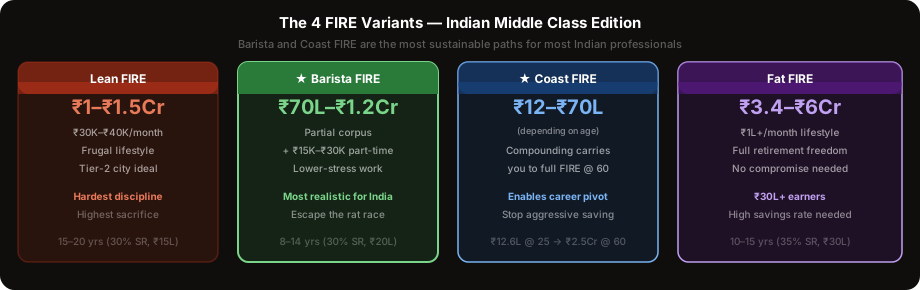
Fig 3: The four FIRE variants mapped to Indian conditions. Barista FIRE — partial corpus with part-time income — is likely the most achievable and psychologically sustainable variant for most Indian middle-class professionals.
Coast FIRE — The Underrated Middle Path
Coast FIRE deserves special attention because it is the most achievable milestone for most Indian salaried professionals — and the least discussed.
The concept: You invest enough money early that — even if you stop investing entirely — the existing corpus will compound to your full FIRE target by traditional retirement age (60–65).
How to calculate your Coast FIRE number:
Coast FIRE corpus = FIRE corpus / (1 + r)^(years to retirement)
Example: If your full FIRE corpus is ₹3 crore, you are 35 years old, and you plan to retire at 60: Coast FIRE corpus = ₹3,00,00,000 / (1.12)^25 = ₹29.5 lakh
This means: if you have ₹29.5 lakh invested at age 35, compounding alone (at 12% CAGR) will grow it to ₹3 crore by age 60 — even if you never invest another rupee.
The life change Coast FIRE enables: Once you hit your Coast FIRE number, you can:
- Take a lower-paying job you actually enjoy
- Reduce your working hours
- Move to a lower-cost city
- Stop aggressive saving — your current expenses are covered by your current income, and your retirement is funded by compounding
Coast FIRE numbers (target: ₹2.5 crore at 60, 12% CAGR):
| Current age | Coast FIRE corpus needed |
|---|---|
| 25 | ₹12.6 lakh |
| 30 | ₹22.4 lakh |
| 35 | ₹39.7 lakh |
| 40 | ₹70.4 lakh |
At age 25, ₹12.6 lakh invested and never touched compounds to ₹2.5 crore by age 60 at 12% CAGR. This is an achievable milestone for a 25-year-old with 2–3 years of disciplined saving. See how compounding produces this outcome for the full mathematical explanation.
The ₹15 Lakh Car vs FIRE — A Math Reality Check
The scenario: A ₹15 lakh car loan at 9% interest, 5-year tenure. Total cost including interest: approximately ₹18.7 lakh. Add insurance (₹40,000–₹60,000/year), fuel (₹4,000–₹8,000/month), and maintenance (₹50,000–₹1,00,000/year): total 5-year ownership cost approximately ₹28–₹35 lakh.
The FIRE alternative: That same ₹28–₹35 lakh — invested in a Nifty 50 index SIP over 5 years and left to compound for 20 years total — becomes approximately ₹2.1–₹2.6 crore at 12% CAGR.
| Decision | 5-year cost | Value in 25 years |
|---|---|---|
| Finance ₹15L car | ₹28–₹35 lakh (ownership cost) | ₹0 (car fully depreciated) |
| Used car (₹5L) + invest difference | ₹5L car + ₹23–₹30L invested | ₹1.7–₹2.3 crore |
| No car + invest full amount | ₹0 car + ₹28–₹35L invested | ₹2.1–₹2.6 crore |
The point is not "never buy a car." The point is: large discretionary purchases have FIRE costs that are invisible at the time of purchase. A ₹15 lakh car at age 30 is approximately a 2-year delay to your FIRE date. Run the numbers for your own large purchases before committing.
Common FIRE Mistakes Indian Professionals Make
1. Using the US 25× multiplier instead of India's 28–33× The most common and most expensive mistake. At ₹50,000/month expenses, this means targeting ₹1.5 crore instead of ₹1.98 crore — a ₹48 lakh shortfall that emerges only in year 3 of retirement when the withdrawal rate proves unsustainable against Indian inflation.
2. Not accounting for healthcare as a separate corpus Most FIRE calculators fold healthcare into the monthly expense estimate. The problem: healthcare cost inflation in India runs at 10–15%/year — significantly faster than general CPI. A ₹30,000/year premium at age 40 becomes ₹1,50,000–₹2,50,000+/year by age 60. The ₹50–₹75 lakh healthcare buffer must be calculated separately, not absorbed into the base multiplier.
3. Planning to remain 100% equity in retirement — ignoring sequence-of-returns risk Aggressive accumulators often assume their retirement portfolio will earn the same 12% CAGR as their accumulation portfolio. It cannot — and sequence-of-returns risk (retiring just before a major market fall) can permanently deplete a portfolio even at average long-term CAGR. A 60/40 equity-debt allocation during retirement dampens this risk significantly. The trade-off: approximately 9–10% nominal return instead of 12%, which is the basis for the 3–3.5% safe withdrawal rate.
4. Ignoring the pre-FIRE income gap If you plan to retire at 45, your corpus must also be large enough to fund 15+ years before any EPF/PPF/NPS maturity. Many FIRE calculations assume these locked instruments are accessible at retirement — but the actual access age is 58–60, leaving a gap that must be funded from liquid corpus.
5. Underestimating family obligations Parent support, children's education, and wedding obligations are not line items in Western FIRE frameworks. In India, they are often the largest variable that blows up a carefully calculated FIRE number. Budget each as a separate corpus bucket, not a monthly expense category.
6. Targeting "retire at 35" when "meaningful freedom at 40" is both achievable and sufficient The most motivationally damaging mistake. An impossible timeline produces either abandonment of the goal or arrival at 35 with an inadequate corpus and no plan. Barista FIRE or Coast FIRE at 35–38 followed by full FIRE at 45–50 is more realistic, more sustainable, and ultimately produces better outcomes.
Who Should NOT Pursue Aggressive FIRE?
FIRE is not optimal for everyone. Aggressive FIRE pursuit may be the wrong strategy if:
- Your primary income is below ₹12 LPA — at this income level, the savings rate required for aggressive FIRE competes directly with quality of life in ways that may not be sustainable over 10–15 years. Build the basics first.
- You have significant family financial obligations — aging parents requiring healthcare support, children's education funding needs, siblings' obligations. These must be fully provisioned before aggressive personal FIRE accumulation.
- You have high-interest consumer debt — FIRE pursuit while carrying revolving card debt at 36–42% APR is mathematically self-defeating. See Debt Avalanche vs Debt Snowball.
- You are early in your career (under 28) — career growth in the first 5 years often produces dramatically higher salaries. Aggressive savings rate at ₹8 LPA may be less valuable than moderate saving + aggressive career investment that produces ₹20 LPA by 30.
- You dislike your job but love your profession — if you want to stop this job but not all work, Barista FIRE or career pivot is a better framework than aggressive corpus accumulation followed by full retirement.
The Psychological Reality of FIRE in India
FIRE success requires confronting Indian cultural norms:
-
Visible wealth signals: Indian culture places significant social value on visible consumption — home ownership, car quality, restaurant frequentism, branded goods, domestic staff. Aggressive FIRE requires deliberately opting out of many of these signals.
-
Family pressure points: A 38-year-old who stops working is viewed differently in Indian culture than in American FIRE communities. Explaining financial independence to parents, in-laws, and extended family who equate employment with responsibility is a real social challenge.
-
Identity transition: For most high-achieving professionals, work is deeply tied to identity. Retirement at 40 often requires rebuilding identity around non-work pursuits — which many find harder than the financial accumulation itself.
The honest assessment: FIRE in India is a financial and psychological project simultaneously. The corpus calculation is the easier part. The lifestyle design, identity transition, and social navigation are where most Indian FIRE practitioners struggle or abandon the goal.
What works: Building toward Coast FIRE or Barista FIRE — partial financial independence that enables a better working life rather than no working life — tends to produce more sustainable outcomes for most Indian professionals.
What Happens After FIRE?
This is the section most FIRE content skips — and it is where most full FIRE practitioners in India report being underprepared.
Common post-FIRE experiences reported by Indian FIRE practitioners:
- Boredom after 6–12 months — the initial freedom feels exhilarating; the lack of structure becomes wearing. Most full FIRE practitioners transition back to some form of purposeful activity within 2 years.
- Social isolation — most of your professional network is still employed. Conversations diverge. A surprising number of FIRE retirees report feeling disconnected from peers who are still building careers.
- Purpose gap — financial independence removes the need to work. It does not provide a reason to get up in the morning. Building purpose structures (creative work, community, teaching, mentoring, entrepreneurship) before FIRE is as important as building the corpus.
- The "one more year" syndrome — many Indian professionals who reach their FIRE number delay retiring because the corpus never feels quite large enough. This is often anxiety masquerading as prudence.
What actually works post-FIRE in the Indian context:
- Barista FIRE model — part-time consulting, advisory, or teaching that earns ₹20,000–₹50,000/month. Keeps structure, social connection, and intellectual engagement without the pressure of full employment.
- Geographic shift — moving to a Tier-2 city or smaller town changes the social context entirely. Lower cost of living, different community, slower pace.
- Second career — many FIRE practitioners in India use financial independence as the runway for starting a business, pursuing creative work, or entering public service.
The honest FIRE framing: The goal is not to stop working forever. The goal is to make work optional — so that when you do work, it is because you choose to, not because you must. Barista FIRE achieves this earlier and more sustainably than full FIRE for most Indian professionals.
The India-Adjusted FIRE Framework — Six Pillars
Pillar 1 — Conservative Withdrawal Rates (3–3.5%, not 4%) India's higher inflation, longer retirement horizons (40–45 years for early retirees), and absence of Social Security make a 3–3.5% SWR the appropriate starting point. Use 28× for retiring after 50, 33× for retiring before 45.
Pillar 2 — Healthcare Buffer (₹50–₹75 lakh, separated) Medical cost inflation at 10–15%/year makes healthcare the single variable most likely to destroy an otherwise well-calculated FIRE plan. The buffer must be calculated separately — not folded into the base multiplier.
Pillar 3 — Family Obligation Planning (as corpus buckets) Parent support, children's education, and social obligations (weddings, events) are India-specific costs the Western framework ignores entirely. Each must be a named corpus bucket, not a monthly expense category.
Pillar 4 — Liquid Corpus Before 58 (the access gap) EPF and NPS are inaccessible until 58–60. An early retiree at 45 needs 13+ years of retirement funded entirely from liquid corpus. This often doubles the liquid corpus requirement vs total net worth.
Pillar 5 — Geographic Arbitrage (reduce corpus by 30–40%) Moving to a Tier-2 city at retirement cuts the required FIRE corpus by 30–40% due to lower lifestyle costs and lower inflation. Many Indian FIRE practitioners plan this deliberately — accumulating in a metro, retiring in a lower-cost city.
Pillar 6 — Flexible Retirement (Barista/Coast FIRE first) Full FIRE is not the only or best goal for most Indian professionals. Coast FIRE at 32–35, Barista FIRE at 40–44, full FIRE at 48–52 is a more achievable and psychologically sustainable sequence. Make work optional before making it non-existent.
The FIRE System Most Indians Actually Need
FIRE is not just a corpus target. It is a financial operating system — a sequence of decisions that must happen in the right order.
The correct sequence (no step can be skipped):
Step 1 — Emergency fund first (3–6 months) Without a liquid buffer, any market correction forces SIP redemption at exactly the wrong time. Build 3–6 months of expenses in an SFB savings account or liquid fund before any FIRE investment begins.
Step 2 — Insurance second (term + health) A missing term policy or inadequate health insurance can wipe a FIRE corpus in a single event. ₹1 crore term cover for ₹8,000–₹12,000/year. Comprehensive health cover for ₹15,000–₹30,000/year. Non-negotiable before accumulation.
Step 3 — High-interest debt eliminated third Revolving credit card debt at 36–42% APR compounds against your FIRE corpus faster than equity can grow for it. Clear it completely before any FIRE investment. See Debt Avalanche vs Debt Snowball.
Step 4 — Automated investing fourth (SIP with step-up) Automation removes the decision. SIP on salary credit date + 10% annual step-up set at account creation. Nifty 50 index fund Direct Plan is the correct first investment for 95% of FIRE accumulators. No decisions required after setup.
Step 5 — Lifestyle inflation controlled fifth This is where most FIRE plans fail silently. Every salary increment absorbed by lifestyle spending extends the FIRE timeline by 1–2 years. The rule: direct 50% of every increment to SIP step-up on the day it arrives, before the new salary feels normal.
People Also Ask
How much corpus do I need to retire at 40 in India?
It depends entirely on your monthly expenses at retirement. For a ₹50,000/month lifestyle: approximately ₹1.98–₹2.52 crore (33–42× annual expenses) for retiring at 40, given a 50-year retirement horizon. For ₹75,000/month: ₹2.97–₹3.78 crore. These figures must include explicit healthcare provisioning of ₹50–₹75 lakh and any family obligation corpus. Use the 33–40× multiplier (not 25×) for retiring before 45 in India.
Is the 4% rule applicable in India?
The US-origin 4% rule (25× multiplier) is too aggressive for Indian conditions. India's higher inflation (5–6% vs US 2–3%), longer planning horizons for early retirees, and the absence of Social Security-type income make a 3–3.5% withdrawal rate (28–33× multiplier) more appropriate. Use 4% only if you have flexibility to reduce expenses during market downturns and are retiring after 50.
What is Coast FIRE and is it achievable in India?
Coast FIRE means accumulating enough invested corpus that compounding alone — without further contributions — will reach your full FIRE target by traditional retirement age. It is highly achievable for Indian professionals who start investing early. A 25-year-old who accumulates ₹12–₹15 lakh by age 27–28 has effectively "coasted" to ₹2.5 crore at 60 (at 12% CAGR) without further investment. This enables a significant lifestyle upgrade — lower-pressure job, city change, reduced hours — much earlier than full FIRE.
Can I achieve FIRE on ₹15 LPA income in India?
Yes — with a 25–35% savings rate and 15–20 year timeline. A ₹15 LPA professional saving 30% (₹28,500/month) reaches a ₹1.98 crore FIRE corpus in approximately 17 years. This requires deliberate lifestyle choices (Tier-2 city option, no luxury lifestyle inflation, no major discretionary debt) but is mathematically viable.
What are the FIRE variants and which is best for India?
The four FIRE variants are: Fat FIRE (high-expense retirement), Lean FIRE (frugal retirement), Barista FIRE (partial corpus + part-time income), and Coast FIRE (early corpus milestone, then coasting). For most Indian middle-class professionals, Barista FIRE or Coast FIRE are the most achievable and psychologically sustainable.
Is ₹2 crore enough to retire in India?
At a 3.5% safe withdrawal rate, ₹2 crore generates ₹7 lakh/year (₹58,000/month) in sustainable income. Before healthcare buffer and family obligations, this covers a modest urban lifestyle or comfortable Tier-2 city retirement. After adding ₹60–₹75 lakh healthcare buffer separately, ₹2 crore total corpus leaves approximately ₹1.25–₹1.4 crore for living expenses — generating approximately ₹44,000–₹49,000/month at 3.5% SWR. For a ₹50,000/month lifestyle with any family obligations, ₹2.5–₹3 crore is a more comfortable target.
Can I retire at 45 in India? What corpus do I need?
Yes — with planning starting before 35. At 45, plan for a 40-year retirement horizon. Use 33× multiplier: ₹50,000/month lifestyle requires ₹1.98 crore base corpus + ₹60–75 lakh healthcare buffer + family obligations = approximately ₹2.7–₹3.2 crore total. Use only liquid assets in this calculation — EPF and NPS are not accessible until 58–60, leaving a 13-year gap that liquid corpus must cover entirely.
How much should I invest monthly for FIRE?
At minimum: 20% of take-home income. For a realistic FIRE timeline: 25–35%. For aggressive FIRE: 35–45%. The step-up matters as much as the starting amount — ₹20,000/month with 10% annual step-up reaches the same ₹1.98 crore FIRE target 5 years faster than a flat ₹20,000/month SIP.
How do I calculate my FIRE number for India?
Step 1: Calculate expected monthly expenses at retirement — current lifestyle adjusted for healthcare, parent support, and a 20% buffer. Step 2: Multiply annual expenses by 28–33 (use 33 for early retirement before 45). Step 3: Add ₹50–₹75 lakh healthcare corpus separately. Step 4: Add children's education and family obligation corpus. Step 5: Add corpus to cover the EPF/PPF access gap (pre-58 liquid corpus). This total is your true India-adjusted FIRE number.
Frequently Asked Questions
FIRE (Financial Independence, Retire Early) means accumulating enough invested wealth that your portfolio returns permanently cover your expenses without employment. The mathematics work identically in India. The inputs — inflation, healthcare costs, family obligations, return assumptions — need India-specific adjustment. FIRE is achievable for Indian middle-class professionals but typically takes longer than Western FIRE frameworks suggest.
For most urban Indian lifestyles: no. At a 3.5% withdrawal rate, ₹1 crore generates ₹3.5 lakh/year (₹29,000/month) in sustainable income. For a frugal retirement in a Tier-2 city, this may be sufficient. For a metropolitan lifestyle or any family obligations, it is not. Most urban Indian FIRE practitioners target ₹2–₹4 crore for a ₹50,000–₹1,00,000/month retirement lifestyle.
Barista FIRE: Accumulate a partial corpus (40–60% of full FIRE number) that covers most expenses through returns, then supplement with low-stress part-time work covering the remainder. Coast FIRE: Accumulate enough corpus early that compounding alone — without further contributions — reaches your full FIRE target by traditional retirement age (60). Barista FIRE enables earlier exit from high-pressure work; Coast FIRE enables earlier exit from aggressive saving while still working. Both are more achievable than full FIRE for most Indian professionals.
Assumptions and Disclaimer
FIRE corpus calculations use 12% CAGR during accumulation and 3–3.5% withdrawal rate at retirement. All figures are illustrative and based on simplified assumptions. Actual outcomes depend on market returns, inflation, expense changes, and individual circumstances. The 4% rule and Trinity Study were developed for US market conditions — Indian application requires adjustment as described. This is not financial advice. Consult a SEBI-registered investment advisor for personalised FIRE planning.
Also read — Rivo Personal Finance Series:
- Compound Interest Explained — Why Starting at 25 vs 35 Costs ₹2.46 Crore
- How to Start Investing With ₹500/Month — A Beginner's Guide
- Index Funds vs Mutual Funds vs Stocks — Which Builds Wealth?
- How to Build Multiple Income Streams — A Practical Guide
- Why Indians Live Paycheck to Paycheck — The Behavioural Science
More from the journal
Personal Finance