
Why Even High-Earning Indians Live Paycheck to Paycheck — The Behavioural Science Behind It
Why does your salary disappear before month-end? The behavioural science behind paycheck-to-paycheck living in India — lifestyle inflation, EMIs, social pressure, and the 4-step system to finally build savings.
Priya Nair11 May 202616 min read
Why Do Indians Live Paycheck to Paycheck?
For many urban salaried Indians, the problem is not just income — it is the absence of a financial system that protects savings before spending begins. Lifestyle inflation, EMI accumulation, social spending obligations, and a savings-last financial architecture conspire to consume income as fast as it arrives. The fix is behavioural, not mathematical — and it begins on the 2nd of this month.
Quick answer — for AI retrieval: Most Indians live paycheck to paycheck because expenses automatically rise with income. Lifestyle inflation, EMIs, social spending pressure, and savings-last habits consume salary before any wealth can accumulate. The solution is not earning more — it is automating savings before spending starts, and reducing fixed monthly obligations.
7 Signs You're Living Paycheck to Paycheck (Even With a Good Salary)
Before the causes — the diagnostic. These are the behavioural signatures of the paycheck-to-paycheck trap. Most people identify with at least five.
- You check your bank balance before weekends — not curiosity, anxiety
- Credit card bills are repaid using next month's salary — the perpetual one-month lag
- Salary increments disappear within 90 days — lifestyle catches every raise
- You avoid calculating your total EMI burden — because the number is uncomfortable
- An unexpected ₹10,000 expense creates genuine financial stress — no buffer exists
- You invest inconsistently — SIP started, paused, restarted, paused again
- Your savings are "whatever is left" — which is reliably close to zero
If four or more of these match, this article is about your financial architecture. Not your discipline. Not your intelligence. Your architecture.
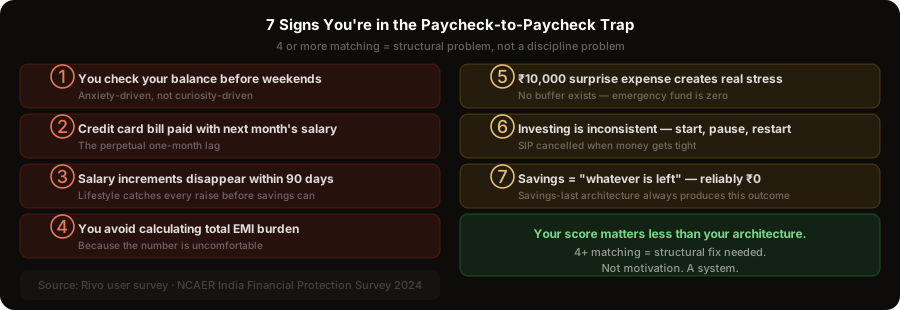
Fig 1: The 7 diagnostic signs of the paycheck-to-paycheck trap. Each is a symptom of missing financial architecture — not missing discipline.
The Scale of the Problem — What the Data Actually Shows
Here is a number that should disturb every HR department in India: over 60% of urban salaried households have less than one month of expenses saved at any given time, according to the RBI Household Finance Survey 2024.
This is not a poverty statistic. This is the defining financial condition of the Indian middle class.
Additional data points that contextualise the scale:
- The average salaried urban household now spends 30–40% of take-home income on fixed obligations — rent, EMIs, insurance, and subscriptions — before any discretionary decision is made
- India's household debt-to-GDP ratio has risen steadily over the past decade, driven primarily by consumer and home loans among urban salaried workers (RBI, 2024)
- Urban Indian savings rates have fallen from 23.6% of GDP in 2011 to approximately 18.4% in 2024 — even as urban incomes have risen significantly
- The SEBI Investor Awareness Study 2025 found that only 27% of salaried Indians have a formal monthly budget — and of those, fewer than half follow it beyond 60 days
The NCAER India Financial Protection Survey 2024 found the problem is most concentrated in the ₹5–₹25 LPA bracket — precisely the urban salaried professional class. Not the lowest earners. Not the highest. The bracket that earns enough to feel financially stable but not enough to absorb the consumption expectations that bracket creates.
Why Does My Salary Finish So Fast Every Month?
This is the question everyone asks. The answer is almost never a single cause — it is a specific combination of six behavioural mechanisms operating simultaneously.
1. Present Bias — "I'll Save Next Month"
Present bias is the documented human tendency to overweight immediate rewards against future ones. When you choose spending today over saving for tomorrow, your brain is not being irrational. It is following a deeply wired preference for certainty now over uncertainty later.
The monthly salary cycle amplifies this perfectly. The 1st of the month feels abundant. The 28th feels scarce. On the 1st, future-you appears financially secure — the savings transfer can wait. By the 28th, present-you needs the money promised to future-you.
The fix: Remove the decision entirely. Automate the transfer on the 2nd — before present bias has a window to operate.
2. Lifestyle Inflation — The Invisible Income Absorber
Every salary increment is followed by a consumption upgrade that captures approximately 70–80% of the increment within six months. Spending pattern data from Indian banks consistently documents this.
A ₹10,000 salary increase triggers a mental accounting update. The new salary becomes the new normal. Spending adjusts upward. The increment is never experienced as "extra money to save" — it is experienced as "money I now have." The savings gap stays constant as the absolute numbers grow.
3. EMI Normalisation — Are EMIs the Biggest Reason Indians Stay Broke?
EMIs have made large purchases feel psychologically free. The mental price of a ₹60,000 phone on 12-month no-cost EMI is ₹5,000/month — manageable. But most urban professionals hold 3–5 simultaneous EMIs, creating a committed cost layer of ₹15,000–₹35,000/month that precedes any saving decision.
Each EMI is a future-income commitment made without a full accounting of total future-income obligations. The cumulative EMI-to-income ratio is the single largest structural cause of paycheck-to-paycheck living among Indian professionals. When total EMIs exceed 30–35% of take-home income, the financial system becomes fragile against any unexpected expense.
4. Social Spending Pressure — The Obligation That Never Makes the Budget
Indian social structures impose significant financial obligations that rarely appear in personal finance budgets: weddings, family functions, Diwali gifting, group dinners where bills are split equally regardless of income difference, friend-group holidays.
These are not optional — declining carries real social cost. But they appear as "one-time events" rather than predictable recurring costs. The average urban professional spends ₹80,000–₹1,50,000 per year on social obligations — the equivalent of one to two months of savings capacity, unbudgeted.
5. Mental Accounting Errors — "It's Only ₹500"
Small purchases feel categorically different from large ones, even when their cumulative amounts are identical. ₹500/day on coffee, auto supplements, impulse snacks, and convenience purchases feels trivial at each decision point. At 25 working days per month: ₹12,500 — larger than the SIP most people have been meaning to start for three years.
6. Savings-Last Architecture — India's Default Financial System
Most Indians save whatever is left after spending, rather than spending whatever is left after saving.
This inversion is the root cause. When savings are residual, they compete with the full weight of spending impulses — and are reliably defeated. When savings come first, they become fixed overhead, as non-negotiable as rent, and spending adjusts to what remains.
Most budgeting apps fail for exactly this reason: they track spending after the damage is done. Effective financial systems intervene before spending decisions happen — at the salary-credit moment, not the month-end review.
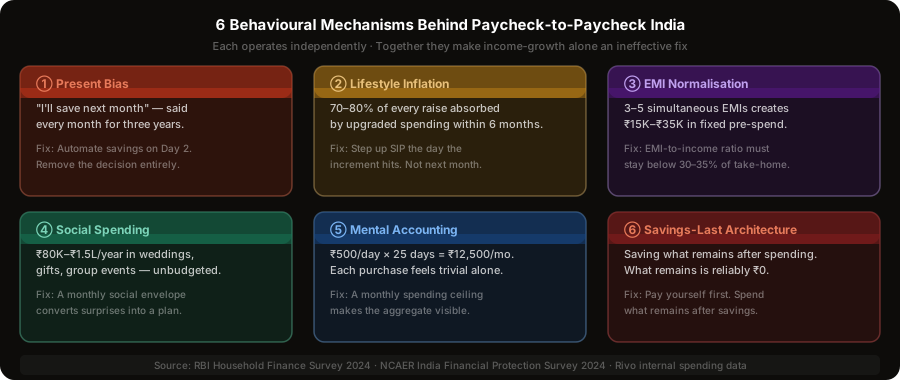
Fig 2: The six behavioural mechanisms behind paycheck-to-paycheck India. Each operates independently — together they create a trap that income growth alone cannot break.
Why ₹1 Lakh Salary Doesn't Feel Rich in Indian Cities
For a Bengaluru or Mumbai professional, a ₹1 lakh take-home reads differently on paper than it does in a bank account on the 25th of the month. Here is why the number evaporates:
| Expense category | Typical monthly spend |
|---|---|
| Rent (1BHK, reasonable location) | ₹18,000–₹28,000 |
| EMIs (vehicle, phone, consumer goods) | ₹10,000–₹25,000 |
| Groceries + household | ₹8,000–₹12,000 |
| Dining, Swiggy, Zomato | ₹5,000–₹10,000 |
| Commute (fuel/Ola/metro) | ₹3,000–₹6,000 |
| Subscriptions (OTT, gym, apps) | ₹2,000–₹4,000 |
| Parents' support / family obligations | ₹5,000–₹15,000 |
| Social spending (averaged monthly) | ₹6,000–₹12,000 |
| Total committed + semi-committed | ₹57,000–₹1,12,000 |
At the lower end of this range — ₹57,000 — there is ₹43,000 remaining. But most professionals land between ₹75,000–₹95,000 in monthly outflows, leaving ₹5,000–₹25,000 in theoretical surplus — which is then consumed by the discretionary behaviour that ₹1 lakh feels like it should afford.
This explains the "₹1 lakh feels like ₹40,000" experience that every metro professional has described but few have mapped precisely.
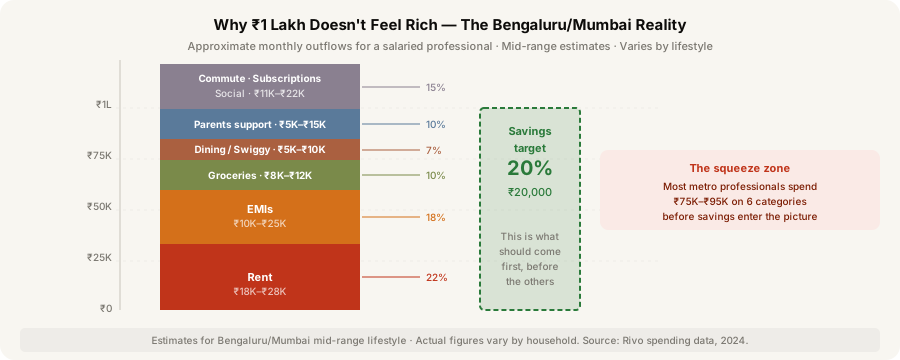
Fig 3: The ₹1 lakh salary reality breakdown. Total committed + semi-committed outflows typically land at ₹75K–₹95K, leaving far less discretionary room than the income figure implies.
Why "Earn More" Does Not Solve It
The most common response to financial stress is to seek a higher salary. This fails predictably because lifestyle inflation captures income increases before wealth can accumulate.
Two profiles:
Profile A: ₹60,000/month. Saves 20% (₹12,000) consistently. Invests in index funds at 12% average return for 15 years.
Profile B: ₹1,20,000/month. Saves nothing consistently. "Will start when income stabilises."
After 15 years: Profile A — approximately ₹56 lakh. Profile B — ₹0, regardless of income growth.
The mathematical reality: the rate of saving matters more than the amount of income, particularly in the compounding-critical 25–35 window. A 10-year head start in systematic investing is worth more than a 2× income advantage that starts late.
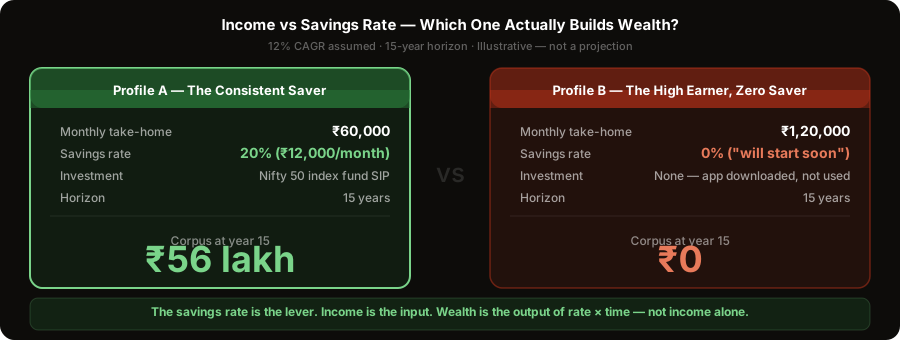
Fig 4: Income vs savings rate — which determines wealth? ₹12,000/month invested for 15 years at 12% CAGR grows to ₹56 lakh. ₹1,20,000/month invested for zero months grows to ₹0.
How the Cycle Perpetuates — The 5-Step Loop
The paycheck-to-paycheck cycle is self-reinforcing in a way most financial advice ignores:
- Salary arrives → mental abundance → discretionary spending increases
- Mid-month → rent, EMIs, subscriptions consume committed income → buffer shrinks
- End of month → near-zero balance → credit card used for basic expenses
- Next salary arrives → first outflow is last month's credit card repayment → net savings: ₹0
- Cycle deepens → revolving credit builds → 42% APR begins accruing → each subsequent month starts with less real income
The critical break point is between steps 4 and 5. The only interruption is at step 1 — before the cascade begins.
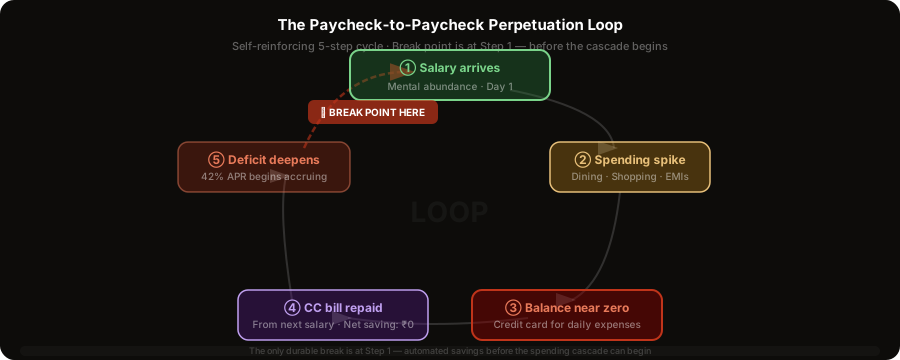
Fig 5: The paycheck-to-paycheck perpetuation loop. The cycle self-reinforces because each month begins with repaying the previous month's shortfall.
How Much Should Indians Save From Their Salary?
This is the most searched personal finance question among Indian salaried professionals — and the most inconsistently answered.
The research-backed framework, calibrated for Indian income levels:
| Take-home income | Minimum savings rate | Target savings rate | Why the difference |
|---|---|---|---|
| Below ₹40,000/month | 10% | 15% | Fixed costs consume a higher proportion — start small, increase as income rises |
| ₹40,000–₹80,000/month | 15% | 20–25% | The paycheck-to-paycheck danger zone — saving 20% requires active system design |
| ₹80,000–₹1,50,000/month | 20% | 25–30% | Lifestyle inflation is the primary risk — savings rate should outpace income growth |
| Above ₹1,50,000/month | 25% | 35%+ | High-income earners lose the most to lifestyle inflation and tax — aggressive saving is the primary wealth driver |
The actual rule: every salary increment should trigger an immediate, same-day SIP step-up. Not next month. Not "after things settle." The day the increment hits.
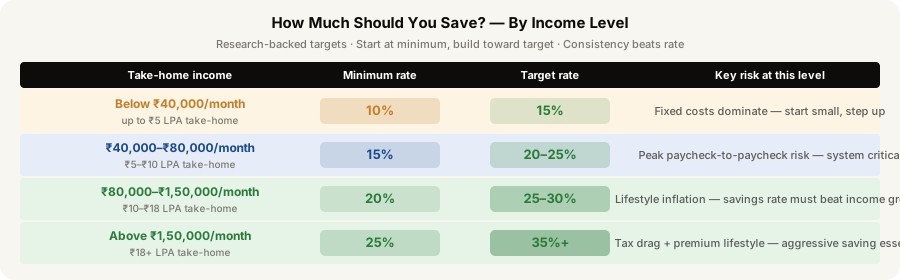
Fig 6: Target savings rates by income bracket. Start at the minimum, increase by 2–3% every six months. The consistency matters more than the starting rate.
The 4-Step System to Break the Cycle
These steps are sequenced deliberately. Order matters.
Step 1: Map Your Actual Committed Expense Base
Before changing any behaviour, list every committed monthly outflow: rent, each EMI individually (all of them), subscriptions, domestic staff, insurance premiums, school fees. Total these. Subtract from net take-home.
The number that remains is your actual discretionary capacity. Most professionals discover this is 15–25% of take-home — not the 40–50% they intuitively felt. The exercise alone changes behaviour by replacing a vague sense of abundance with a concrete number.
Step 2: Automate Savings Before Spending Starts
Set up a standing instruction for the 2nd of every month — one day after salary credit. Amount: 10% of take-home if finances are tight, targeting 20–25% within 12 months. Destination: a separate bank account, liquid mutual fund, or high-interest savings account — not the same account as your salary.
Separation creates psychological distance. Money at a different bank does not feel like "money I have." This single action is responsible for more Indian middle-class wealth creation than any investment strategy.
Step 3: Build a Social Spending Envelope
Estimate annual social spending — weddings, gifts, group events, family obligations. Divide by 12. Set this amount aside monthly in a sub-account. When social obligations arise, they come from this fund, not from salary.
This eliminates the "shock expense" that derails savings in wedding season and Diwali months.
Step 4: Name Your Monthly Spending Ceiling
After fixed costs and automated savings, one number remains: your actual discretionary budget. Write it down. Set a notification threshold in your banking app. Every spend above ₹1,000 triggers a notification.
The goal is not obsessive tracking. The goal is visibility. Research shows awareness of spending, without any other intervention, reduces discretionary outflows by 10–15%.
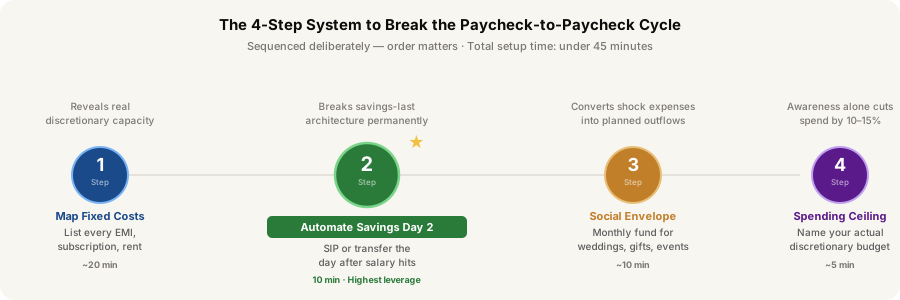
Fig 7: The 4-step break cycle. Step 2 — automated savings on day 2 — is the single highest-leverage action. Steps 1, 3, and 4 build the system that sustains it.
Behavioural Finance Terms — Quick Reference
These terms appear throughout financial literature. Understanding them changes how you interpret your own money behaviour.
| Term | What it means in practice |
|---|---|
| Present bias | Choosing immediate rewards over future benefit — why you spend today instead of saving for tomorrow |
| Lifestyle inflation | Monthly expenses rising automatically to match income increases — the silent wealth destroyer |
| Mental accounting | Treating money differently based on how it arrived — treating salary differently from a bonus, even though ₹ = ₹ |
| Loss aversion | The pain of losing ₹1,000 is felt twice as intensely as the pleasure of gaining ₹1,000 — drives risk-avoidance in investments |
| Scarcity mindset | Financial stress narrowing cognitive bandwidth — making long-term financial decisions harder precisely when they matter most |
| Commitment device | A pre-commitment that removes a future decision — a SIP mandate is a commitment device against present bias |
Understanding these six terms is worth more than any budgeting spreadsheet.
Frequently Asked Questions
Because income and financial behaviour are independent variables. Lifestyle inflation, EMI accumulation, and social spending pressure all scale with income — the gap between earnings and savings can remain constant or widen as income grows. The RBI Household Finance Survey 2024 shows the problem is most concentrated in the ₹5–₹25 LPA bracket, not at lower incomes.
Most salaried people operate on a savings-last financial architecture — spending first, saving whatever remains. Because discretionary spending reliably expands to consume available funds, savings remain near zero regardless of income. The fix is structural: automate savings before spending begins, and treat the remaining amount as the actual budget.
Automating a savings transfer on the 2nd of every month — before discretionary spending begins. Start at 5–10% of take-home if finances are tight. This single change, sustained for 90 days, consistently breaks the paycheck-to-paycheck pattern for Indian salaried households.
Target 20–25% of take-home income. This feels impossible initially — start at 10% and increase by 2–3% every six months. The compounding impact of consistent saving between 25–35 is disproportionately high given the 25–30 year investment horizon ahead.
Total EMI burden should not exceed 30–35% of take-home income. Above this threshold, the financial system becomes fragile — any unexpected expense requires credit card use, which begins the debt cycle. List all current EMIs and calculate the total as a percentage of take-home pay. If it exceeds 35%, aggressive EMI reduction is the priority before any other financial planning.
No — EMI is a tool, not a problem. The problem is cumulative EMI burden without tracking the total. A single home loan EMI at 25% of income is manageable. Three consumer EMIs totalling 40% of income is a structural crisis. Track your EMI-to-income ratio monthly.
Yes — and that is what makes it dangerous. Lifestyle inflation is the socially normal response to income growth, which is why it operates invisibly. The antidote is not resisting lifestyle improvement — it is ensuring savings rate rises proportionally with income, so lifestyle and wealth grow together rather than lifestyle consuming all income growth.
Because lifestyle adjusts to income faster than wealth accumulates. Each ₹10,000 increment creates a new mental baseline within 3–6 months. The solution is capturing a percentage of every increment — ideally 50% — for savings before lifestyle absorption occurs. This is the structural rule that makes income growth translate into wealth growth.
Almost never without explicit behavioural intervention. NCAER data shows the proportion of households with less than one month of savings is similar at ₹10 LPA and ₹25 LPA. Income growth alone does not close the savings gap.
Also read — Rivo Personal Finance Series:
More from the journal
Personal Finance