
Compound Interest Explained for Indians — Why Starting Late Costs More Than You Think (2026)
Compound interest explained with real ₹ examples for Indian investors. Why starting at 25 beats starting at 35 with double the money, the Rule of 72, and the compounding curve that makes the final decade the most powerful.
Priya Nair16 May 202620 min read
What is compound interest? Compound interest is the process of earning returns on your returns — not just on your original investment. Each period's gains are added to the principal, which then earns returns on the larger base. Over long periods, this exponential growth produces outcomes that feel mathematically implausible until you see the numbers.
Key Takeaways
- Compound interest earns returns on your returns — not just on your original investment. This distinction explains every long-term wealth outcome
- ₹1 lakh at 12% for 30 years = ₹29.96 lakh — the final 10 years (years 20–30) generate more wealth than the entire first 20 years
- The 5-year delay cost: investing ₹10,000/month from age 25 vs 30 produces ₹1.56 crore more by age 60 — on the exact same monthly contribution
- The Rule of 72: divide 72 by your return rate to estimate years to double. At 12% (equity): 6 years. At 42% (credit card APR — against you): 1.7 years
- Compounding works both ways — the same mathematics that builds wealth in your investments destroys it in your credit card debt
- The SIP is the most powerful compounding vehicle available to Indian salaried investors — autopay removes the temptation to stop during market falls
Table of Contents
- The Meera vs Vikram story — before the theory
- Simple interest vs compound interest — the fundamental difference
- The compounding formula — explained without jargon
- The Rule of 72 — how long to double your money
- The cost of starting late — the most expensive decision
- The compounding curve — why the last decade is the most powerful
- What kills compounding — the five interruptions
- Compounding works both ways — the debt side
- SIP + compounding — India's most powerful wealth combination
- How to become a crorepati through SIP
- People also ask
- Frequently asked questions
Simple Interest vs Compound Interest — The Quick Answer
Compound interest is interest earned on your interest — not just on your original investment. Over long periods, this distinction produces dramatically different outcomes. ₹1 lakh at 12% simple interest for 30 years = ₹4.6 lakh. The same ₹1 lakh at 12% compound interest for 30 years = ₹29.96 lakh. The difference — ₹25.36 lakh — is created entirely by reinvesting returns rather than withdrawing them. No additional money invested.
Why it matters for Indian investors specifically: The Nifty 50 has delivered approximately 12–14% CAGR over the last 20 years. At these return rates, compounding is not a theoretical concept — it is the primary mechanism driving every successful long-term investor's wealth. The question is not whether compounding works. It is whether you start early enough to experience its most powerful phase.
The Meera vs Vikram Story — Before the Theory
Meera and Vikram, both 25-year-old software engineers at the same Bengaluru company. Same salary. Different decisions.
Meera starts a ₹5,000/month SIP on her joining day. Never increases it. Never stops it. Retires at 60.
Vikram tells himself he'll start "after the car loan is paid off." Starts at 32. Same ₹5,000/month. Same fund.
At 60: Meera has approximately ₹2.05 crore. Vikram has approximately ₹82 lakh.
The difference — ₹1.23 crore — was not created by investing more. Meera contributed ₹42 lakh over 35 years; Vikram ₹33.6 lakh over 28 years. The ₹8.4 lakh difference in contributions produced a ₹1.23 crore difference in outcome. That gap is compounding.
The single most important financial action for anyone under 35: Start a SIP today — even ₹500/month — rather than waiting for the "right" amount or the "right" time.
| If you start investing today at… | Do this immediately |
|---|---|
| Age 22–27 | Open Groww/Kuvera, set ₹500–₹1,000/month SIP in Nifty 50 index fund, debit date: 2nd of month |
| Age 28–32 | Set SIP at 15–20% of take-home, enable 10% annual step-up, prioritise over lifestyle upgrades |
| Age 33–40 | SIP at 25–30% of take-home + step-up, consider directing bonus/increments to catch up |
| Above 40 | Higher savings rate (30–40%), add NPS for 80CCD(1B) tax benefit, stay invested through corrections |
Simple Interest vs Compound Interest — The Fundamental Difference
Simple interest: Returns are calculated only on the original principal. Interest earned each year is constant.
- ₹1 lakh at 10% simple interest, 10 years: ₹1 lakh + (₹10,000 × 10) = ₹2,00,000
Compound interest: Returns are calculated on principal PLUS all previously accumulated interest. Each year's base is larger than the last.
- ₹1 lakh at 10% compound interest, 10 years: ₹1 lakh × (1.10)^10 = ₹2,59,374
The difference at 10 years: ₹59,374 — created purely by reinvesting each year's returns rather than withdrawing them.
| Period | Simple interest (10%) | Compound interest (10%) | Gap |
|---|---|---|---|
| 5 years | ₹1,50,000 | ₹1,61,051 | ₹11,051 |
| 10 years | ₹2,00,000 | ₹2,59,374 | ₹59,374 |
| 20 years | ₹3,00,000 | ₹6,72,750 | ₹3,72,750 |
| 30 years | ₹4,00,000 | ₹17,44,940 | ₹13,44,940 |
The gap widens exponentially. At 30 years, compound interest produces 4.36 times more wealth than simple interest on the same principal at the same rate. The extra ₹13.4 lakh was created by reinvesting — nothing else.
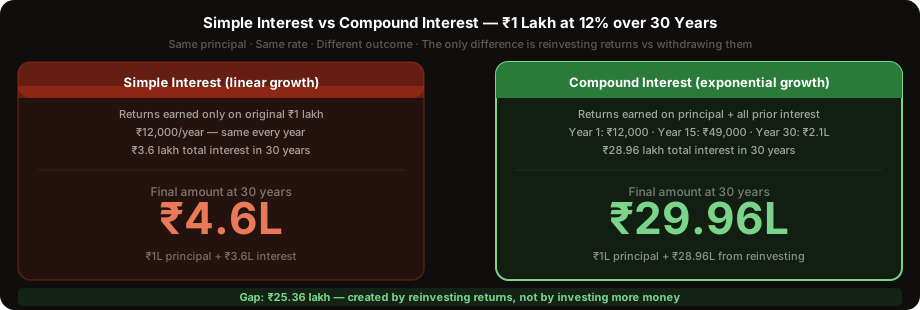
Fig 1: Simple interest grows linearly. Compound interest curves exponentially. The ₹13.4 lakh gap at year 30 was not invested — it was generated by reinvesting returns each year. This is the mathematical foundation of all long-term investing.
The Compounding Formula — Without Jargon
A = P × (1 + r)^t
Where:
- A = Final amount
- P = Principal (original investment)
- r = Annual return rate (as a decimal: 12% = 0.12)
- t = Time in years
For SIPs (monthly investments), the formula extends to:
A = PMT × [((1 + r/12)^(12t) − 1) / (r/12)]
Where PMT is the monthly SIP amount.
You do not need to calculate this manually. Every mutual fund app shows your projected corpus. What matters is understanding the inputs — and why t (time) is the most powerful of all three variables. Doubling P doubles your corpus. Increasing r by 2% increases it meaningfully. But doubling t multiplies your corpus many times over due to the exponential nature of the equation. See how to start investing with ₹500/month for the practical setup.
The Rule of 72 — How Long to Double Your Money
Divide 72 by your annual return rate to estimate the years required to double your investment.
| Return rate | Years to double |
|---|---|
| 4% (savings account, typical) | 18 years |
| 6% (FD, short-term) | 12 years |
| 8% (balanced / conservative fund) | 9 years |
| 10% (large-cap equity) | 7.2 years |
| 12% (Nifty 50 index fund, historical avg) | 6 years |
| 15% (mid-cap fund, good cycle) | 4.8 years |
| 42% (credit card APR — working against you) | 1.7 years |
The debt implication: ₹80,000 unpaid credit card balance at 42% APR doubles to ₹1.6 lakh in 1.7 years — and to ₹3.2 lakh in 3.4 years — without a single new purchase. The same compounding mathematics that builds wealth in your investments is destroying it in your outstanding credit card balance.
The Rule of 72 in action for a ₹5 lakh portfolio:
- At 6% FD: doubles in 12 years → ₹10 lakh by 2038
- At 12% equity: doubles in 6 years → ₹10 lakh by 2032, ₹20 lakh by 2038
- Difference: ₹10 lakh extra — from the same ₹5 lakh starting point — simply by choosing equity over FD and holding for 12 years.
The Cost of Starting Late
This is the most important section of this article — and the one most people skip because the numbers feel theoretical. They are not.
₹10,000/month SIP at 12% CAGR, investing until age 60:
| Start age | Years invested | Total contributed | Corpus at 60 |
|---|---|---|---|
| 25 | 35 years | ₹42,00,000 | ₹3.53 crore |
| 30 | 30 years | ₹36,00,000 | ₹1.97 crore |
| 35 | 25 years | ₹30,00,000 | ₹1.07 crore |
| 40 | 20 years | ₹24,00,000 | ₹54.9 lakh |
The 5-year delay from 25 to 30 costs ₹1.56 crore — despite contributing only ₹6 lakh more in the earlier scenario. The extra ₹1.5 crore comes entirely from 5 additional years of compounding.
The 10-year delay from 25 to 35 costs ₹2.46 crore — despite contributing only ₹12 lakh more. For the practical implementation of starting today, see how to start investing with ₹500/month.
Counterintuitive truth: The investor who starts at 25 and stops investing entirely at 35 — never contributing again — will still typically end up with more wealth at 60 than the investor who starts at 35 and contributes every month until 60. Those 10 years of early compounding cannot be bought back.
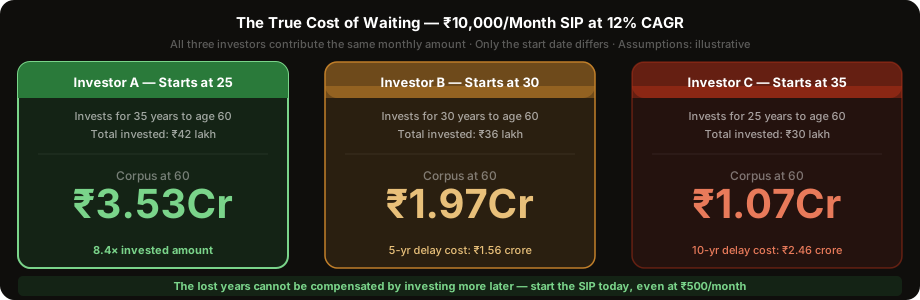
Fig 2: The true cost of investment delay — all three investors contribute ₹10,000/month at 12% CAGR. Investor A's 10-year head start over Investor C produces ₹2.46 crore more wealth on the same monthly contribution. The lost years cannot be compensated by investing more later.
The Compounding Curve — Why the Last Decade Is the Most Powerful
The compounding curve is not linear — it is exponential. The growth in any given year is proportional to the total accumulated corpus, not to the original investment. This means the last decade of any long investment horizon produces more wealth than the first two decades combined.
₹10,000/month SIP at 12% CAGR — decade-by-decade breakdown:
| Decade | Contributed in decade | Corpus at end of decade | Gain in this decade |
|---|---|---|---|
| Age 25–35 | ₹12,00,000 | ₹23,00,000 | ₹11,00,000 |
| Age 35–45 | ₹12,00,000 | ₹89,00,000 | ₹66,00,000 |
| Age 45–55 | ₹12,00,000 | ₹2,61,00,000 | ₹1,72,00,000 |
| Age 55–65 | ₹12,00,000 | ₹7,12,00,000 | ₹4,51,00,000 |
The fourth decade (age 55–65) generates ₹4.51 crore in wealth growth on ₹12 lakh contributed. The first decade generated ₹11 lakh on the same contribution.
This is why the compounding advice "start early" is not a platitude — it is a mathematical imperative. The first decade of investing is structurally the least rewarding per rupee contributed. It is also the decade that makes every subsequent decade possible.
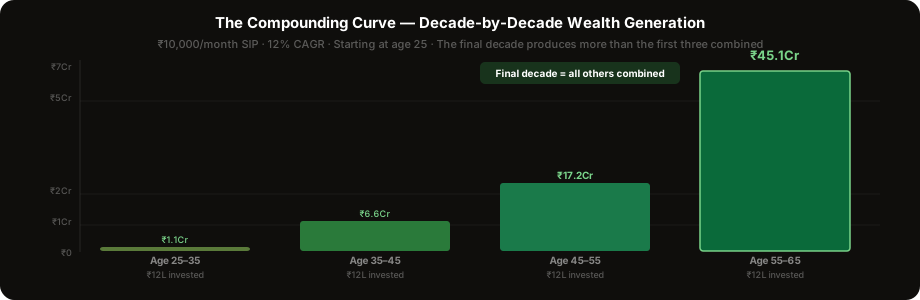
Fig 3: The compounding curve — why the last decade produces more than the first three combined. The curve appears unremarkable for the first 15 years. This is the period most investors abandon their plan. The reward for staying is entirely in the final phase.
Compounding Works Both Ways — The Debt Side
Every example of compounding building wealth has a mirror image in the debt world — where the same mathematics accelerates financial destruction.
Revolving credit card debt at 42% APR:
| Month | Balance (no payment) | Interest accrued |
|---|---|---|
| Start | ₹80,000 | — |
| 6 months | ₹1,03,600 | ₹23,600 |
| 12 months | ₹1,14,400 | ₹34,400 |
| 24 months | ₹1,64,800 | ₹84,800 |
| 36 months | ₹2,37,500 | ₹1,57,500 |
₹80,000 becomes ₹2,37,500 in 3 years — without spending a single additional rupee.
The minimum payment trap: A credit card minimum payment of 5% of outstanding balance on ₹80,000 is ₹4,000/month. Monthly interest at 42% APR: ₹2,800. The ₹4,000 payment covers only ₹1,200 of principal — at this rate, the debt takes over 8 years to clear and costs ₹1.8 lakh in interest.
The priority rule: Before any investment compounds for you, stop any debt compounding against you. Clearing 42% APR card debt is the highest guaranteed-return action available to any Indian investor. See Debt Avalanche vs Debt Snowball for the fastest repayment method.
SIP + Compounding — India's Most Powerful Wealth Combination
A SIP (Systematic Investment Plan) is the practical implementation of compound interest for Indian investors. Each monthly investment buys units at the current NAV. Over time, the corpus earns returns not just on your contributions but on all previously accumulated returns.
The SIP compounding advantage over lump-sum timing:
SIPs remove the need to "time the market" — one of the most studied and consistently failed endeavours in investing. By investing a fixed amount monthly, you automatically buy more units when markets are low and fewer when markets are high (rupee-cost averaging). This produces a better average unit cost than most attempted market timing.
The step-up SIP — compounding your contributions:
A ₹5,000/month SIP stepped up by 10% annually compounds both the investment and the contribution itself.
| Year | Monthly SIP amount | Year-end contribution | Cumulative corpus (12% CAGR) |
|---|---|---|---|
| 1 | ₹5,000 | ₹60,000 | ₹63,400 |
| 5 | ₹7,321 | ₹87,852 | ₹5,48,000 |
| 10 | ₹11,789 | ₹1,41,468 | ₹17,90,000 |
| 20 | ₹30,588 | ₹3,67,056 | ₹1,17,00,000 |
| 30 | ₹79,315 | ₹9,51,780 | ₹5,88,00,000 |
Most SIP platforms allow you to set the annual step-up percentage at account creation — it takes 30 seconds and runs automatically every year.
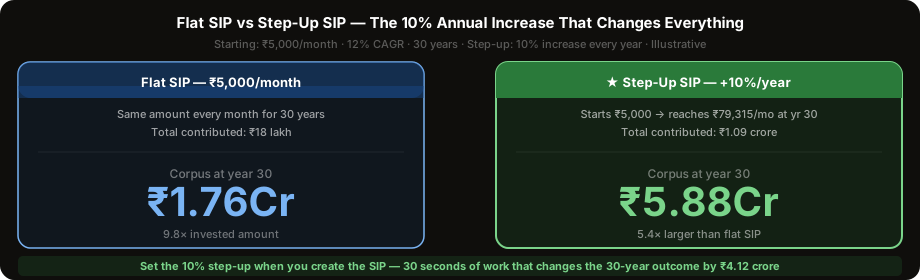
Fig 4: Flat SIP vs step-up SIP — same starting amount, same return rate, different outcome. The 10% annual step-up produces ₹5.88 crore vs ₹1.76 crore at 30 years. The step-up amount at year 30 (₹79,315/month) still represents approximately 20–25% savings rate on a salary that has grown at 8–10% annually throughout.
What Kills Compounding — The Five Interruptions
Every interruption to a compounding investment series costs more than it appears to in the moment — because you lose not just the current contribution, but all future returns on that contribution.
1. Stopping the SIP during a market correction When markets fall 20–30%, your ₹5,000 buys significantly more units at cheaper prices. Stopping the SIP at exactly this point is the worst possible decision — it both forgoes the cheapest units and misses the recovery compounding on the full corpus. Historically, every major Nifty 50 correction has been followed by a recovery that exceeded the prior peak.
2. Withdrawing corpus early for a depreciating asset Using invested corpus to buy a car, fund a vacation, or cover a lifestyle upgrade permanently forfeits all future compounding on the withdrawn amount. ₹2 lakh withdrawn at age 30 does not cost ₹2 lakh — it costs the full compounded value of that ₹2 lakh at the end of the investment horizon, which at 12% CAGR over 30 years is approximately ₹60 lakh.
3. Delaying the start The most expensive interruption — and the most common. Every year of delay shifts the investment outside the most powerful phase of the compounding curve. The cost is not linear; it is compounding. Each year of delay at ₹10,000/month SIP costs materially in terminal corpus — costs that cannot be recovered by simply investing more later.
4. Switching funds based on recent performance Chasing last year's best-performing fund means buying high, selling the underperforming fund low, and incurring exit loads and capital gains tax — all while resetting the compounding clock. Fund switching has a measurably negative impact on long-term returns for most investors.
5. Treating the SIP as optional during financial stress A ₹5,000/month SIP feels affordable when comfortable and first on the cutting list when stressed. The problem: stress periods often coincide with market corrections — exactly the worst time to stop. The structural solution is automation: NACH autopay on salary credit date means the SIP runs whether you check your phone or not.
How to Become a Crorepati Through SIP
This is the most searched question on Indian personal finance — and the answer is simpler than most content suggests.
The crorepati formula: Consistent monthly SIP × enough time × 12% CAGR = ₹1 crore+
| Monthly SIP | Years to ₹1 crore | Total contributed | Corpus |
|---|---|---|---|
| ₹3,000 | 30 years | ₹10.8 lakh | ₹1.06 crore |
| ₹5,000 | 25 years | ₹15 lakh | ₹1.04 crore |
| ₹10,000 | 20 years | ₹24 lakh | ₹1.00 crore |
| ₹20,000 | 15 years | ₹36 lakh | ₹1.00 crore |
| ₹5,000 + 10% step-up | 20 years | ₹34 lakh | ₹1.17 crore |
The insight: A ₹3,000/month SIP — less than a weekend dinner for two in most metros — becomes ₹1 crore over 30 years at 12% CAGR. The amount is not the barrier. The start date is.
For faster results: the step-up SIP is the most powerful lever. Increasing your SIP by 10% every year (typically less than your annual salary increment) produces dramatically higher outcomes without requiring a large starting amount. See how index funds deliver this return.
People Also Ask
How does compound interest work in SIP?
In a SIP, each monthly investment buys mutual fund units at the current NAV. As the fund generates returns, these returns increase the NAV — meaning your existing units are now worth more. Each subsequent month's SIP investment earns returns not just on its own purchase value but on the entire accumulated corpus. This is compound interest in practice: each month's returns form part of the base for the following month's growth.
How much SIP is needed to become a crorepati in India?
At 12% CAGR: ₹3,000/month for 30 years, ₹5,000/month for 25 years, or ₹10,000/month for 20 years each produces approximately ₹1 crore. With a 10% annual step-up, ₹5,000/month reaches ₹1 crore in approximately 20 years. The key variable is not the monthly amount — it is the time horizon. Starting at 25 with ₹3,000/month is more powerful than starting at 35 with ₹10,000/month.
What is the Rule of 72 and how do I use it?
Divide 72 by your expected annual return rate to estimate the number of years for your investment to double. At 12% CAGR (approximate Nifty 50 historical average): 72÷12 = 6 years to double. At 6% (FD): 12 years. The Rule of 72 also applies to debt — credit card debt at 42% APR doubles in 1.7 years (72÷42). It is a useful mental shortcut for comparing investment options and understanding the urgency of debt repayment.
Is it too late to start investing at 35?
No — but the opportunity cost of waiting from 25 to 35 is significant and cannot be fully recovered. An investor starting at 35 with ₹10,000/month reaches ₹1.07 crore at 60. The same person starting at 25 reaches ₹3.53 crore. The solution for someone starting at 35: invest a higher percentage of income (25–30% rather than 15–20%), enable a 10% annual step-up immediately, and never stop the SIP during corrections. The compounding clock is running whether you participate or not.
What is the power of compounding with a real India example?
Meera starts ₹5,000/month at age 25; Vikram starts the same amount at age 32. At 60: Meera has approximately ₹2.05 crore; Vikram has approximately ₹82 lakh. The ₹1.23 crore gap was not created by investing more — Meera contributed ₹8.4 lakh more in total, producing ₹1.23 crore more in outcome. The rest is compounding.
How much will ₹1 lakh grow to in 20 years at 12%?
₹1 lakh at 12% CAGR for 20 years = ₹1 lakh × (1.12)^20 = approximately ₹9.65 lakh. At 25 years: ₹17 lakh. At 30 years: ₹29.96 lakh. The 5-year difference between 25 and 30 years produces ₹12.96 lakh in additional wealth on the same ₹1 lakh starting point — illustrating why the final years of any compounding horizon are the most productive.
Frequently Asked Questions
Simple interest pays returns only on your original principal — the same amount each year. Compound interest pays returns on your principal plus all previously accumulated interest — a growing base each year. At 10% over 30 years, simple interest produces ₹4 lakh from ₹1 lakh invested. Compound interest produces ₹17.45 lakh — more than 4 times as much, from the same starting amount.
A SIP is the delivery mechanism; compound interest is the mathematical engine that powers it. Every equity SIP generates compound returns — the monthly investment grows as the accumulated corpus generates returns that are then reinvested. The two are complementary, not alternatives.
At 12% CAGR: ₹3,000/month for 30 years, ₹5,000/month for 25 years, or ₹10,000/month for 20 years each produces approximately ₹1 crore. With a 10% annual step-up starting at ₹5,000/month, you reach ₹1 crore in approximately 20 years on ₹34 lakh contributed. The reliable path: start early, invest consistently, step up annually, never stop during corrections. Time and consistency are the two non-negotiable inputs — the monthly amount is secondary.
Assumptions and Disclaimer
All return projections use 12% CAGR — the approximate 20-year historical CAGR of the Nifty 50 index. Past performance does not guarantee future returns. Actual returns will vary. SIP projections assume monthly compounding and no interruptions. All figures are illustrative. Mutual fund investments are subject to market risk. Consult a SEBI-registered investment advisor for personalised recommendations.
Also read — Rivo Personal Finance Series:
- How to Start Investing With ₹500/Month — A Complete Beginner's Guide
- Index Funds vs Mutual Funds vs Stocks — Which Builds Wealth Fastest?
- FIRE Movement for Indian Middle Class — Is It Realistic?
- Why Indians Live Paycheck to Paycheck — The Behavioural Science
- Debt Avalanche vs Debt Snowball — Which Pays Off Debt Fastest?
- 10 Legal Tax Deductions for Salaried Employees — India 2026
More from the journal
Personal Finance