
10 Legal Tax Deductions for Salaried Employees in India — Save Up to ₹2.7 Lakh in FY 2025-26
10 legal tax deductions that can save salaried Indians up to ₹2.7 lakh in FY 2025-26. Covers 80C, NPS, HRA, home loan, 80D, and the old vs new regime calculation — with exact rupee examples at ₹15L, ₹20L, ₹30L income.
Priya Nair12 May 202616 min read
Key Takeaways
- Most salaried Indians claim only 3–4 deductions out of 10 available — leaving ₹50,000–₹1,50,000 in tax on the table
- Maximum deduction stack under Old Regime: 80C (₹1.5L) + NPS 80CCD(1B) (₹50K) + HRA + 80D (₹75K) + home loan interest (₹2L) + standard deduction (₹75K) = ₹7–9 lakh
- Tax saved at 30% bracket: ₹2.1–₹2.7 lakh per year — recurring, every year
- The Old vs New Regime decision: Old Regime wins above ~₹4.25 lakh in total deductions for most income levels; New Regime wins below
- NPS 80CCD(1B) is the most underused deduction — ₹50,000 completely separate from 80C, saving ₹15,600/year at 30% bracket
- Never choose insurance products (ULIPs, endowments) for 80C — poor returns plus poor insurance
Table of Contents
- How much tax are you leaving unclaimed?
- Old regime vs new regime — decide this first
- The 10 deductions in order of impact
- Combined calculation — real numbers at three income levels
- The old vs new breakeven analysis
- 5 common tax mistakes salaried Indians make
- People also ask
- Frequently asked questions
Quick Answer — How Much Tax Can You Legally Save?
A salaried Indian earning ₹30 lakh gross and claiming all available deductions under the Old Tax Regime can reduce taxable income by ₹7–9 lakh, saving ₹2.1–₹2.7 lakh in tax annually. The 10 deductions are: Standard Deduction (₹75K), 80C (₹1.5L), NPS 80CCD(1B) (₹50K), HRA exemption (formula-based), Home Loan Interest 24(b) (₹2L), 80D health insurance (₹25K–₹75K), 80TTA savings interest (₹10K), Professional Tax, 80G donations, and LTA exemption.
How Much Tax Are You Leaving Unclaimed?
Rohan, 32, software architect in Bengaluru. Gross CTC: ₹28 lakh. He claims 80C (EPF + ELSS) and standard deduction — and stops there.
Deductions he is not claiming:
- NPS 80CCD(1B): ₹50,000 — saves ₹15,600/year at 30% bracket
- 80D health insurance for parents: ₹25,000–₹50,000 — saves ₹7,800–₹15,600/year
- HRA exemption: ₹1,80,000–₹2,40,000 (paying ₹22,000/month rent in Bengaluru)
- Professional tax: ₹2,400/year
Conservative estimate of unclaimed deductions: ₹3,00,000–₹4,00,000. Tax left on the table: ₹93,000–₹1,25,000 per year.
This is not tax avoidance. Every deduction listed in this article is explicitly provided by the Income Tax Act for salaried employees.
Counterintuitive truth: The Indian tax code is not designed to extract maximum tax from salaried employees — it provides substantial deductions that most people never claim because no one told them these exist.
Old Regime vs New Regime — Decide This First
All 10 deductions below apply exclusively under the Old Tax Regime. The New Tax Regime (default from FY 2024–25) offers lower slab rates but eliminates most of these deductions.
New Tax Regime slab rates (FY 2025-26):
| Income | Tax rate |
|---|---|
| Up to ₹3 lakh | Nil |
| ₹3–₹7 lakh | 5% |
| ₹7–₹10 lakh | 10% |
| ₹10–₹12 lakh | 15% |
| ₹12–₹15 lakh | 20% |
| Above ₹15 lakh | 30% |
Old Tax Regime slab rates (FY 2025-26):
| Income | Tax rate |
|---|---|
| Up to ₹2.5 lakh | Nil |
| ₹2.5–₹5 lakh | 5% |
| ₹5–₹10 lakh | 20% |
| Above ₹10 lakh | 30% |
Which regime wins: Old Regime becomes superior when total deductions exceed approximately ₹4.25 lakh (the breakeven point shifts with income — calculate both using your actual numbers).
| Total deductions available | Better regime (typically) |
|---|---|
| Below ₹3.75 lakh | New Tax Regime |
| ₹3.75–₹5 lakh | Calculate both — often close |
| Above ₹5 lakh | Old Tax Regime usually wins significantly |
For a salaried professional with HRA + 80C (EPF + ELSS) + NPS + 80D + home loan, total deductions typically exceed ₹6–8 lakh — making the Old Regime the better choice at most income levels above ₹15 lakh.
Critical note: Your regime choice must be declared to your employer at the start of the financial year for correct TDS calculation. You can switch regimes when filing your ITR — but your employer's TDS is based on your stated regime. Declare accordingly.
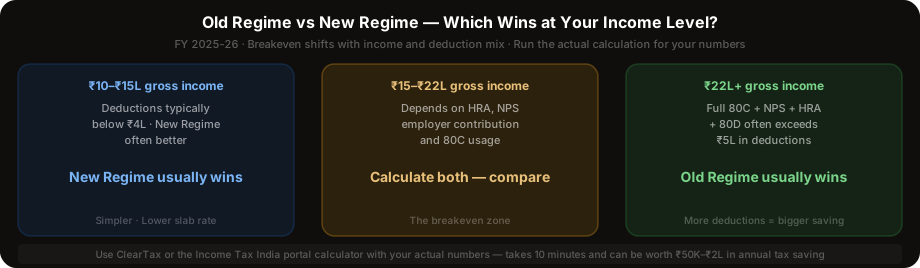
Fig 2: Old vs New Tax Regime breakeven at three income levels. Above ₹15 lakh with meaningful deductions (HRA + 80C + NPS + home loan), the Old Regime consistently saves more. Below ₹10 lakh, the New Regime usually wins.
The 10 Deductions — In Order of Impact
1. Standard Deduction — ₹75,000 (automatic)
A flat ₹75,000 deduction for all salaried individuals and pensioners — no documentation, no action required. Applied automatically.
Tax saving at 30% bracket: ₹23,400/year Available in New Regime: Yes — this is the one deduction that applies in both regimes.
2. Section 80C — Up to ₹1,50,000
The highest-volume deduction. Covers multiple instruments under one ₹1.5 lakh ceiling:
| 80C instrument | Lock-in | Expected return | Recommendation |
|---|---|---|---|
| EPF contribution | Until retirement | ~8.25% (declared annually) | Automatic — already happening |
| ELSS mutual fund | 3 years | ~12%+ CAGR (equity) | Start here for remaining headroom |
| PPF | 15 years | 7.1% (government-set) | Long-term guaranteed, tax-free at maturity |
| NSC | 5 years | 7.7% | Modest — use if equity aversion |
| 5-year tax-saving FD | 5 years | 6.5–7.5% | Guaranteed, no equity risk |
| Home loan principal | Until loan ends | N/A (reduces debt) | Captured automatically via Form 16 |
| Life insurance premium | Policy term | Policy-dependent | Only term insurance premiums — avoid endowments |
Tax saving at 30% bracket: ₹1.5 lakh × 30% × 1.04 cess = ₹46,800/year
Priority within 80C: First let EPF fill whatever it naturally does. Then ELSS for remaining headroom. Avoid endowments and ULIPs — they produce poor insurance cover and poor investment returns simultaneously.
3. Section 80CCD(1B) — NPS Additional ₹50,000
Completely separate from 80C. This additional deduction for NPS Tier 1 contributions is the most underused high-value deduction in India.
You can contribute ₹50,000/year to NPS Tier 1 over and above your 80C maximum, and claim it as a separate deduction.
Tax saving: ₹50,000 × 30% × 1.04 = ₹15,600/year — additional to the 80C saving
NPS considerations: Locked until age 60. At maturity: 60% tax-free withdrawal; 40% must purchase an annuity (annuity income is taxable). NPS is appropriate as a retirement vehicle — not a liquidity vehicle. The ₹50,000 deduction benefit is real and immediate; the illiquidity is the trade-off.
4. HRA Exemption — Formula-Based
If your salary includes a House Rent Allowance component and you pay rent, you can exempt the lowest of:
- Actual HRA received
- Actual rent paid minus 10% of basic salary
- 50% of basic salary (Delhi, Mumbai, Kolkata, Chennai) or 40% (other cities)
Example (Bengaluru):
- Basic: ₹70,000/month | HRA received: ₹28,000 | Monthly rent: ₹24,000
- Option A: ₹28,000 (HRA received)
- Option B: ₹24,000 − ₹7,000 (10% of basic) = ₹17,000
- Option C: ₹28,000 (40% of basic, non-metro)
- Exempt amount: ₹17,000/month = ₹2,04,000/year
Documents required: Rent receipts (monthly or quarterly), rental agreement, landlord PAN if annual rent exceeds ₹1 lakh.
HRA cannot be claimed if: You own the property you live in, or you live rent-free with family (parents' home — but you can pay rent to parents if they own it, claim HRA, and they declare the rental income).
5. Section 24(b) — Home Loan Interest up to ₹2,00,000
Interest paid on a home loan for a self-occupied property is deductible up to ₹2 lakh/year. This is separate from the 80C principal deduction.
Tax saving at 30%: ₹2 lakh × 30% × 1.04 = ₹62,400/year
For let-out properties: No ₹2L cap — actual interest paid is deductible (subject to loss set-off rules). Consult a CA for rental property tax treatment.
Under-construction: Pre-construction interest can be claimed in 5 equal instalments from the year of possession.
6. Section 80D — Health Insurance Premium up to ₹75,000
| Covered persons | Maximum deduction |
|---|---|
| Self + spouse + children (all below 60) | ₹25,000 |
| Self + family + parents (parents below 60) | ₹50,000 |
| Self + family + senior citizen parents | ₹75,000 |
| Preventive health check-up | ₹5,000 (within above limits) |
Tax saving at 30%: Up to ₹23,400/year
The senior citizen parent premium deduction (₹50,000 for parents above 60) is dramatically underused — many professionals pay their parents' health insurance but do not claim the deduction.
7. Section 80CCD(2) — NPS Employer Contribution
If your employer contributes to your NPS account, that contribution is deductible up to 10% of your basic salary — with no upper limit tied to 80C.
This deduction is not available through employee self-contribution under 80C — it specifically covers the employer's NPS contribution. If your employer offers NPS as part of CTC restructuring, this can be one of the highest-value deductions available.
Tax saving: 10% of basic salary × 30% × 1.04 cess (no monetary cap, unlike 80C and 80CCD(1B))
8. Section 80TTA — Savings Account Interest up to ₹10,000
Interest on savings accounts (not FDs, not RDs) up to ₹10,000/year is exempt from tax. This is automatically applicable if your savings account earns interest — no paperwork.
For senior citizens: Section 80TTB allows ₹50,000 on all deposit interest including FDs.
9. Professional Tax
State-level professional tax (₹200–₹2,500/year depending on state) is fully deductible. Automatically appears in Form 16 — no action required. Small but automatic.
10. LTA (Leave Travel Allowance)
LTA received from your employer for actual travel within India is exempt — twice in every 4-year block (current block: 2022–2025). Requires actual travel receipts and tickets.
Not relevant for all employers — check your CTC structure for whether LTA is included.
Combined Calculation — Real Numbers at Three Income Levels
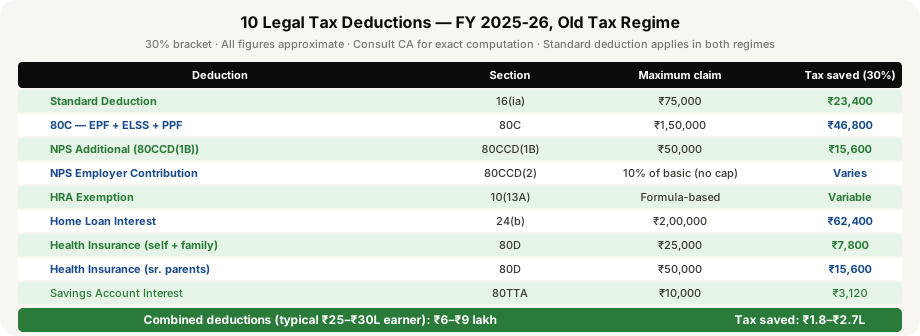
Fig 1: Combined deduction impact at three income levels. The absolute tax saving increases with income because each deduction eliminates more from a higher marginal slab.
₹15 lakh gross income (Old Regime):
- Standard deduction: ₹75,000
- 80C (EPF + ELSS): ₹1,50,000
- NPS 80CCD(1B): ₹50,000
- 80D self + parents: ₹50,000
- HRA (varies): ₹1,20,000 (approximate, Tier-2 city)
- Total deductions: ~₹4,45,000
- Taxable income: ~₹10,55,000
- Approximate tax saved vs no deductions: ₹80,000–₹1,00,000
₹20 lakh gross income (Old Regime):
- Same deductions as above + higher HRA (~₹1,80,000)
- Total deductions: ~₹5,05,000
- Taxable income: ~₹14,95,000
- Approximate tax saved: ₹1,30,000–₹1,60,000
₹30 lakh gross income (Old Regime):
- All above + Home Loan Interest ₹2,00,000 + senior parent 80D ₹75,000
- Total deductions: ~₹7,50,000–₹9,00,000
- Taxable income: ~₹21,00,000–₹22,50,000
- Approximate tax saved: ₹2,10,000–₹2,70,000
All figures are illustrative. Actual tax depends on exact CTC structure, HRA component, rent amount, and deductions availed. Verify with a CA.
The Old vs New Regime Breakeven Analysis
For each income level, there is a deduction breakeven point — above it, Old Regime wins; below it, New Regime wins.
| Gross income | Approximate breakeven deductions |
|---|---|
| ₹10 lakh | ~₹3.0 lakh total deductions |
| ₹15 lakh | ~₹4.0 lakh total deductions |
| ₹20 lakh | ~₹4.5 lakh total deductions |
| ₹30 lakh | ~₹5.0 lakh total deductions |
A salaried professional with HRA + 80C (EPF alone) + standard deduction at ₹20 lakh typically hits ₹4–5 lakh in deductions — right at the breakeven. Adding NPS (₹50K) and 80D (₹25K+) tips most people clearly into Old Regime territory.
How to calculate: Use an online tax calculator (ClearTax, Income Tax India portal) with both regimes using your actual deduction numbers. The calculation takes 10 minutes and is worth ₹50,000–₹2,00,000/year in certainty.
5 Common Tax Mistakes Salaried Indians Make
1. Defaulting to New Regime without calculating Old Regime The New Regime is the employer default from FY 2024–25. If you don't actively declare Old Regime to your employer, TDS is calculated on New Regime rates. Many employees with HRA + 80C + NPS + 80D would save significantly more under Old Regime but never ran the comparison.
2. Using endowments or ULIPs for 80C ULIPs charge 3–5% annually in expenses. The insurance cover is inadequate; the investment returns are poor. Use ELSS (3-year lock-in, equity returns, tax deduction) for 80C — and a separate term insurance plan for protection.
3. Not claiming 80CCD(1B) NPS The additional ₹50,000 NPS deduction (separate from 80C) saves ₹15,600/year at 30% bracket. Most people have never heard of it. Requires opening an NPS Tier 1 account and contributing ₹50,000/year — takes 30 minutes to set up.
4. Not submitting rent receipts for HRA HRA exemption requires submitting rent receipts to your employer for TDS adjustment. Without submission, TDS is calculated on the full HRA received as income. Submit before December each year.
5. Ignoring 80D for parents' health insurance If you pay for your parents' health insurance (common for salaried professionals), the premium is deductible under 80D — up to ₹50,000/year if parents are senior citizens. Most people don't realise the policy can be in their parents' name while the premium is paid by the child and deducted against the child's income.
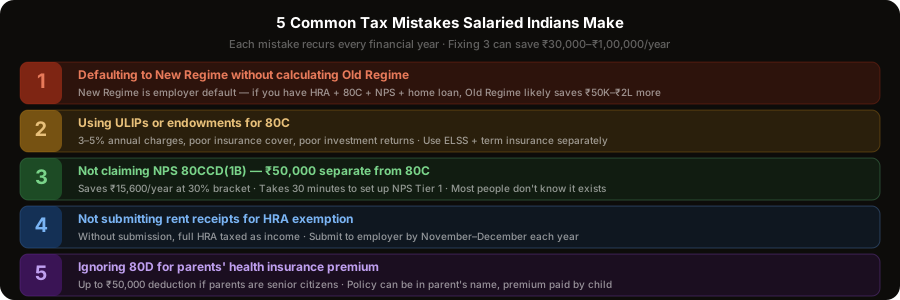
Fig 3: The 5 most common tax mistakes by salaried Indians. Each mistake is recurring — the annual cost compounds. Fixing mistakes 2, 3, and 5 alone can save ₹30,000–₹1,00,000/year.
People Also Ask
Is the Old Tax Regime better than the New Tax Regime in India 2026?
It depends entirely on your available deductions. Old Regime wins if your total deductions (80C + HRA + NPS + 80D + home loan + standard deduction) exceed approximately ₹4–5 lakh — which is achievable for most salaried professionals paying rent and contributing to EPF. New Regime wins if you have minimal deductions or are a first-time employee. Calculate both with your actual numbers — a 10-minute exercise that can save ₹50,000–₹2,00,000/year.
What is the best way to save tax for a salaried person in India?
The highest-impact sequence: (1) Max 80C to ₹1.5 lakh (EPF + ELSS), (2) Contribute ₹50,000 to NPS for 80CCD(1B), (3) Buy adequate health insurance and claim 80D, (4) Submit rent receipts for HRA if you pay rent, (5) Claim home loan interest under Section 24(b) if applicable. Together, these five actions can legally reduce taxable income by ₹4–8 lakh.
Can I claim both 80C and NPS in the same year?
Yes. Section 80CCD(1B) is completely separate from Section 80C. You can claim the full ₹1.5 lakh under 80C and an additional ₹50,000 under 80CCD(1B) in the same financial year — for a combined deduction of ₹2 lakh from these two sections alone.
What documents do I need for HRA exemption?
Rent receipts (monthly or quarterly) with landlord name, address, amount, and signature. A signed rental agreement. The landlord's PAN card copy if annual rent exceeds ₹1 lakh. Submit to your employer payroll team by November–December for TDS adjustment in that financial year.
Which 80C investment is best for a 30-year-old?
Priority: (1) ELSS mutual funds — highest expected returns (12%+ CAGR), 3-year lock-in, can align with wealth building. (2) EPF — already automatic via salary. (3) PPF — guaranteed returns, 15-year lock-in. Avoid endowment policies and ULIPs — the combination of poor insurance cover and high investment charges makes them among the worst 80C choices despite being heavily marketed.
What is the NPS Tier 1 account and how does it help with tax?
NPS Tier 1 is the pension account that qualifies for both 80C (if contributed via salary deduction — part of the existing 80CCD(1)) and the additional 80CCD(1B) deduction of ₹50,000. Tier 1 is locked until age 60 — appropriate for retirement savings. Opening an NPS account takes 30 minutes via the NPS Trust website or any Point of Presence (major banks, NSDL). The ₹50,000 deduction under 80CCD(1B) saves ₹15,600/year at the 30% bracket.
Frequently Asked Questions
₹1,50,000 per financial year — combined across all 80C instruments (EPF, ELSS, PPF, NSC, home loan principal, life insurance premium, tax-saving FD, SCSS). Contributions above ₹1.5 lakh receive no additional 80C benefit.
No. HRA exemption requires that you pay rent to a landlord. If you live in your own property, HRA received as part of salary is fully taxable. If you live in your parents' house and pay them rent, you can claim HRA — but your parents must declare the rental income in their returns.
₹75,000 — applicable to all salaried individuals and pensioners. No documentation required. Available under both Old and New Tax Regimes.
Most employees already contribute to EPF via salary — this fills part of 80C automatically. For remaining headroom: ELSS is recommended for those with a 3+ year horizon who want equity market returns. PPF is appropriate for conservative investors wanting government-guaranteed returns. Avoid tax-saving FDs and NSC unless you need guaranteed short-term instruments.
Important Disclaimers
All figures in this article are based on Income Tax Act provisions as of FY 2025-26. Tax laws change — verify current applicability with a Chartered Accountant or on the Income Tax India portal. HRA and other formula-based deductions depend on individual CTC structure. All tax saving calculations at 30% bracket including 4% cess. Consult a SEBI-registered financial advisor or CA for personalised tax planning.
Also read — Rivo Personal Finance Series:
More from the journal
Personal Finance