
High-Yield Savings Accounts vs Fixed Deposits India 2026: Where Your Emergency Fund Actually Belongs
High-yield savings accounts vs fixed deposits India 2026 — which earns more, which is safer, and where your emergency fund actually belongs. SFB rates, liquid funds, sweep FDs, and real post-tax numbers compared.
Priya Nair11 May 202624 min read
Key Takeaways
- Standard savings accounts at major banks (2.5–3.5%) earn below inflation (4.5%) — convenient for daily transactions, but inefficient for storing large emergency fund balances over time
- Small finance bank savings accounts (7–8.5%) carry the same DICGC ₹5 lakh deposit insurance as SBI — 2.5–3× higher return for balances within the insured limit
- Liquid mutual funds (6.5–7.5%) have T+1 redemption, no premature withdrawal penalty, and no TDS — better than FDs for emergency funds above ₹2L at the 20–30% tax bracket
- Sweep FDs give better returns than standard savings accounts without needing a separate account — a quick upgrade for people who won't open an SFB account
- The post-tax difference between SBI savings (₹12,150/year) and AU SFB savings (₹33,750/year) on ₹5 lakh: ₹21,600/year for a one-time account opening
High-Yield Savings vs Fixed Deposits — Quick Answer
For 2026: small finance bank savings accounts (7–8.5% p.a.) and liquid mutual funds (6.5–7.5% annualised) outperform standard savings accounts (2.5–3.5%) and often match short-term FDs — with superior liquidity. For emergency funds: liquid mutual funds or SFB savings accounts are the optimal choice for most Indian salaried professionals. Standard savings accounts at major banks are convenient for daily transactions but inefficient for storing large emergency fund balances over time.
| Instrument | Rate | Liquidity | DICGC insured | Best for |
|---|---|---|---|---|
| Standard savings (SBI/HDFC) | 2.5–3.5% | Instant | ✅ ₹5L | Day-to-day transactions, salary credit |
| Small Finance Bank savings | 7–8.5% | Instant | ✅ ₹5L | Core emergency fund |
| Liquid mutual fund | 6.5–7.5% | T+1 / instant ₹50K | ❌ | Emergency fund >₹2L, 20–30% slab |
| Sweep FD | 5–7% | Instant (auto-break) | ✅ ₹5L | Salary account upgrade |
| 1-year FD | 6.5–9% | 1–2 days + penalty | ✅ ₹5L | Known planned expenses |
Best Place to Keep Your Emergency Fund in India (2026)
For most salaried professionals in India:
- ₹50,000–₹1 lakh → salary account for instant UPI/ATM access
- ₹2–₹5 lakh → small finance bank savings account (7–8.5% p.a., DICGC insured)
- Above ₹2 lakh, 20–30% tax bracket → liquid mutual fund (no TDS, T+1 redemption)
- Planned expenses with known timeline → fixed deposit matched to tenure
This structure balances liquidity, safety, and post-tax returns better than concentrating all emergency money in a standard savings account.
Quick pick:
- Emergency fund, any size → SFB savings account (7–8.5%, insured, instant)
- Emergency fund above ₹2L, 20–30% tax slab → Liquid mutual fund (no TDS, T+1)
- Don't want a new account → Sweep FD on existing account (5–7%)
- Planned expense in 6–12 months → FD (lock in the rate, match tenure to goal)
Is Your Money Losing Value Right Now?
Kiran, 31, product manager in Pune. Salary: ₹1.4 lakh/month. Emergency fund: ₹6 lakh sitting in his HDFC savings account at 3.5% p.a. Inflation: 4.5%.
Every year, Kiran's ₹6 lakh earned ₹21,000 in interest — and lost ₹27,000 in real purchasing power. Net: he was losing ₹6,000 per year in real terms, while believing he was being financially responsible.
Moving ₹5 lakh to an AU Small Finance Bank savings account at 7.5% (keeping ₹1 lakh in HDFC for instant access) took 25 minutes. The result: ₹37,500/year instead of ₹17,500 — a difference of ₹20,000/year for a one-time action.
Counterintuitive truth: The biggest risk to your emergency fund is not market volatility. It is the slow, invisible erosion of purchasing power when money earns below inflation — in what feels like the safest possible place.
The Savings Landscape in India 2026
The gap between what most Indian savings accounts pay and what is available in the market represents a significant, invisible annual cost to every household that has not optimised their cash holdings.
In 2026, the choice architecture for liquid savings looks like this:
- Standard savings accounts (major PSU and private banks): 2.5–3.5% p.a.
- Small finance bank savings accounts: 7–8.5% p.a.
- Liquid mutual funds: 6.5–7.5% annualised (variable, market-linked)
- Sweep FD / auto-sweep accounts: 5–7% p.a. (threshold-triggered)
- Short-term FDs (7–90 days): 4.5–6.5% p.a.
- 1-year FDs: 6.5–7.5% at major banks; 8–9% at small finance banks
The difference between 2.75% (SBI savings) and 8% (AU SFB savings) on ₹5 lakh is ₹26,250 per year — requiring only a one-time account opening. Most Indians leave this uncollected indefinitely.
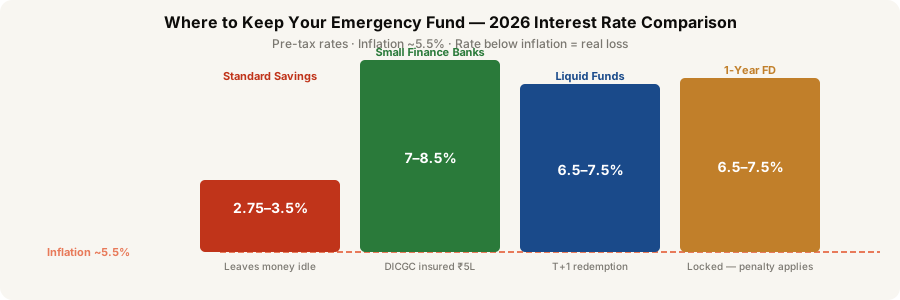
Fig 1: India savings rate landscape 2026. The inflation line (4.5%) shows that standard savings accounts at major banks produce negative real returns. SFB savings and liquid funds are the only liquid options that beat inflation.
Standard Savings Accounts — The Comfortable but Costly Default
Standard savings accounts at major banks are the default holding location for Indian household cash. They offer unmatched convenience — direct salary credit, UPI integration, immediate debit card access. But convenience comes at a return cost that most people have never calculated.
| Bank | Savings account rate (April 2026) | ₹ earned on ₹5L/year |
|---|---|---|
| State Bank of India | 2.70% | ₹13,500 |
| HDFC Bank | 3.00–3.50% | ₹15,000–₹17,500 |
| ICICI Bank | 3.00–3.50% | ₹15,000–₹17,500 |
| Axis Bank | 3.00–3.50% | ₹15,000–₹17,500 |
| Kotak Mahindra Bank | 3.50–4.00% | ₹17,500–₹20,000 |
Rates as of April 2026. Interest on savings accounts above ₹10,000/year is taxable as income.
After accounting for inflation at 4.5%, every rupee in a standard SBI savings account is losing approximately 1.8% of real purchasing power annually. The nominal balance grows — but its ability to buy goods and services shrinks. For daily transactions and salary inflow, this is acceptable. For storing months of emergency reserves, it is a structural inefficiency worth correcting.
Key insight: Keeping a large emergency fund in your salary account is not inherently reckless — but it carries a real, invisible cost. The nominal balance feels stable while purchasing power quietly erodes. For daily use and immediate access, the salary account is the right home. For 3–6 months of reserves that sit idle for months at a time, it is worth the one-time friction of a better instrument.
Small Finance Banks — The Highest Liquid Return in India
Small finance banks are RBI-licensed, DICGC-insured, and regulated under the same framework as commercial banks. Their higher savings rates are structural — they serve underbanked segments and compete on rate rather than branch network.
| Small Finance Bank | Savings rate (April 2026) | ₹ earned on ₹5L/year |
|---|---|---|
| AU Small Finance Bank | 7.00–8.00% | ₹35,000–₹40,000 |
| Ujjivan Small Finance Bank | 7.50% | ₹37,500 |
| ESAF Small Finance Bank | 7.00–8.50% | ₹35,000–₹42,500 |
| Jana Small Finance Bank | 6.50–7.25% | ₹32,500–₹36,250 |
| Suryoday Small Finance Bank | 7.25–8.25% | ₹36,250–₹41,250 |
Rates as of April 2026. Verify current rates on the bank's official website before opening an account.
The return difference between SBI savings (₹13,500/year) and AU SFB savings (₹37,500/year) on ₹5 lakh is ₹24,000/year — for identical insurance coverage.
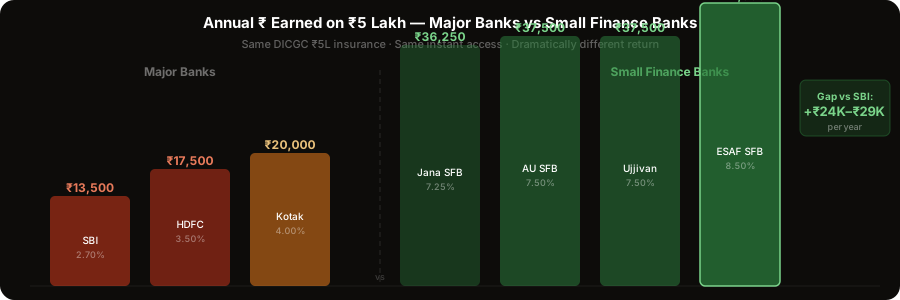
Fig 4: Annual ₹ earned on ₹5 lakh — major banks vs small finance banks. The gap is ₹17,000–₹29,000/year for identical DICGC insurance coverage. This is the cost of staying with your salary bank.
Is a Small Finance Bank Actually Safe?
This is the single biggest objection to switching — and it is based on a misunderstanding of how deposit insurance works in India.
DICGC (Deposit Insurance and Credit Guarantee Corporation) insures deposits up to ₹5 lakh per depositor per bank. This covers savings accounts, FDs, recurring deposits, and current accounts — at every DICGC-member bank in India.
For deposits within the ₹5 lakh insurance limit, the deposit insurance coverage is identical across DICGC-member banks — including SBI, HDFC Bank, and small finance banks. A ₹5 lakh deposit at AU SFB carries the same government-backed deposit insurance as ₹5 lakh at SBI.
What is different: Major banks carry lower operational concentration risk due to larger balance sheets, higher capital adequacy ratios, and greater asset diversification. Bank safety involves more than deposit insurance alone — it also includes resolution timelines, operational continuity, and overall financial stability. For deposits within the DICGC limit, this difference is less material in practice, but worth understanding.
The practical rule:
- Up to ₹5 lakh: SFB savings account offers higher return with equivalent deposit insurance. Use SFB for the yield advantage.
- Above ₹5 lakh: Distribute. ₹5L at SFB + ₹5L at major bank + remaining in liquid fund.
Who Should Avoid Small Finance Bank Savings Accounts?
SFB savings accounts are not the right choice for everyone:
- People uncomfortable managing multiple bank accounts — the SFB works best as a secondary account alongside your salary bank, not a replacement
- Users who need extensive branch access — SFBs have smaller branch networks than major banks
- Individuals storing more than ₹5 lakh at one institution — above the DICGC limit, distributing across multiple institutions is more important than chasing yield at one
- Users who prioritise ecosystem integration — major bank savings accounts integrate more seamlessly with credit cards, home loans, and salary processing
For these users, a sweep FD on an existing major bank account or a liquid mutual fund may be more practical than opening a new SFB account.
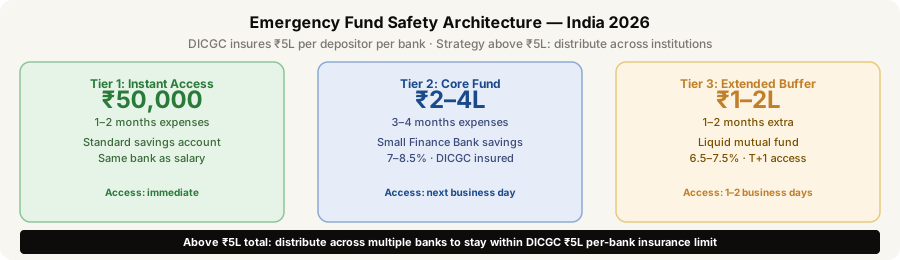
Fig 3: DICGC insurance covers ₹5 lakh per depositor per bank — identically at SBI and small finance banks. Above ₹5 lakh, distribute across institutions to stay fully covered.
Liquid Mutual Funds — The Tax-Efficient, Flexible Option
Liquid funds are debt mutual funds that invest in instruments maturing within 91 days — treasury bills, commercial papers, certificates of deposit. They are not capital-guaranteed, but have an extremely strong historical record of stable, positive returns.
Important: While liquid funds have historically shown very low volatility, they are market-linked products and do not carry guaranteed returns or deposit insurance. NAV can technically fluctuate, and credit or liquidity risk — while low for well-rated funds — is not zero. They are not equivalent to bank deposits.
Key characteristics:
- Current annualised yield: 6.5–7.5% (market-linked, varies by fund)
- Redemption: T+1 business day (up to ₹50,000 can be redeemed instantly via most platforms)
- Tax: gains taxed as income at your slab rate — no TDS deducted at source
- No exit load on most liquid funds (verify before investing)
- No premature withdrawal penalty — unlike FDs
The tax comparison for 20–30% bracket investors:
FD interest above ₹40,000/year attracts 10% TDS (Tax Deducted at Source). TDS is not an additional tax — it is a prepayment mechanism. The actual tax liability depends on your income slab at filing; TDS is adjusted against your final liability. For someone in the 30% bracket, the total tax on FD interest is 30% — TDS of 10% is deducted upfront, and the remaining 20% is paid at filing.
Liquid fund gains have no TDS deducted at source — you pay tax at your slab rate when you redeem. For someone in the 30% bracket with ₹5 lakh in a liquid fund earning 7%:
- Pre-tax gain: ₹35,000
- Tax at 30% slab on redemption: ₹10,500
- Post-tax: ₹24,500
vs SFB savings at 7.5%, 30% slab:
- Pre-tax: ₹37,500
- Total tax at 30%: ₹11,250 (10% TDS upfront, 20% at filing)
- Post-tax: ~₹26,250
For the 30% bracket: SFB savings slightly outperforms liquid funds post-tax. The liquid fund's primary advantages are no upfront TDS friction and no premature withdrawal penalty — not a tax saving per se.
Fixed Deposits — Predictable but Constrained
FDs offer guaranteed returns and complete capital safety for the committed tenure. They are appropriate for money you know you will not need before the FD matures.
| Tenure | Major private banks | Small finance banks |
|---|---|---|
| 7–45 days | 4.50–5.00% | 5.50–6.50% |
| 46–90 days | 5.00–5.75% | 6.00–7.00% |
| 91–180 days | 5.50–6.25% | 6.50–7.50% |
| 181–364 days | 6.00–6.75% | 7.00–8.00% |
| 1–3 years | 6.50–7.25% | 7.50–9.00% |
Rates as of April 2026. Premature withdrawal typically incurs a 0.5–1% penalty on the applicable rate.
The liquidity problem: Premature withdrawal of an FD incurs both a rate penalty and a processing delay of 1–2 working days. For genuine emergencies, this is manageable. But the penalty (₹2,500–₹5,000 on a ₹5L FD broken early) is an unnecessary cost that liquid alternatives avoid entirely.
Where FDs make sense: Goal-specific savings where you know the timeline — a vacation in 8 months, a home appliance purchase in a year, a wedding contribution in 18 months. Match the FD tenure to the goal; do not use FDs as emergency funds unless you have a liquid buffer separately.
Sweep FD — The Easiest Upgrade
A sweep FD automatically converts savings account balances above a set threshold into FDs — and sweeps money back when your balance falls below a minimum. No manual action required after setup.
How it works:
- Set threshold at, say, ₹25,000 in your savings account
- Every rupee above ₹25,000 automatically converts to a short-term FD at 5.5–7% p.a.
- When you spend and balance drops below ₹25,000, the FD breaks automatically (LIFO order) to restore the minimum
Available at: HDFC Bank, ICICI Bank, Axis Bank, Kotak Mahindra Bank, and most major private banks. Setup time: 10–15 minutes in netbanking.
The honest limitation: Sweep FD rates (5.5–7%) are still below SFB savings accounts (7–8.5%). A sweep FD is a meaningful improvement over a standard savings account — but not the maximum available return for liquid money.
Best for: People who will not open a separate SFB or liquid fund account. A sweep FD turns your existing salary account into a better instrument with no friction beyond a one-time setup.
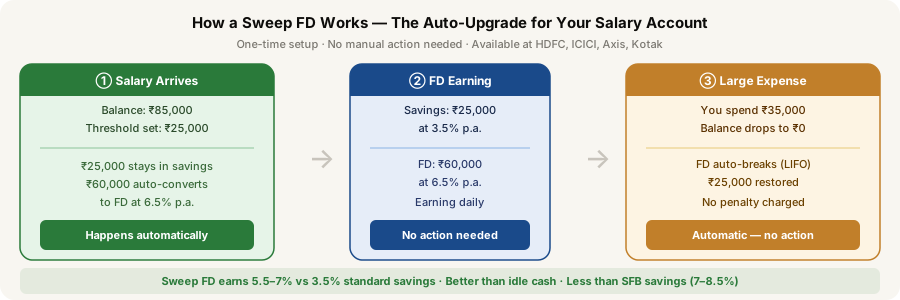
Fig 6: Sweep FD in three states. The automation is the feature — once the threshold is set, the system handles all conversions and breaks without any action from you. Earns 5.5–7% vs 3.5% on idle cash.
Real Returns on ₹5 Lakh — Post-Tax Comparison
| Instrument | Pre-tax return | Post-tax (30% slab) | Annual ₹ on ₹5L | vs SBI savings |
|---|---|---|---|---|
| SBI savings account | 2.70% | ~2.43% | ₹12,150 | Baseline |
| HDFC savings account | 3.50% | ~3.15% | ₹15,750 | +₹3,600 |
| Sweep FD (major bank) | 6.00% | ~5.40% | ₹27,000 | +₹14,850 |
| Liquid fund | 7.00% | ~4.90% | ₹24,500 | +₹12,350 |
| AU SFB savings | 7.50% | ~6.75% | ₹33,750 | +₹21,600 |
| 1-year FD (major bank) | 7.00% | ~6.30% | ₹31,500 | +₹19,350 |
| 1-year FD (SFB) | 8.50% | ~7.65% | ₹38,250 | +₹26,100 |
Post-tax figures assume 30% income tax slab. 10% TDS on FD/savings interest above ₹40,000/year (₹10,000 for non-senior residents). Liquid fund gains taxed at slab on withdrawal. Illustrative — actual tax depends on total income.
The post-tax gap between SBI savings (₹12,150/year) and AU SFB savings (₹33,750/year): ₹21,600/year for a one-time 25-minute account opening.
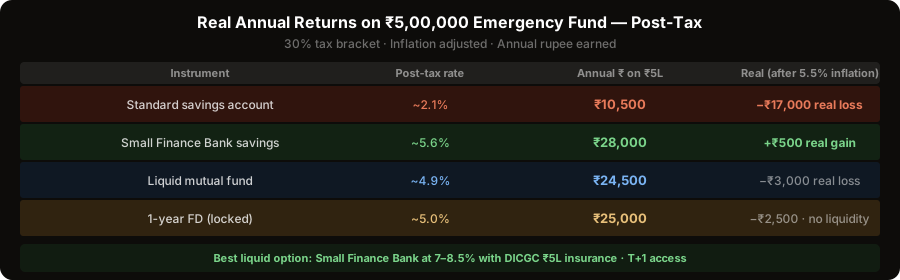
Fig 2: Post-tax annual ₹ earned on ₹5 lakh across all instruments (30% tax slab). The "vs SBI savings" column shows the invisible cost of inertia — ₹21,600/year given up by keeping emergency funds at a major bank savings account.
Where Does Your Emergency Fund Actually Belong?
An emergency fund has four non-negotiable requirements:
- Accessible within 24 hours — emergencies do not wait for FD maturity processing
- Capital preservation — this money cannot lose nominal value
- Return at or near inflation — 4.5% is the threshold for real preservation
- No premature penalty — breaking it early cannot cost money
This set of requirements eliminates standard FDs (1–2 day processing + penalty), medium-term debt funds (variable NAV), and standard savings accounts (return below inflation). What remains: SFB savings accounts, liquid mutual funds, and sweep FDs.
The recommended tiered structure:
| Tier | Amount | Instrument | Why |
|---|---|---|---|
| Tier 1 — Instant buffer | ₹50,000–₹1,00,000 | Salary bank savings | Immediate UPI/ATM access |
| Tier 2 — Core emergency fund | ₹2–₹5 lakh | SFB savings or liquid fund | Maximum liquid return, insured/flexible |
| Tier 3 — Extended buffer | ₹1–₹2 lakh | Sweep FD on salary account | Auto-managed, no friction |
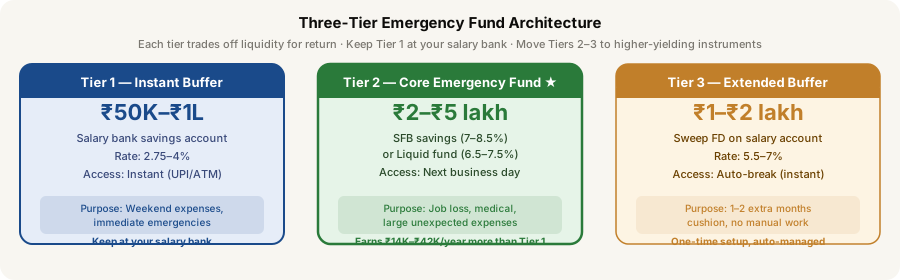
Fig 5: The three-tier emergency fund architecture. Tier 1 stays at your salary bank for instant access. Tiers 2 and 3 move to higher-returning instruments — gaining ₹15,000–₹25,000/year with no reduction in effective accessibility.
Small Finance Bank Savings vs Liquid Fund — Which Should You Choose?
Both SFB savings accounts and liquid funds are strong alternatives to standard savings accounts for emergency funds. The right choice depends on three factors: balance size, tax bracket, and preference for simplicity.
| Factor | SFB Savings Account | Liquid Mutual Fund |
|---|---|---|
| Capital safety | DICGC insured up to ₹5L | Not insured — market-linked |
| Return (pre-tax) | 7–8.5% | 6.5–7.5% |
| Post-tax (30% slab) | ~5.6–6.0% | ~4.6–5.25% |
| Redemption | Instant | T+1 (up to ₹50K instant) |
| Premature penalty | None | None (most funds) |
| TDS | Yes (above ₹40K/year) | No |
| Account needed | New bank account | Demat/MF platform |
| Best for | All sizes, 10–20% bracket | Above ₹2L, 20–30% bracket |
Bottom line: For most Indian salaried professionals, an SFB savings account is the simpler and slightly higher-returning option. Liquid funds offer a marginal operational advantage (no TDS friction) for larger balances in the higher tax brackets — but the difference is smaller than commonly assumed.
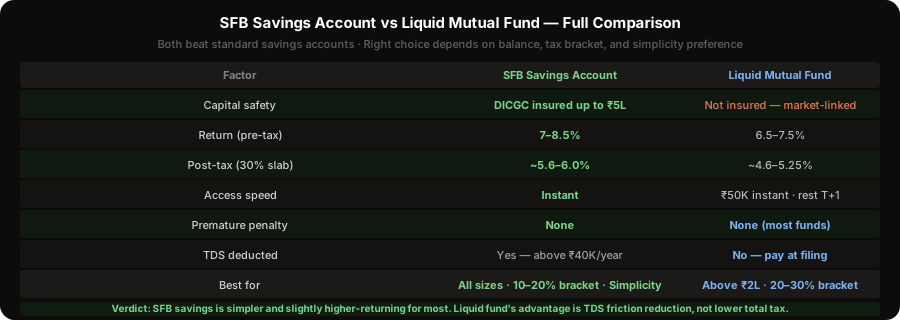
Fig 7: SFB savings vs liquid fund — full comparison. SFB wins on capital safety and slightly higher post-tax return. Liquid fund's advantage is TDS friction reduction and no premature penalty, not lower total tax.
FD vs Liquid Fund vs Savings Account — At a Glance
| Standard Savings | SFB Savings | Liquid Fund | FD (1 year) | |
|---|---|---|---|---|
| Return | 2.5–3.5% | 7–8.5% | 6.5–7.5% | 6.5–9% |
| Capital guarantee | ✅ (DICGC ₹5L) | ✅ (DICGC ₹5L) | ❌ | ✅ (DICGC ₹5L) |
| Instant access | ✅ | ✅ | ₹50K instant, rest T+1 | ❌ penalty applies |
| Premature penalty | None | None | None | 0.5–1% rate cut |
| Beats inflation | ❌ | ✅ | ✅ | ✅ |
| Best for | Daily transactions | Emergency fund | Emergency fund >₹2L | Planned goals |
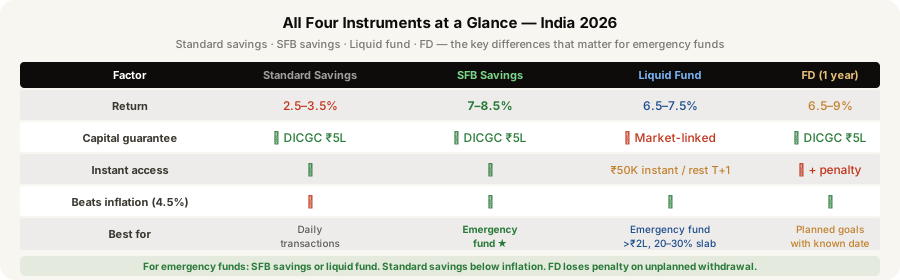
Fig 8: All four instruments at a glance. Standard savings is the only one that fails to beat inflation. FD is the only one with a premature withdrawal penalty. SFB savings covers the most boxes for emergency fund use.
Who Should Use Which Instrument?
| Your situation | Best option |
|---|---|
| First emergency fund, any amount | SFB savings account |
| ₹10L+ cash holdings | Distribute: SFB + major bank + liquid fund |
| 20–30% tax bracket, above ₹2L | Liquid fund (no TDS friction) |
| Wants simplicity, no new account | Sweep FD on existing salary account |
| Planned purchase in 6–18 months | FD matched to timeline |
| Uncomfortable with multiple banks | Liquid fund or sweep FD |
| Retired / senior citizen | FD (higher senior citizen rates; simpler tax) |
5 Common Mistakes with Emergency Funds in India
1. Keeping ₹10 lakh+ at one institution Above ₹5 lakh at any single bank, deposits exceed DICGC coverage. Distribute across multiple banks or move the excess to liquid funds.
2. Using equity mutual funds as an emergency fund Equity funds have capital risk — a market crash at the wrong moment turns an emergency into a compounded crisis. Emergency funds require capital stability, not growth.
3. Locking all reserves in FDs without a liquid buffer If the emergency arrives 4 months into a 12-month FD, you pay a premature penalty and wait 1–2 days. Always keep at least 1 month of expenses in an instant-access account.
4. Ignoring the inflation erosion in savings accounts ₹5 lakh in an SBI savings account loses ~₹9,000/year in real purchasing power (inflation 4.5% minus 2.7% return). This is invisible but cumulative — over 5 years, the erosion compounds.
5. Confusing TDS with total tax TDS of 10% on FD interest is a prepayment — not an additional cost. Your actual tax is determined by your income slab at filing. Not accounting for this leads to overestimating the tax advantage of liquid funds.
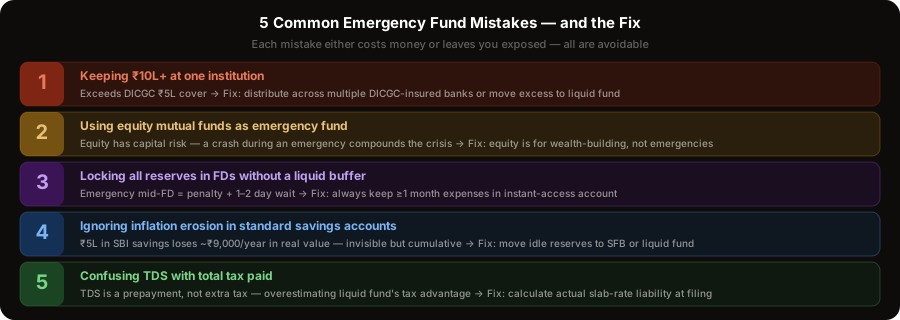
Fig 9: The 5 most common emergency fund mistakes. Mistakes 1–3 create liquidity or safety risk. Mistakes 4–5 cause financial decisions based on incomplete information.
People Also Ask
Which is better for emergency fund — SFB savings account or liquid mutual fund?
For amounts below ₹2 lakh or for investors in the 10% tax bracket: SFB savings account. Higher return (7–8.5%), DICGC insured, instant access. For amounts above ₹2 lakh in the 20–30% tax bracket: liquid mutual fund is comparable post-tax with the added advantage of no premature withdrawal penalty. Both dramatically outperform standard savings accounts.
Is a small finance bank safe in India?
For deposits up to ₹5 lakh: the DICGC deposit insurance coverage is the same across all RBI-licensed banks in India, including small finance banks. Major banks carry lower operational concentration risk — bank safety involves more than insurance coverage alone. For storing up to ₹5 lakh, SFBs are a well-regulated, RBI-licensed, insured option. Above ₹5 lakh, distribute across multiple institutions to maintain full coverage.
What is the highest savings account interest rate in India in 2026?
As of April 2026, ESAF Small Finance Bank and Suryoday Small Finance Bank offer 7.25–8.50% p.a. on savings accounts. AU Small Finance Bank and Ujjivan Small Finance Bank offer 7–7.5% p.a. These are savings accounts — not FDs — with instant access and full DICGC insurance. Rates are subject to change; verify on the bank's official site.
What is a sweep FD and how does it work?
A sweep FD (auto-sweep account) automatically converts savings account balances above a threshold into short-term FDs at a higher interest rate. When your balance falls below the threshold — for example, when you make a large payment — the FD breaks automatically to restore the minimum balance. Available at HDFC, ICICI, Axis, and Kotak. Returns: 5.5–7% p.a. — better than standard savings, less than SFB savings accounts.
Should I keep my emergency fund in a liquid fund or FD?
For the 20–30% tax bracket: liquid fund is generally superior — no TDS, no premature withdrawal penalty, T+1 redemption, comparable returns to FDs. For the 10% tax bracket or simpler needs: the tax advantage of liquid funds is smaller; FDs may be simpler. The key rule: never use a locked FD as your primary emergency fund unless you maintain a separate liquid buffer.
Can I have accounts at both my salary bank and a small finance bank?
Yes — no restriction exists on holding savings accounts at multiple banks. The recommended structure: salary received into major bank account (UPI, credit card payments, existing commitments) + surplus above 1–2 months expenses transferred to SFB account or liquid fund for higher return.
Frequently Asked Questions
For deposits within the ₹5 lakh DICGC insurance limit: the deposit insurance coverage is the same across all DICGC-member banks, including SFBs. Major banks carry lower operational concentration risk due to larger balance sheets and greater diversification — bank safety involves more than deposit insurance alone. For the practical purpose of storing up to ₹5 lakh, SFBs are a well-regulated, insured option. Above ₹5 lakh, distribute across multiple institutions.
As of April 2026, ESAF Small Finance Bank (up to 8.50%) and Suryoday Small Finance Bank (up to 8.25%) offer the highest rates on savings accounts. These rates vary by balance slab — verify the slab structure on the bank's official website.
For amounts above ₹2 lakh in the 20–30% tax bracket: liquid mutual funds offer comparable post-tax returns with no TDS and no premature penalty. For amounts below ₹2 lakh or simpler needs: SFB savings account is the better choice. Both are dramatically better than a standard savings account.
Yes — holding savings accounts at multiple banks is unrestricted. Recommended structure: salary into major bank for daily operations, surplus above 1–2 months expenses transferred to SFB or liquid fund for better returns.
For investors in the 20–30% bracket: yes — comparable returns, no TDS, no premature penalty, T+1 redemption. For the 10% bracket or simpler needs: FDs may be adequate. The critical advantage of liquid funds over FDs: no penalty when you need the money unexpectedly.
Disclaimer: All interest rates are indicative as of April 2026 and subject to change — verify on bank websites before opening accounts. DICGC insurance details sourced from the DICGC official website. Tax calculations assume the 30% income tax slab; actual post-tax returns depend on total income, deductions, and filing status. Liquid fund returns are historical — not guaranteed. Consult a SEBI-registered investment advisor for personalised advice.
Also read — Rivo Personal Finance Series: