
How to Build Credit from Zero in India 2026: Secured Cards, Credit Limits & the Exact Timeline
How to build credit from zero in India 2026 — step-by-step guide using secured credit cards, salary account shortcuts, BNPL traps to avoid, and the exact CIBIL score timeline from NH to 750+.
Priya Nair9 May 202616 min read
Table of Contents
- How CIBIL Scores Are Calculated
- Why Building Credit Takes Strategy
- Best Secured Credit Cards in India 2026
- The 12-Month Plan: NH to 700+ CIBIL
- Month 12+: Graduating to a Regular Card
- The Authorised User Strategy
- The Fastest Path If You Have a Salary Account
- Why Many Indians Still Struggle to Build Credit
- Secured Card vs BNPL
- Mistakes to Avoid While Building Credit
- Best Credit Habits for Students
- Frequently Asked Questions
Key Takeaway:
Open a fixed deposit (₹20,000–₹50,000) at HDFC Bank, SBI, Axis Bank, ICICI Bank, or Kotak Mahindra Bank, apply for their secured credit card (no CIBIL required), use it for small purchases (20–30% of limit), and pay the full statement balance every month via NACH autopay. After 12 months you typically have a CIBIL score of 700–730. The FD continues earning 5–7% interest throughout — it's not idle capital.
Credit building timeline — typical estimates:
| Goal | Typical timeframe |
|---|---|
| First CIBIL score generated | 3–6 months |
| Reach 680–730 (most starter cards) | ~12 months |
| Reach 740–760 (mid-tier cards) | 18–24 months |
| Qualify for premium cards | 24–36 months |
Score evolution varies significantly by individual — utilisation pattern, payment consistency, and how your bank reports to CIBIL all affect actual progress. Treat these as directional estimates, not guarantees.
How CIBIL Scores Are Calculated — A Simple Breakdown
Understanding what moves your score helps you prioritise correctly.
| Factor | Approximate importance | What it means in practice |
|---|---|---|
| Payment history | High | On-time payments are the single most important factor — one missed payment hurts disproportionately on a thin file |
| Credit utilisation | High | Keep balance below 30% of your credit limit on the statement date |
| Credit age | Medium | Older accounts help — avoid closing your oldest card |
| Hard inquiries | Medium | Each formal credit application adds a hard inquiry — limit applications to one at a time |
| Credit mix | Low–Medium | Having both a credit card and a small loan slightly improves the mix |
TransUnion CIBIL does not publish exact weightages. The classifications above are based on industry analysis and CIBIL's published guidance — not a precise formula. Payment history and utilisation together account for the large majority of score movement for most cardholders.
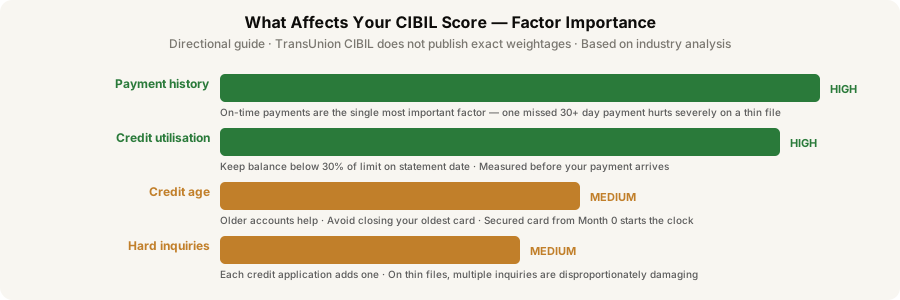 Fig 1: CIBIL score factors ranked by importance. Payment history and utilisation are the two levers that matter most — especially on a thin file where there's little else to buffer a negative event.
Why Building Credit in India Takes Strategy
India's credit system creates a well-known catch-22: you need credit history to get a credit card, but you need a credit card to build credit history. A thin credit file affects three groups: first-time earners (fresh graduates with no credit file — CIBIL "NH" status), NRI returnees (whose Indian CIBIL history has aged out after years abroad), and credit recovery cases (individuals rebuilding after past financial problems).
The solution for all three: a secured credit card against a fixed deposit.
Best Secured Credit Cards in India 2026
| Bank | Minimum FD | Credit Limit | Annual Fee | Issuer |
|---|---|---|---|---|
| SBI Card Unnati | ₹25,000 | 90% of FD | ₹0 (first 4 years) | SBI Card |
| HDFC Bank Secured Card | ₹25,000 | 85% of FD | ₹500 | HDFC Bank |
| Axis Bank Insta Easy | ₹20,000 | 80% of FD | ₹500 | Axis Bank |
| ICICI Bank Coral Secured | ₹20,000 | 85% of FD | ₹500 | ICICI Bank |
| Kotak 811 DreamDifferent | ₹10,000 | 90% of FD | ₹0 | Kotak Mahindra Bank |
SBI Card Unnati — best for zero-fee entry with large FD; no fee for 4 years. HDFC Bank Secured Card — best if you already bank with HDFC Bank; fastest upgrade path to regular cards. Axis Bank Insta Easy — best for existing Axis Bank customers. Kotak 811 DreamDifferent (secured variant) — best for smallest FD minimum (₹10,000); easiest entry point.
Who should NOT get a secured card: Anyone who already has a CIBIL score of 650+ (you can apply directly for the Kotak 811 DreamDifferent Credit Card without locking up FD funds), and anyone needing the FD money in the short term (the FD is locked as collateral until the card is closed or upgraded).
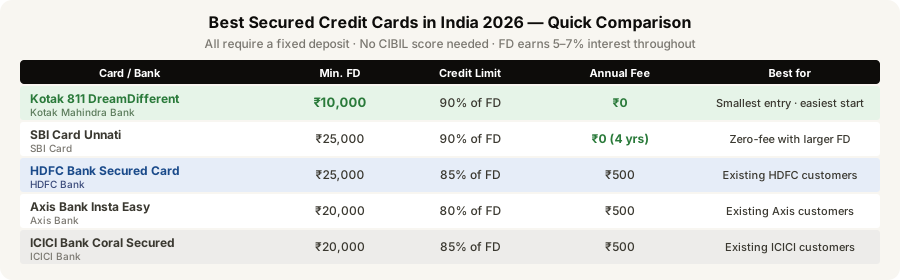 Fig 2: Best secured credit cards in India 2026. Kotak 811 DreamDifferent has the lowest FD requirement (₹10,000). SBI Unnati is the only zero-fee card for the first 4 years. Your existing bank is usually the fastest path to approval.
The 12-Month Plan: NH to 700+ CIBIL
Month 0: Set Up the Foundation
- Open an FD of ₹25,000–₹50,000 at your chosen bank. The FD earns 5–7% p.a. throughout — it's not idle capital.
- Apply for the secured credit card linked to the FD. Approval is typically within 7–10 days with no CIBIL check or income verification.
- Set up NACH autopay for the full statement amount from Day 1. This is the single most important step — it prevents any possibility of a missed payment.
Months 1–12: The Three Non-Negotiable Rules
Rule 1: Use the card, but lightly. Spend ₹3,000–₹6,000/month — about 20–30% of your credit limit. CIBIL needs to see active usage. Zero usage builds no history. Over-usage (above 30%) damages the score.
Rule 2: Pay the FULL balance every month. Not the minimum. The full statement balance. One missed payment here resets 6 months of positive history. Autopay is your safety net.
Rule 3: Never go above 30% utilisation. If your limit is ₹20,000, keep monthly spend below ₹6,000. This is the utilisation sweet spot for CIBIL score building.
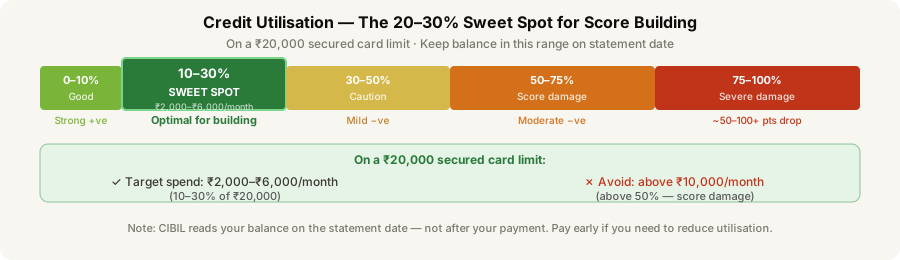 Fig 3: The utilisation sweet spot for credit building. On a ₹20,000 limit, target ₹2,000–₹6,000/month spend. CIBIL reads your balance on the statement date — not after your payment arrives.
The Typical Score Timeline
| Timeline | Typical CIBIL Range | What It Often Unlocks |
|---|---|---|
| Month 0 | NH (No History) | Credit history begins |
| Month 3 | 550–640 | First score generated |
| Month 6 | 630–670 | Kotak 811 DreamDifferent (unsecured) |
| Month 12 | 680–730 | Axis Bank Ace, Amazon Pay ICICI, SBI SimplyCLICK |
| Month 18 | 720–750 | HDFC Regalia Gold territory |
| Month 24 | 740–780 | Most premium cards often accessible |
These are illustrative ranges — individual results vary. Your score depends on utilisation, payment record, hard inquiries, and how your issuer reports to CIBIL.
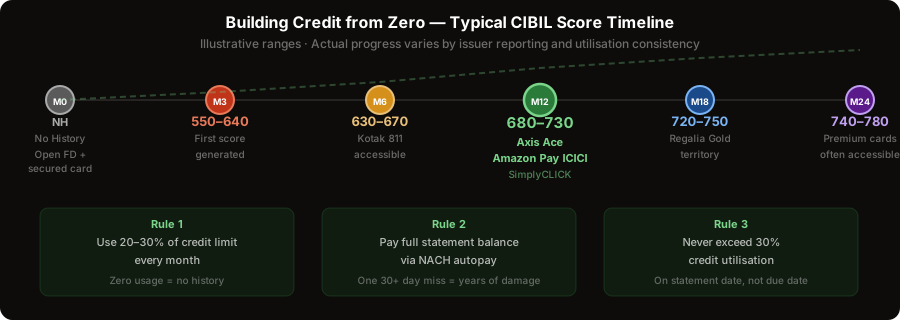 Fig 4: Typical CIBIL score building timeline from NH to 700+. Month 12 is the key milestone — most entry-level regular cards become accessible. The three rules below each phase are the only habits that matter.
Month 12+: Graduating to a Regular Credit Card
With a 700–730 CIBIL score after 12 months:
Option A: Ask your bank to upgrade the secured card. Most banks will convert a secured card to an unsecured regular card after 12 months of clean usage, releasing your FD. Ask specifically: "I'd like to upgrade my secured card to an unsecured card and release my fixed deposit." This preserves your account age — valuable for CIBIL.
Option B: Apply for a new regular card. With 700+ CIBIL, you now qualify for the Axis Bank Ace Credit Card by Axis Bank, the Amazon Pay ICICI Credit Card by ICICI Bank, or SBI SimplyCLICK Credit Card by SBI Card. Apply for one — and keep your secured card open for at least 6 more months to preserve credit history length.
The Authorised User Strategy — A Potential Accelerator
If a parent, spouse, or close family member has a credit card with 5+ years of clean history, being added as an authorised user (add-on cardholder) can accelerate your credit building — but with important caveats specific to India.
Add-on card reporting is inconsistent in India. Some issuers may report add-on card activity to credit bureaus, potentially helping establish credit visibility. Others provide limited or no direct bureau benefit. This is quite different from the US "authorised user" model where full account history typically transfers. Treat this as a possible accelerator — not a reliable shortcut. Always combine it with your own secured card as the primary credit-building vehicle.
The Fastest Path If You Have a Salary Account
If you receive your salary in a bank account, your own bank may offer a pre-approved or low-barrier starter card without requiring an FD or a long credit history.
| Bank | Salary account → Starter card |
|---|---|
| HDFC Bank | MoneyBack+ or Millennia — pre-approved offers frequent for salary account holders |
| ICICI Bank | Coral or Rubyx — entry offers common for salary account customers |
| Axis Bank | Neo or Rewards cards — available to salary account holders with 6+ months of credits |
| Kotak Mahindra Bank | 811 DreamDifferent — available at CIBIL 650+ or as pre-approved for salary customers |
How to check: Log into your bank's net banking or mobile app → look for "Credit Card Offers" or "Pre-approved Offers." If a pre-approved offer exists, it typically involves a soft inquiry (no CIBIL score impact) and faster approval.
Why Many Indians Still Struggle to Build Credit — The Reality Check
Even with a secured card and the right strategy, three things commonly slow or reverse score growth.
1. Irregular income and missed autopay. NACH autopay fails if the linked account doesn't have sufficient balance on the debit date. A payment reported as 30+ days overdue can remain on your TransUnion CIBIL report for years and materially damage your score — particularly severe on a thin file.
2. BNPL apps and short-term consumer loans. Buy Now Pay Later platforms (LazyPay, Simpl, ZestMoney, PayLater) and app-based micro-loans report to credit bureaus inconsistently — and defaults or late payments on them can damage your CIBIL score significantly while providing little positive history when paid on time. Many first-time earners damage their score early through BNPL defaults on small purchases.
3. EMI purchases beyond repayment ability. Consumer EMIs on appliances, phones, and electronics show up as loan accounts on your CIBIL report. Missing even one EMI on a ₹15,000 phone can cost 40–80 CIBIL points and takes months to recover.
The BNPL trap: A ₹500 BNPL default from a forgotten purchase can damage a carefully built credit profile significantly. Before using any BNPL platform, verify whether it reports to CIBIL, and set a reminder for every repayment.
Secured Card vs BNPL — Which Builds Credit Better?
| Factor | Secured Credit Card | BNPL (Buy Now Pay Later) |
|---|---|---|
| CIBIL score building | ✓ Consistent, positive reporting | Mixed — inconsistent across platforms |
| Late payment impact | Significant but manageable | Disproportionately high on thin files |
| Interest risk | Zero if paid in full monthly | High late fees on short cycles |
| Future loan eligibility | ✓ Directly improves | Minimal positive impact |
| Recommended for credit building | ✓ Yes — primary tool | No — use only with caution |
Secured credit cards are categorically better for credit building than BNPL in India. BNPL platforms rarely contribute meaningfully to positive CIBIL history but can damage it quickly through defaults. Use a secured card as your primary credit-building tool and treat BNPL as a convenience payment method, not a credit tool.
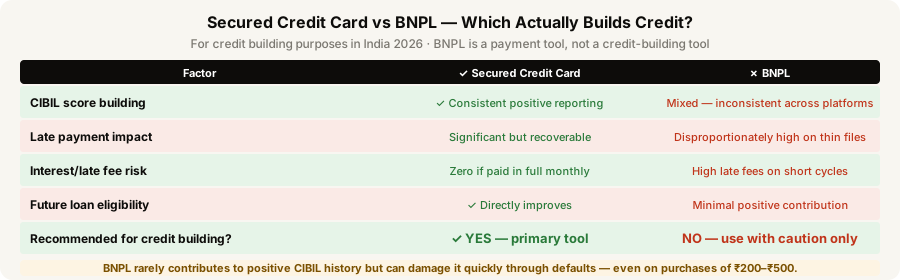 Fig 5: Secured card vs BNPL for credit building. BNPL loses on every dimension that matters for CIBIL score construction. The risk asymmetry — little upside, significant downside — makes BNPL a poor credit-building tool.
Mistakes to Avoid While Building Credit from Zero
Applying for multiple cards while building. Every credit card or loan application triggers a hard inquiry — a formal credit check that temporarily reduces your CIBIL score by 5–15 points per inquiry. On a thin file (NH or below 650), multiple hard inquiries signal financial stress to lenders and can cost 30–60 points cumulatively. Use one secured card for 12 months before applying for anything else.
Maxing out the secured card. Even if you pay in full — a ₹18,000 balance on a ₹20,000 limit reports 90% utilisation to CIBIL. This damages your score even as you're trying to build it.
Closing the secured card the moment you get a regular card. Account age matters. Keep the secured card open for at least 6 months after getting the regular card.
Using the card for cash withdrawals. Cash advances begin accruing interest immediately with no grace period, and typically carry both a flat fee and a high monthly interest rate. They add no positive credit history. Never use a credit card at an ATM.
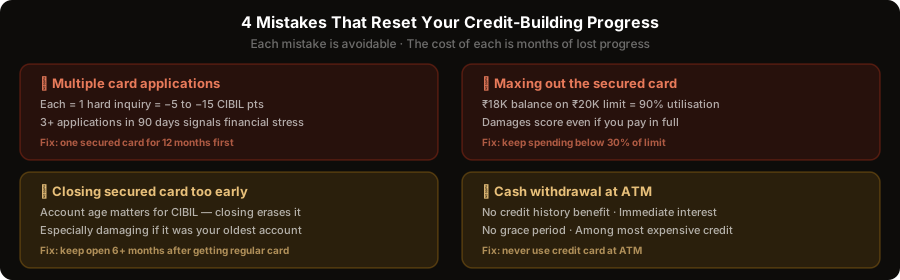 Fig 6: The 4 mistakes that reset credit-building progress. Each is avoidable. The most common among first-time earners: maxing out the secured card thinking that paying in full makes the utilisation irrelevant — it doesn't.
Best Credit Score Habits for Students and First-Time Earners
If you're building credit for the first time, these six habits are all you need: keep utilisation below 30% (set a mental ceiling of ₹3,000–₹6,000/month on a ₹20,000 limit secured card), enable NACH autopay immediately for the full statement amount, avoid BNPL for non-essential purchases (the risk of a small default is disproportionate to the benefit), don't apply for multiple cards at once, check your CIBIL report every 3–6 months (free at cibil.com or through CRED), and build one stable account before chasing rewards (spend 12–18 months on the secured card, then graduate to an Axis Bank Ace or Amazon Pay ICICI for rewards).
The simplest summary for students: Open one FD-backed card, use it lightly for grocery and utility payments, pay in full by autopay every month, and check your score every 6 months. That's it. No tricks needed — just 12 months of boring consistency.
Frequently Asked Questions
Open a fixed deposit of ₹20,000–₹50,000 at HDFC Bank, SBI, Axis Bank, ICICI Bank, or Kotak Mahindra Bank, apply for their secured credit card (no CIBIL required, credit limit = 80–90% of FD value), use it for small regular purchases (20–30% of limit), and pay the full balance every month via autopay. After 12 months, you typically have a CIBIL score of 700–730. If you have a salary account with any of these banks, check for pre-approved starter cards first — they may not require an FD.
Kotak Mahindra Bank's 811 DreamDifferent Credit Card accepts CIBIL 650+. Most mid-tier cards (Axis Bank Ace, SBI SimplyCLICK, Amazon Pay ICICI by ICICI Bank) typically require 700+. Secured cards against FDs have no minimum CIBIL requirement from any of the major banks. Actual approval also depends on income, employment type, and banking relationship.
From NH (no history) status, reaching 750 typically takes 18–24 months of consistent on-time payments and utilisation below 30%. Reaching 700 is achievable in approximately 12 months. These are estimates — actual progress varies by how your bank reports to CIBIL and how consistently you maintain low utilisation.
Yes — through secured credit cards against fixed deposits. SBI Card (Unnati), HDFC Bank, Axis Bank, ICICI Bank, and Kotak Mahindra Bank all offer these with no CIBIL requirement. Your credit limit equals 80–90% of the FD value.
Generally no — BNPL platforms report inconsistently to Indian credit bureaus. Most provide little positive score benefit when repaid on time, but can damage your score significantly through defaults or late payments. A secured credit card is categorically more effective for credit building than BNPL in India.
A hard inquiry is a formal credit check triggered when you apply for a credit card or loan. Each hard inquiry typically reduces your CIBIL score by 5–15 points temporarily. On a thin file (NH or below 650), multiple hard inquiries within a short period are disproportionately damaging — avoid applying for multiple cards simultaneously. Checking your own CIBIL score (soft inquiry) does not affect your score.
If you receive salary in a bank account and have 6+ months of consistent salary credits, your bank may offer a pre-approved starter card without requiring an FD or extensive credit history. HDFC Bank, ICICI Bank, Axis Bank, and Kotak Mahindra Bank all have entry-level cards available to salary account holders. Check the "Pre-approved Offers" section of your bank's app before applying anywhere else.
More from the journal
Credit & Loans