
Credit Card vs Debit Card vs UPI in India 2026: Which Should You Actually Be Using?
Credit card vs UPI vs debit card in India 2026: compare rewards, fraud protection, CIBIL impact, and the best payment strategy for salaried Indians — with realistic earn rate estimates and behavioural caveats.
Priya Nair9 May 202631 min read
Credit card vs debit card vs UPI in India 2026 — when to use each:
- Credit card → Best for disciplined users who pay in full every month: earns 1–5% cashback, builds CIBIL score, 30–51 days free float, fraud doesn't drain your savings
- UPI → Best for peer-to-peer transfers, small merchants, and anywhere the merchant charges a credit card surcharge above your cashback rate; UPI itself typically does not provide direct rewards comparable to credit cards
- Debit card → Best for ATM cash withdrawals, spending control for those rebuilding finances, and merchants who charge card surcharges
Optimal stack for disciplined full-payment users: Credit card for everything possible → UPI for the rest → Debit card for ATMs. At ₹50,000/month spend: this stack earns ₹12,000–₹18,000/year that debit/UPI would deliver as ₹0.
⚠️ Important caveat: Credit cards only outperform debit and UPI if you pay the full statement balance every month. For users who carry balances, miss payments, or tend to overspend when using credit, debit cards and UPI are the safer choice — they limit spending to money you actually have.
TL;DR — which payment method do you need?
If you want… Use Rewards + CIBIL building Credit card Spending control / debt risk = zero Debit card or UPI Fast small payments to anyone UPI Fraud that doesn't drain savings Credit card International travel Credit card Sending money to family/staff UPI You regularly carry balances Debit card or UPI — not credit
The 15-second answer — pick your situation:
Your situation Best default You always pay bills in full Credit card + UPI You overspend easily UPI primary You want maximum rewards Cashback credit card You want zero complexity UPI is enough You travel internationally Credit card dominant You are rebuilding finances Debit card + UPI only You're a student / first earner One secured card + UPI
India's Payment Landscape in 2026
UPI by NPCI, Visa/Mastercard/RuPay credit cards, and debit cards issued by HDFC Bank, SBI, ICICI Bank, and Axis Bank now coexist in most Indian payment flows. India processed over 1,800 crore UPI transactions in March 2026 — the world's largest real-time payment network by volume. Simultaneously, credit card spends crossed ₹2.5 lakh crore monthly for the first time. Each payment method optimises for a different outcome: rewards, convenience, budgeting discipline, fraud protection, or credit building. The right choice depends on one variable more than any other: whether you pay your credit card bill in full every month.
What changed in 2026:
- RuPay credit on UPI expanded — link a RuPay credit card to Google Pay or PhonePe and earn card rewards on UPI transactions, blurring the line between the two
- UPI limits raised — ₹5 lakh per transaction for verified hospital and education payments (up from ₹1 lakh)
- Premium card devaluations accelerated — lounge access, milestone bonuses, and airline partners cut by multiple banks; premium card ROI harder to realise
- Tap-to-pay adoption widened — contactless cards now accepted at most organised retail
What Are Credit Cards, Debit Cards, and UPI? — Quick Definitions
Credit card: Lets you borrow from the bank up to a preset limit and repay later. If paid in full before the due date, no interest is charged and you earn rewards on every purchase. If not paid in full, interest accrues at 36–52% APR. See credit card interest rates explained.
UPI (Unified Payments Interface): India's instant bank-to-bank payment system developed by NPCI that directly debits your bank account in real time. Zero cost for most users. No debt layer. Works via QR code, mobile number, or UPI ID.
Debit card: Directly deducts money from your bank account at payment time. No credit, no rewards on most Indian debit cards, no CIBIL impact. Useful for ATM withdrawals and merchants where credit cards aren't accepted.
Pros and Cons: Credit Card vs Debit Card vs UPI
Credit Card
| Pros | Cons |
|---|---|
| 1–5% cashback or reward points | High interest (36–52% APR) if balance unpaid |
| Builds CIBIL score with every on-time payment | Overspending risk — deferred payment reduces spending pain |
| Fraud doesn't immediately drain your savings | Mental overhead: tracking due dates, categories, redemptions |
| 30–51 days interest-free float | Annual fees on most cards (₹499–₹60,000) |
| Strongest for international travel | Premium rewards require portal-dependent redemption |
UPI
| Pros | Cons |
|---|---|
| Instant, free, zero fees for users | Typically earns zero rewards (some apps offer periodic cashback) |
| Works everywhere — from kirana to airport | No CIBIL score building |
| Zero debt risk — limited to bank balance | No fraud buffer: fraud immediately depletes savings |
| No annual fees | No international use |
| Easiest for P2P: rent, splitting bills, family | Transaction limit: ₹1 lakh per transaction (₹5L for healthcare/education) |
Debit Card
| Pros | Cons |
|---|---|
| Hard spending limit — can't overspend beyond balance | Minimal rewards (0–0.5%) on most Indian debit cards |
| No debt risk | No CIBIL score building |
| Works for NACH autopay mandates | Fraud depletes savings immediately (same as UPI) |
| Useful for ATM cash | Card infrastructure fees can apply |
Complete Comparison: Credit Card vs Debit Card vs UPI
| Factor | Credit Card | Debit Card | UPI |
|---|---|---|---|
| Rewards/Cashback | High (1–5%) | Very low (0–0.5%) | Typically zero; some apps offer periodic cashback/coupons |
| CIBIL Score Impact | Positive (on-time payment) | None | None |
| Fraud Protection | Strong — RBI zero liability | Moderate | Moderate |
| Interest-Free Float | 30–51 days | None | None |
| Account Money at Risk | No — bank's money until payment | Yes — your savings | Yes — your savings |
| International Use | Excellent | Limited, high charges | Not available |
| Merchant Acceptance | Wide | Wide | Rapidly growing |
| Transaction Limit | High (card limit) | Moderate (daily limits) | ₹1L/transaction standard |
| Annual Cost | ₹0–₹12,500 | ₹0–₹750 | Free |
| Credit Building | Yes | No | No |
| Best For | Routine purchases (disciplined full-payment users) | ATM cash, spending control, surcharge avoidance | P2P payments, small merchants |
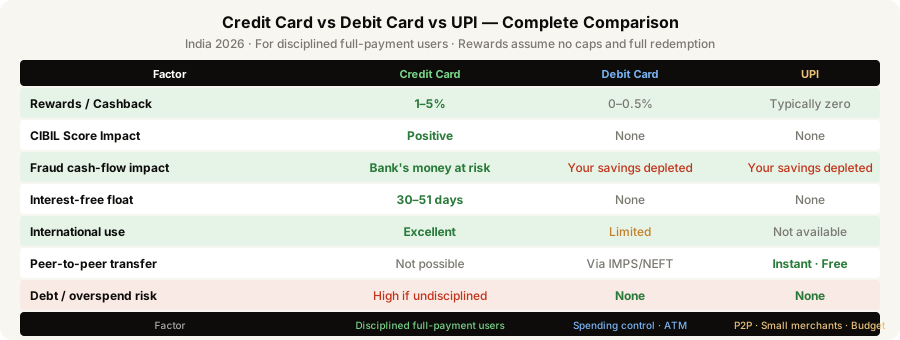 Fig 1: Complete three-way comparison. Credit cards win on rewards, CIBIL, and fraud buffer — but only for disciplined full-payment users. UPI wins on P2P and debt risk. Debit wins on spending control.
Why Credit Cards Win for Most Transactions
For disciplined users who pay in full, credit cards are the highest-returning payment instrument available to Indian consumers.
1. You earn on every rupee — the others give you nothing
A ₹10,000 grocery bill paid by debit card earns ₹0. Paid by UPI earns ₹0. Paid by the Axis Bank Ace Credit Card by Axis Bank earns ₹200 cashback (2% flat).
On ₹50,000/month total spend — entirely routine, nothing exotic — the difference between credit card and debit/UPI:
- Credit card (2% flat): ₹12,000/year
- Debit card or UPI: ₹0/year
That ₹12,000/year is a weekend trip to Coorg, a smartphone upgrade fund, or 12 months of Netflix and Spotify combined. The money is identical either way — the payment instrument is the only variable.
Reward variability note: Actual rewards depend on your spend categories, merchant MCC coding, cashback caps, annual fees, and whether you redeem efficiently. The ₹12,000/year figure assumes 2% flat cashback on all eligible spend with no caps — some categories may earn less. See best cashback credit cards in India 2026 for card-specific earn rates.
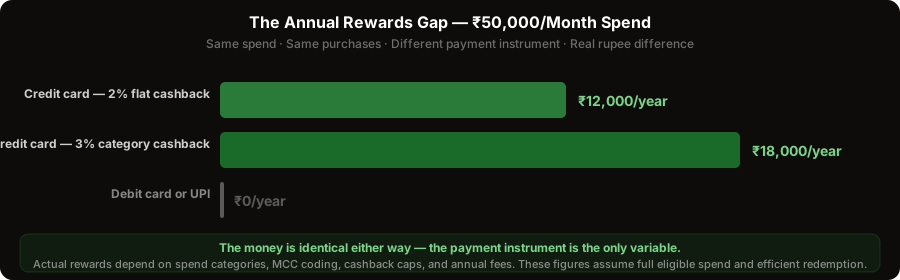 Fig 2: The annual rewards gap at ₹50,000/month spend. ₹12,000–₹18,000/year is real — but depends on eligible categories, no caps hit, and efficient redemption. Actual earnings vary.
2. Fraud protection: your money vs the bank's money
The practical advantage of credit cards in fraud situations is not necessarily stronger legal protection — RBI liability rules apply broadly across electronic payments. The real difference is mechanical:
- Credit card fraud: The bank's money is used. Your savings account is untouched while the dispute is resolved (takes 10–90 days). You can continue paying rent, EMIs, and essentials normally.
- Debit card or UPI fraud: Your savings account is immediately depleted. Recovery takes 10–90 days during which you don't have that money to pay for essentials.
Same legal rights. Dramatically different cash-flow impact during the dispute period.
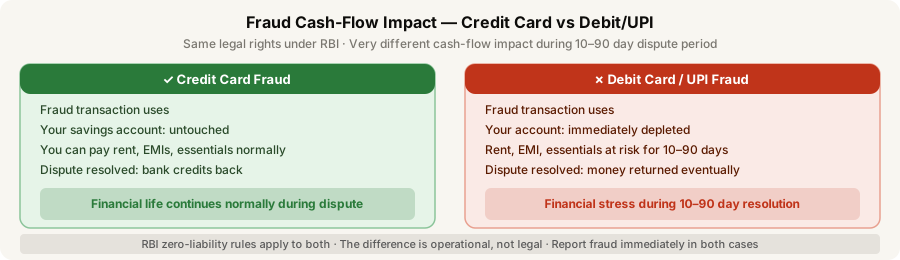 Fig 3: Fraud cash-flow impact. The legal protection is equivalent across payment types — the operational difference is whose money is at risk while the dispute resolves.
3. 30–51 days of completely free borrowing
Every credit card purchase gives 30–51 days before payment is due — at zero interest. That money can sit in your savings account earning 3–7% interest until the due date.
Important: The float only benefits you if you already have the money available and pay the full bill every month. If you're using the float to fund spending you couldn't otherwise afford, the 36–52% APR on unpaid balances will rapidly erase any reward benefit. See how credit card interest compounds.
4. Every payment builds your CIBIL score
Debit card and UPI payments are invisible to CIBIL — they contribute nothing to your credit history. Every on-time credit card payment contributes positively. Over 3–5 years of consistent credit card usage, responsible credit behaviour can materially improve your CIBIL score compared to relying only on debit or UPI — which do not report repayment behaviour to credit bureaus at all. The long-term impact on loan interest rates and credit access is significant.
CardGenius estimate: An average salaried Indian using only UPI and debit instead of a 2% cashback card on ₹30,000/month eligible spend may be leaving ₹7,000–₹9,000/year unclaimed — real money that requires no additional spending, only a change in payment instrument.
When UPI Beats Credit Cards
UPI is not a fallback — for P2P payments, small merchants, and users managing tight budgets, UPI is genuinely the better primary payment method.
Why UPI became India's default payment method
UPI processed over 1,800 crore transactions in March 2026 alone — not because Indians lack credit card access, but because UPI genuinely wins on several dimensions:
- Zero MDR for most merchants — UPI has no payment gateway fee for merchants below certain thresholds, which is why small shops prefer it. Some merchants pass on card acceptance costs through surcharges or pricing differences — calculate whether the surcharge exceeds your cashback rate before choosing.
- Near-universal QR acceptance — a vegetable vendor, autorickshaw, or temple donation box now has a QR code. Card infrastructure is unlikely to reach this scale economically, particularly for low-ticket merchants.
- Instant settlement — UPI settles in seconds. Card transactions can take 1–3 days for merchant settlement.
- No debt layer — spending is tied directly to your bank balance. For users managing tight budgets, this hard constraint is genuinely useful.
- Zero friction for P2P — splitting a bill, paying rent, transferring to family — UPI is faster and simpler than any card-based alternative.
- Easier budgeting — because UPI debits your account immediately, your bank balance reflects reality in real time. Credit cards introduce a 30–51 day lag that makes spending harder to track.
The honest position: UPI is not a compromise for situations where cards don't work. For many Indians — particularly those managing variable incomes or spending discipline — UPI is the better primary payment method. Credit cards add value on top of UPI for users who can manage the discipline requirements.
Peer-to-peer payments
Sending money to friends, family, or domestic staff — UPI is the correct tool. Credit cards cannot do P2P transfers.
Small merchants without card acceptance
Kirana stores, autorickshaws, vegetable vendors, street food — UPI serves merchants that credit card infrastructure cannot economically reach.
When the merchant adds a credit card surcharge
Many small businesses in India pass on the ~1.5–2% payment gateway fee as a surcharge. Calculate: if the surcharge exceeds your cashback rate, UPI wins.
Example: Merchant charges 2% surcharge on credit card. Your card earns 2% cashback. Net benefit = zero — use UPI. If your card earns 5% (Axis Bank Ace on bills), you're still ahead by 3% even with the surcharge.
Credit Card on UPI — The Best of Both Worlds
RuPay credit cards linked to UPI apps earn credit card rewards on UPI transactions — combining UPI's reach with credit card rewards.
The RBI and NPCI have been enabling credit card on UPI, allowing RuPay credit cards to be linked to Google Pay, PhonePe, and Paytm for merchant payments.
How it works:
- Link a RuPay credit card (not Visa/Mastercard) to a supported UPI app
- Pay at any UPI merchant QR code — the charge goes to your credit card, not your bank account
- You earn credit card reward points on the transaction
- Standard credit card billing and repayment applies
Banks supporting this as of April 2026: HDFC Bank, SBI, ICICI Bank, Axis Bank, Kotak Mahindra Bank (expanding — verify your bank's current status in their app)
Current limitations:
- Only RuPay credit cards — Visa and Mastercard credit cards do not support UPI credit
- Merchant must accept UPI (most do); not available for P2P transfers
- Reward earn rates are typically the same as in-store card rates — no bonus for UPI use
Best use case: If you hold a RuPay credit card, link it immediately. You gain credit card rewards on every merchant UPI payment that previously earned zero — with no change to your payment flow.
Myth vs Reality — Common Payment Method Misconceptions
| Myth | Reality |
|---|---|
| UPI will make credit cards obsolete | UPI and credit cards solve different problems — UPI wins for P2P and small merchants, credit cards win for rewards, CIBIL, and fraud protection |
| Debit cards are safer than credit cards | Credit cards usually protect your savings account better — fraud uses the bank's money, not yours |
| Rewards are "free money" | Rewards disappear instantly if you carry a balance — one month of interest at 3.5% erases 3+ months of 2% cashback |
| Premium credit cards are worth it for most people | For most Indians spending ₹50,000/month, a ₹0–₹499/year cashback card outperforms a ₹12,500 premium card |
| UPI is completely free | UPI is free for users but not for large merchants — some pass gateway costs on as surcharges |
| Credit card rewards are guaranteed | Reward rates, earn categories, and redemption values can all change mid-contract |
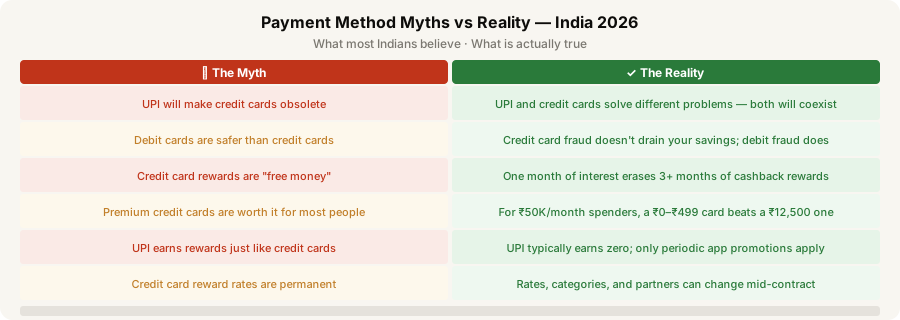 Fig 6: The six most common payment method myths in India. The rewards-as-free-money myth is the most financially damaging: one month of revolving interest erases three months of cashback gains.
When Debit Cards Make Sense
Debit cards are the right default for users who carry balances, overspend on credit, or need a hard limit on their spending.
Debit cards are the right tool in specific situations — and the right default for users who aren't confident they'll pay their credit card in full every month:
- ATM cash withdrawals — credit card cash advances begin accruing interest immediately with no grace period; debit is the correct tool for cash
- Spending control — a debit card's hard limit on available funds is a genuine protection for users prone to overspending
- Merchants charging a surcharge above your credit card's cashback rate
- NACH mandate setup — some recurring payments require a debit card link
- Users rebuilding from debt — avoiding credit card risk while restoring financial habits
The frame that matters: Debit cards are the right default for users who don't pay in full every month. Credit cards are the right tool for users who do. Neither is universally superior — the answer depends on your behaviour, not your income.
The Optimal Payment Stack for India 2026
For disciplined salaried users who pay in full every month, CardGenius recommends the 70-20-10 payment framework:
The 70-20-10 Payment Framework
- 70% of spend → credit card (eligible purchases: groceries, dining, online, fuel, subscriptions)
- 20% of spend → UPI (rent, P2P transfers, small merchants, surcharge scenarios)
- 10% → debit card or cash (ATM withdrawals, situations where cards aren't accepted)
At ₹50,000/month total spend, this stack earns ₹7,200–₹10,800/year in credit card rewards on the ~₹35,000 in card-eligible spend — with zero debt risk if autopay is enabled for the full statement amount.
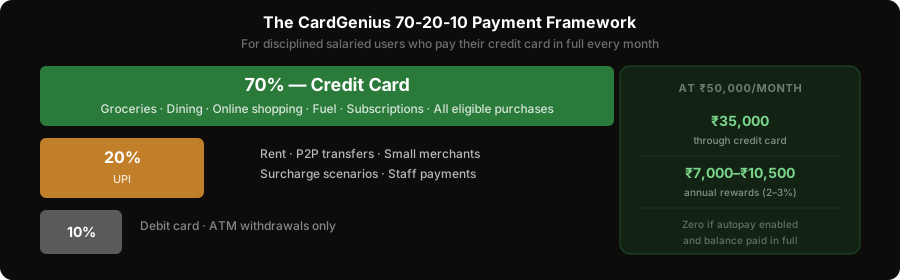 Fig 7: The CardGenius 70-20-10 Payment Framework. At ₹50,000/month, routing 70% through a 2–3% cashback card earns ₹7,000–₹10,500/year. The 30% that must go to UPI (rent, P2P) earns nothing — plan reward expectations around the 70%, not the full 100%.
Tier 1 — Credit card for all possible purchases
→ Axis Bank Ace Credit Card (Axis Bank): bills, dining, delivery, offline daily
→ Amazon Pay ICICI Credit Card (ICICI Bank) or SBI SimplyCLICK (SBI Card): online shopping
→ Annual earnings at ₹50,000/month: ₹12,000–₹18,000

Tier 2 — UPI for what credit cards can't cover
→ P2P transfers (family, staff, friends)
→ Small merchants who don't accept cards
→ Merchants adding surcharge above your card's cashback rate
→ Annual earnings: ₹0

Tier 3 — Debit card for ATM cash only
→ Cash withdrawals only
→ Annual cost: ₹0–₹750 (debit card annual fee)
Net annual gain from optimising the payment stack at ₹50,000/month: ₹12,000–₹18,000 in credit card rewards achievable for users whose spending aligns with card reward categories and cashback caps — previously ₹0 from debit/UPI.
Best Payment Stack by Monthly Income
| Monthly income | Recommended stack | Why |
|---|---|---|
| Below ₹25,000 | UPI + debit primary | Credit card debt risk outweighs reward benefit at tight margins |
| ₹25,000–₹50,000 | Entry cashback card + UPI | Axis Bank Ace or Amazon Pay ICICI — zero fee, 2–5% cashback, manageable |
| ₹50,000–₹1,00,000 | Cashback card primary + UPI backup | Full reward optimisation viable; build CIBIL for future premium eligibility |
| ₹1,00,000+ | One primary card + UPI for gaps | One strong travel or cashback card covers most spend; UPI for P2P and small merchants — most ₹1L earners don't benefit from multi-card complexity |
Important: Income determines eligibility — not the optimal method. A ₹1 lakh earner who carries balances is better served by UPI than by a premium credit card. A ₹25,000 earner who is disciplined can extract real value from a zero-fee cashback card.
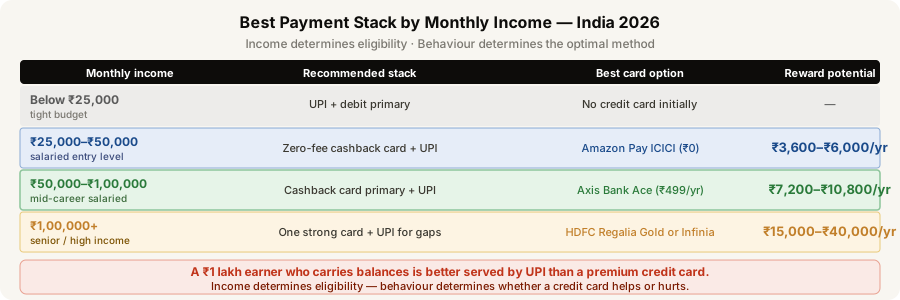 Fig 8: Best payment stack by monthly income. The ₹50,000–₹1,00,000 band delivers the best reward-to-complexity ratio — a single ₹499/year Axis Ace card earns ₹7,200–₹10,800/year with minimal management overhead.
A Real Monthly Example — ₹50,000 Salaried Professional
This is how the payment stack plays out in a typical month for a salaried professional in Bengaluru spending ₹50,000/month:
| Spend category | Amount | Payment method | Why |
|---|---|---|---|
| Groceries (BigBasket/Dunzo) | ₹8,000 | Credit card | 5% on Ace; 2% on Amazon Pay ICICI |
| Rent | ₹15,000 | UPI | Landlord doesn't accept cards |
| Dining + delivery (Swiggy/Zomato) | ₹6,000 | Credit card | 4–5% cashback on dining cards |
| Fuel | ₹3,000 | Credit card | 1% surcharge waiver on most cards |
| Subscriptions (Netflix/Spotify) | ₹1,500 | Credit card | Auto-debit earns points |
| Domestic staff / utilities | ₹4,000 | UPI | P2P and bill payments |
| Kirana / local merchants | ₹3,500 | UPI | No card terminals |
| Miscellaneous online | ₹9,000 | Credit card | Earns on eligible categories |
Monthly rewards earned: ~₹600–₹900 on credit card spend of ~₹27,500 Annual value: ~₹7,200–₹10,800 — real, worth capturing, not transformative
CardGenius analysis: Most urban Indian professionals can realistically route only 50–65% of total monthly spend through reward-earning card categories — the rest goes to UPI for rent, P2P, and small merchants. Headlines that assume 100% credit card spend overstate achievable rewards by 40–50%. See best cashback credit cards for every spend profile in India 2026 for realistic card-specific earn rates.
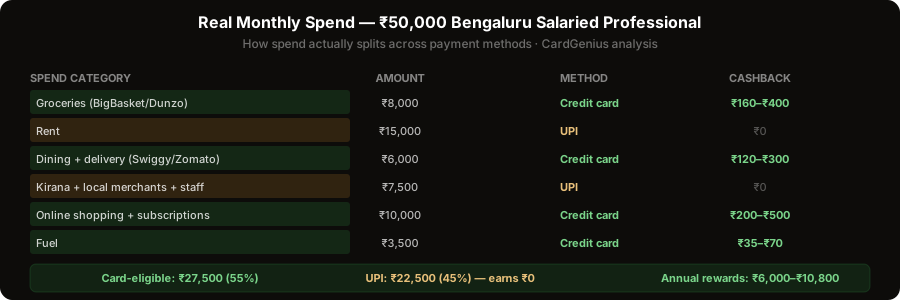 Fig 9: Real monthly spend breakdown. 55% routes through credit card (₹27,500), earning ₹6,000–₹10,800/year. 45% goes to UPI (₹22,500 — rent, local merchants, P2P) earning zero. This is why rewards calculators assuming 100% card spend overstate results by nearly half.
When You Should Avoid Credit Cards
Credit cards only outperform debit cards and UPI under one condition: you pay the full statement balance every month without exception.
If you frequently carry a balance, miss payments, or use credit to fund spending beyond your means, credit cards become the most expensive payment method available:
- A ₹50,000 unpaid credit card balance at 3–4% monthly interest costs ₹1,500–₹2,000 in interest every month — wiping out years of cashback rewards within a few cycles
- Paying only the "minimum due" avoids late fees but keeps users in revolving debt — full interest continues accruing on the remaining balance, making escape from debt progressively harder
- One missed 30+ day payment can reduce your CIBIL score materially and remain on your report for years
- EMI traps — converting large purchases to EMIs on a credit card typically carries 15–24% effective annual interest on top of the original price
The honest answer: For users who regularly carry balances or miss payments, debit cards and UPI are the better payment method. They limit you to money you actually have. The ₹12,000/year reward opportunity only exists if you're not paying ₹18,000/year in interest to access it. See how credit card interest compounds at 42% APR for the full mechanics.
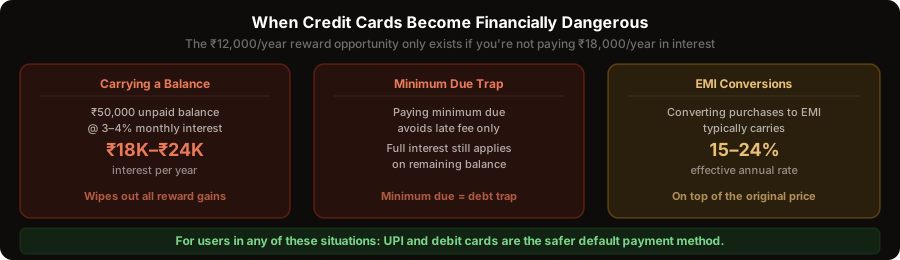 Fig 4: When credit cards become financially dangerous. Any of these three patterns eliminates the reward benefit entirely. For users in these situations, UPI and debit cards are the safer default.
Best Payment Method by Situation — Quick Reference
| Situation | Best method | Why |
|---|---|---|
| Grocery shopping | Credit card | 2–5% cashback on daily spend |
| Rent payment | UPI | Most landlords don't accept cards |
| Small merchants (kirana, auto) | UPI | No card infrastructure; faster |
| Restaurant dining | Credit card | 3–4% cashback on dining cards |
| International travel | Credit card | Low forex markup; rewards; fraud protection |
| ATM cash | Debit card | Credit cash advance = immediate interest |
| Sending money to family/staff | UPI | P2P — credit cards cannot do this |
| Merchant charging card surcharge | UPI or calculate break-even | Surcharge > cashback rate → UPI wins |
| Budgeting / overspending risk | Debit card | Hard spending limit on available funds |
| Paying friends / splitting bills | UPI | Instant, free, no friction |
| Building CIBIL score | Credit card | Only payment method that reports to bureaus |
Best Payment Stack by User Type
| User type | Best default | Why |
|---|---|---|
| Student | UPI + beginner credit card (secured or entry-level) | Build CIBIL from scratch while keeping spending discipline |
| Salaried disciplined spender | Credit card primary + UPI for gaps | Maximum rewards + CIBIL building + fraud buffer |
| Freelancer / irregular income | UPI + debit primary | Spending stays tied to actual cash flow |
| Recovering from debt | Debit card + UPI only | No credit risk; rebuild habits before reintroducing credit |
| Frequent traveller | Credit card dominant | Rewards on every spend, low forex, lounge access |
| Risk-averse / prefers simplicity | UPI for daily, debit for ATM | Zero debt risk, zero management overhead |
The right payment stack is determined by your behaviour — not your income. A ₹10 lakh earner who regularly carries balances is better served by UPI than by a premium credit card.
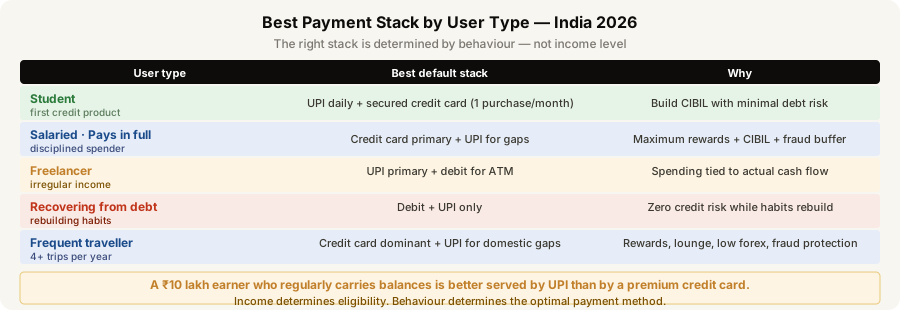 Fig 5: Best payment stack by user type. Income determines eligibility. Behaviour determines the optimal stack. The recovering-from-debt row is the most important: debit and UPI only, no exceptions.
If You're Confused — Start Here
If this article has given you more questions than answers, this is all you need:
- One UPI app (Google Pay or PhonePe — linked to your primary bank account)
- One zero-fee cashback credit card — Axis Bank Ace (₹499/year, 2% flat) or Amazon Pay ICICI (₹0/year, 5% on Amazon, 2% elsewhere)
- NACH autopay enabled for the full statement amount — see how to avoid credit card interest
- No premium cards until you spend ₹1.5L+/month and actively track spend — see premium cards honest ROI
- No EMI conversions unless genuinely unavoidable — see 10 credit card mistakes to avoid
That setup earns ₹6,000–₹12,000/year at ₹50,000/month spend with zero management overhead. The optimisation game can come later — or not at all.
Final Recommendation — The One-Paragraph Summary
If you pay in full every month: Use credit cards as your primary payment method for all purchases where cards are accepted without surcharge — then UPI for everything else. The rewards, CIBIL building, and fraud buffer are real and worth capturing.
If you carry balances or overspend on credit: Use UPI and debit as your primary methods. The interest on unpaid credit card balances eliminates rewards faster than they accumulate. Simplicity and spending discipline are worth more than optimisation.
If you're building CIBIL from zero: Use one low-limit secured credit card carefully — pay it in full every month, keep utilisation below 30%, and use UPI for everything else. See how to build credit from zero in India.
If you value simplicity above all: UPI is enough for most Indians for most transactions. The credit card optimisation game is optional — not a financial obligation.
People Also Ask — Direct Answers
Is UPI replacing credit cards in India?
No — they serve different purposes. UPI dominates low-ticket P2P and small merchant payments where card infrastructure is absent. Credit cards dominate at organised retail and online commerce where rewards and fraud protection matter. RuPay credit cards on UPI increasingly bridge the two. Most urban Indian professionals use both in a complementary stack.
Why do Indians still use credit cards if UPI is free?
Because credit cards earn 1–5% cashback on every purchase while UPI typically earns zero. At ₹50,000/month spend, the difference is ₹7,000–₹12,000/year. Additionally, credit cards build CIBIL score, provide a fraud buffer where the bank's money is at risk rather than your savings, and offer 30–51 days interest-free float. UPI's advantages are speed, universality, and zero debt risk — not rewards.
Can UPI build a CIBIL score?
No. UPI transactions do not report to TransUnion CIBIL, Experian, or any Indian credit bureau. Only credit products — credit cards, loans, EMIs — build credit history. If building CIBIL score is a goal, you need at least one credit card used responsibly. See how to build CIBIL score from zero.
Is a debit card safer than a credit card in India?
Both carry similar legal protections under RBI regulations. The practical difference is operational: credit card fraud uses the bank's money, so your savings account stays intact during the 10–90 day dispute resolution period. Debit card and UPI fraud immediately depletes your savings. Same rights, very different cash-flow impact.
What happens if I don't pay my credit card bill in full?
Interest accrues at 36–52% APR on the unpaid balance from the statement date — there is no grace period on any carry-forward amount. Additionally, your grace period on new purchases is also suspended until the balance is cleared. On ₹50,000 unpaid balance, monthly interest is ₹1,500–₹2,000. One cycle of partial payment can take months to recover from. See credit card interest rates India 2026.
Frequently Asked Questions
Credit cards are better for disciplined users who pay in full — they earn 1–5% cashback and build CIBIL score while UPI typically earns nothing. UPI is better for P2P payments, small merchants, and users who carry balances or need spending control. If you carry balances, UPI is safer — it limits spending to money you have. See best cashback credit cards for every spend profile.
Credit cards are better for disciplined full-payment users — rewards, CIBIL building, and fraud that doesn't drain savings. Debit cards are better for users prone to overspending or carrying balances — the hard spending limit is a genuine protection. Use debit cards for ATM withdrawals regardless.
Credit cards become harmful when you carry a balance — a ₹50,000 unpaid balance at 3–4% monthly interest costs ₹18,000–₹24,000/year, far exceeding any reward benefit. See credit card interest rates India 2026.
Credit card on UPI lets you link a RuPay credit card to Google Pay or PhonePe to earn card rewards on UPI merchant payments. As of April 2026, available for RuPay credit cards from major banks. Visa and Mastercard credit cards do not currently support UPI credit linking.
₹1 lakh per standard UPI transaction. ₹5 lakh for verified hospital and education payments per NPCI rules. Individual banks may cap total daily UPI outflow at ₹1–₹5 lakh depending on account type.
Both have similar RBI legal protections. Credit cards offer better cash-flow protection: fraud uses the bank's money, so your savings stay intact during the 10–90 day dispute period. UPI fraud immediately depletes your balance — same legal rights, very different financial impact while the dispute resolves.
No — UPI transactions do not report to any Indian credit bureau. Only credit products (credit cards, loans, EMIs) build credit history. If building CIBIL score is a goal, you need at least one credit card used responsibly. See beginner CIBIL building guide.
Yes, carefully. One secured FD-backed card or a zero-fee entry card (Axis Ace, Amazon Pay ICICI) used for one or two monthly purchases and paid in full via autopay is an excellent way to start building CIBIL. Avoid premium cards, EMI conversions, and multiple cards. See how to avoid credit card debt India.
Also read:
- Best credit cards for your spending profile in India 2026 — cashback, rewards, and travel
- How credit card interest compounds at 42% APR — and when to avoid credit cards entirely
- How to build credit from zero in India — the complete CIBIL guide
- 10 credit card mistakes that destroy Indian finances — with the real cost of each
More from the journal
Credit & Loans