
The Ultimate Credit Card Glossary 2026: 50 Terms Every Indian Cardholder Must Know
The ultimate credit card glossary for India 2026 — 50 essential terms explained in plain English with India-specific context. From APR to zero liability, understand every term on your credit card statement.
Priya Nair9 May 202625 min read
10 most important credit card terms every Indian must know:
Term What it means in plain language APR 36–52% annual interest if you carry a balance — avoid entirely by paying in full Grace Period 30–51 days of free borrowing — only if you paid last month's bill in full Minimum Due The trap payment (5%) — always pay the full statement balance instead Credit Utilisation % of your credit limit in use — keep below 30% at all times CIBIL Score Your creditworthiness score 300–900 — aim for 750+ Hard Inquiry Score hit from credit application: −5 to −15 CIBIL points Cash Advance ATM withdrawal on credit card — 78%+ annualised, never use Zero Liability Full fraud refund if reported within 3 working days Statement Balance Total owed for the billing cycle — pay this, not the minimum Forex Markup 1.5–3.5% charged on international transactions — choose a low-forex card for travel
Understanding credit card terminology isn't optional — it directly affects how much you pay, how much you earn, and what rights you have. Banks write terms and conditions in financial jargon that benefits them when you don't understand it. This glossary levels the field.
All terms are defined in plain language with India-specific context and real numbers.
⚠️ Interest rates, cashback structures, card benefits, and reward values change frequently. Always verify current MITC on the issuer's official website before applying for any card. This glossary reflects terms as of April 2026.
Jump to: A · B · C · D · E · F · G–H · I–J · K–L · M · N–O · P–R · S · T–Z
How we define these terms: All definitions in this glossary are based on: RBI circulars and master directions (including the Credit Card and Debit Card guidelines 2022), issuer MITC documents, TransUnion CIBIL's published score guidance, NPCI documentation, and publicly disclosed bank fee schedules. Where bank-specific terms vary, we note the range rather than citing a single issuer.
The 5 Most Dangerous Credit Card Terms — Understand These First
| Term | Why it's dangerous | What to do |
|---|---|---|
| Minimum Due | Paying only 5% keeps you in revolving debt indefinitely — full interest accrues on the rest | Always pay the full statement balance |
| Cash Advance | No grace period, immediate interest + 2.5–3% fee = 78%+ annualised cost | Never — use a personal loan or debit instead |
| Dynamic Currency Conversion | Hidden forex markup charged when paying in INR abroad — you pay twice | Always choose to pay in local currency |
| Revolving Credit | Any unpaid balance triggers APR at 36–52% from the statement date | Pay in full every month — no exceptions |
| Overlimit Facility | Extra fee + utilisation spike + potential CIBIL damage | Keep spend below 80% of limit at all times |
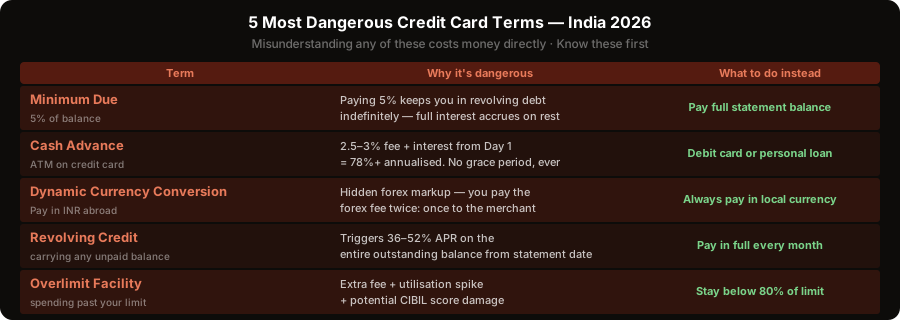 Fig 1: The 5 most financially dangerous credit card terms. Misunderstanding any one of these can cost thousands of rupees. The minimum due trap is the most common; DCC is the most invisible.
Quick Reference: The 10 Most Important Terms
| Term | Plain English Summary | Real Impact |
|---|---|---|
| APR | Annual interest rate if you carry a balance — 36–52% in India | Avoid entirely — pay full balance |
| Grace Period | 30–51 days of free borrowing | Only if previous month paid in full |
| Minimum Due | Bank's trap payment — 5% of balance | Always pay full balance instead |
| Credit Utilisation | % of credit limit in use | Keep below 30% — affects 30% of CIBIL |
| CIBIL Score | Your creditworthiness score 300–900 | Aim for 750+ |
| Hard Inquiry | CIBIL hit from credit application | −5 to −15 points — space 3–6 months |
| Cash Advance | ATM cash on credit card | 78%+ annualised — never use |
| Zero Liability | Full fraud refund within 3 days | Report immediately — don't wait |
| Statement Balance | Total amount due on your statement | Pay this, not the minimum |
| Forex Markup | % charged on international transactions | Choose 0% card for international travel |
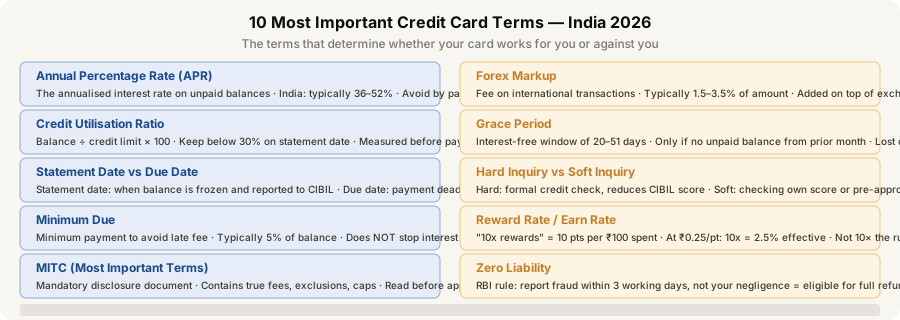 Fig 1: The 10 most important credit card terms — plain language definitions with real-world impact. These terms appear on every credit card statement and determine whether the card works for you or against you.
A
Add-on Card (Supplementary Card) A credit card issued to a family member (spouse, parent, child above 18) on the primary cardholder's account. The add-on card shares the primary card's credit limit. All spending is billed to the primary cardholder who is liable for all payments. Some Indian lenders may reflect add-on card relationships in bureau records, but reporting is inconsistent across issuers and bureaus — this should not be relied upon as a primary credit-building strategy. See how to build credit from zero in India for reliable methods.
Available Credit Your credit limit minus your current balance. If your limit is ₹1,00,000 and you've spent ₹30,000, your available credit is ₹70,000. This is what you can still spend before the card is declined. Monitoring this helps keep utilisation in check. Banks may temporarily reduce available credit during fraud investigations.
Annual Fee The yearly charge for holding a credit card. Ranges from ₹0 (several zero-fee entry cards) to ₹60,000+ (ultra-premium cards). Many cards waive the annual fee upon meeting a minimum annual spend threshold — this waiver condition is in the MITC and must be checked before applying. See best credit cards by annual fee tier.
Annual Percentage Rate (APR) The annualised interest rate charged when you carry unpaid credit card debt.
In India: Typically 36–52.8% per annum (3.0–4.4% per month) — among the highest mainstream borrowing rates available to consumers.
In simple words: ₹50,000 unpaid for 12 months at 42% APR = approximately ₹21,000 in interest. The only complete defence: pay the full statement balance every month. See how 42% APR compounds on unpaid balances.
Authorised User See Add-on Card. Being added as an authorised user (add-on cardholder) on a family member's credit card account may help establish credit visibility with some Indian lenders — but bureau reporting for add-on cardholders is inconsistent in India and differs from the US model where full history typically transfers. Treat as a potential supplementary step, not a guaranteed credit-building shortcut.
Auto-Debit (NACH Mandate) An automated payment instruction linked to your bank account. Can be set for minimum due, fixed amount, or full statement amount. Setting NACH autopay for the full statement amount is the single most important credit card habit — it makes missing a payment essentially impossible.
B
Balance Transfer Moving outstanding credit card debt to another card (lower interest) or converting to a personal loan (12–18% APR). Personal loan balance transfer cuts interest costs by 50–70% vs credit card APR of 36–52%. Contact your bank's customer care and ask for "credit card outstanding balance to personal loan transfer."
Billing Cycle The 30–31 day period during which credit card transactions are tracked before a statement is generated. The specific dates vary by card (e.g., 1st–31st, or 15th–14th of next month).
Billing Date (Statement Date) The date each month when your bank generates the monthly credit card statement. Your credit utilisation is reported to CIBIL on this date — before you make payment. This is why making a mid-cycle payment before the billing date reduces your reported utilisation.
C
Card Network The payment infrastructure that connects banks, merchants, and cardholders globally. In India: Visa, Mastercard, RuPay (domestic, by NPCI), and American Express. The network determines: where the card is accepted, which travel benefits apply, and (for RuPay) whether UPI credit linking is available. For international travel, Visa and Mastercard have the widest global acceptance. For domestic use, RuPay is fully accepted and offers UPI credit card integration.
Chargeback A dispute mechanism where you formally ask your bank to reverse a credit card charge — for unauthorized transactions, merchant non-delivery, or billing errors. Different from fraud reporting: chargebacks also cover authorized transactions where a merchant failed to deliver as promised. Initiate through your bank's app or customer care within the specified window (typically 120 days). Bank investigates and, if upheld, reverses the charge. See credit card fraud and disputes explained.
Contactless / Tap-to-Pay Technology that allows payment by tapping or hovering the card over a point-of-sale terminal (NFC-enabled). In India, RBI mandates PIN entry for contactless transactions above ₹5,000 — below this amount, the card taps and pays without PIN. Contactless fraud risk is very low given proximity requirements (within 4cm). Set a contactless limit in your bank's card controls if you want additional protection.
Cash Advance Withdrawing cash from an ATM using your credit card. Charges: 2.5–3% cash advance fee (minimum ₹300–₹500) + full APR interest from Day 1 with no grace period = 78%+ annualised effective cost. One of the worst financial decisions available. Never use except in genuine emergencies.
Cash Advance Fee 2.5–3% of the amount withdrawn (minimum ₹300–₹500), charged immediately on transaction. Separate from and in addition to the ongoing daily interest.
CIBIL Score A 3-digit number from 300–900 generated by CIBIL TransUnion measuring your creditworthiness. India's most widely used credit score. Banks from HDFC Bank to Kotak Mahindra Bank pull this score for every credit card and loan application. Target: 750+. The five score factors: payment history (35%), credit utilisation (30%), credit age (15%), credit mix (10%), new inquiries (10%).
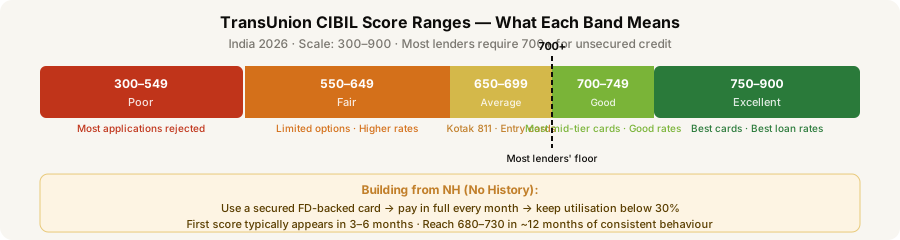 Fig 2: TransUnion CIBIL score ranges and what each unlocks. The 700 threshold is where most mid-tier credit cards and competitive loan rates become accessible. Building from NH to 680–730 typically takes 12 months of consistent secured card usage.
CIBIL Report A detailed document from CIBIL TransUnion listing all your credit accounts, payment history, outstanding balances, and credit inquiries associated with your PAN card. One free report per year at cibil.com. Check annually — errors (incorrect late payment records, accounts that aren't yours) can suppress your score by 50–150 points.
Credit Limit The maximum outstanding balance your bank permits. If your limit is ₹1,00,000, spending more is declined (or triggers an over-limit fee). Request a credit limit increase — it's typically a soft inquiry (no CIBIL impact) and reduces your utilisation ratio without changing spending.
Credit Mix The variety of credit types in your CIBIL profile — credit cards (revolving) and loans (instalment). Having both is a mild positive. This factor accounts for 10% of your CIBIL score.
Credit Utilisation Ratio The percentage of your total credit limit currently being used.
Formula: (Balance ÷ Credit Limit) × 100
Example: ₹30,000 balance on a ₹1,00,000 limit = 30% utilisation.
This single factor accounts for 30% of your CIBIL score — the same weight as payment history. Keep below 30% at all times. Above 50% begins meaningfully damaging your score even if you pay in full. Critical: CIBIL measures your utilisation on the statement date — before your payment arrives.
CVV (Card Verification Value) The 3-digit security code on the back of your credit card (4-digit on the front for Amex cards). Required for online and telephone transactions. Never share your CVV with anyone — not with callers claiming to be from HDFC Bank, SBI, ICICI Bank, or any other institution. Legitimate banks never ask for CVV over the phone.
D
Dynamic Currency Conversion (DCC) A trap at international payment terminals: the merchant's terminal offers to charge you in INR (your home currency) instead of the local currency. Always decline and pay in local currency. When you pay in INR via DCC, the merchant's bank sets a poor exchange rate and adds a conversion margin — you effectively pay the forex markup twice. This is the most common avoidable foreign transaction cost for Indian travellers.
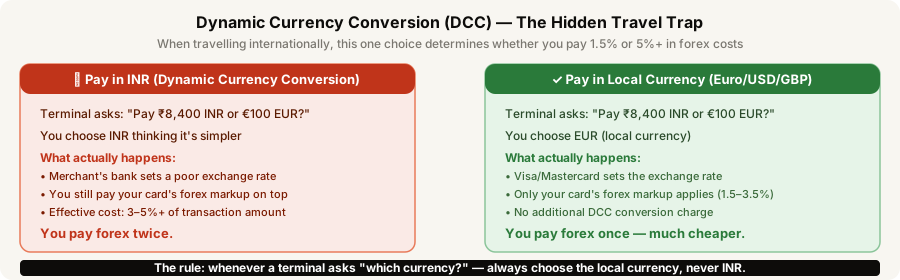 Fig 5: How Dynamic Currency Conversion works. Always choose local currency — EUR, USD, GBP — when a terminal asks. Choosing INR activates DCC and adds a second layer of forex cost on top of your card's existing markup.
Default Failure to repay credit card dues for 90+ consecutive days. The most serious negative mark on a CIBIL report — can reduce your score by 200–300 points and stays on the report for 7 years. Makes future credit approvals extremely difficult.
Due Date The last date to make at least the minimum payment without incurring a late fee and CIBIL damage. Paying the full statement balance by this date avoids all interest charges. Due dates are typically 15–21 days after the statement date.
E
EMI (Equated Monthly Instalment) Converting a large credit card transaction into fixed monthly repayments over 3–24 months at 12–18% interest — much lower than carrying a balance at 36–52% APR. Available as no-cost EMI (merchant-subsidised, common on electronics and appliances) or standard EMI (bank charges interest). A legitimate tool for managing large purchases responsibly — but verify the effective interest rate before converting, as "no-cost" EMI sometimes embeds costs in the product price. Some cards offer accelerated rewards on EMI transactions; check the current MITC for your specific card.
EDGE Miles Axis Bank's proprietary reward currency earned on all Axis Bank credit cards including the Axis Bank Ace Credit Card and Axis Bank Magnus Credit Card. EDGE Miles can be transferred to 13+ airline and hotel loyalty programmes or redeemed via Axis Bank's portal. Value: ₹0.20 (standard redemptions) to ₹1.00+ (airline transfers).
F
Finance Charge The interest charged on your outstanding balance when you don't pay in full. Calculated from the original transaction date (not the due date) at the monthly APR rate. One missed full payment triggers finance charges on all transactions — including new ones — until the next complete payment cycle.
Foreign Transaction Fee (Forex Markup) The bank's commission on foreign currency transactions. Ranges from approximately 1.5% to 3.5% on most Indian credit cards — always verify the exact rate in the card's MITC before transacting internationally. Low-forex cards (1.5–1.99%) exist at mid-tier and premium tiers. On a ₹5 lakh international trip, the difference between a 1.5% and a 3.5% card is ₹10,000 in hidden charges. See best travel credit cards India 2026 for current low-forex options.
Free Credit Period (Grace Period) The interest-free window between your statement date and due date — typically 15–21 days, giving 30–51 effective free days from purchase date. Only available if you paid your previous month's balance in full. If you carried any balance forward, interest accrues from transaction dates on all purchases with no grace period.
G–H
Hard Inquiry (Hard Pull) A check on your credit report triggered by a credit card or loan application. Reduces your CIBIL score by 5–15 points and stays visible on your report for 2 years. Multiple hard inquiries signal financial desperation to lenders. Space credit applications 3–6 months apart.
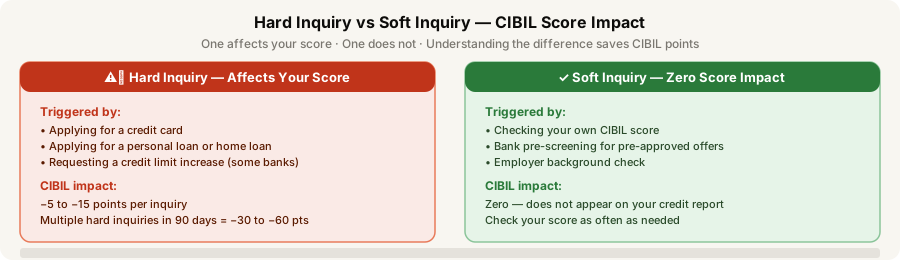 Fig 6: Hard vs soft inquiry. Only formal credit applications trigger hard pulls. Pre-approved offer screening, checking your own score, and employer checks are all soft inquiries with zero CIBIL impact.
Hard Block A permanent card deactivation requested when you report a card lost or stolen. All transactions are declined. A new card with a different number is issued. Distinct from a temporary lock (reversible via banking app) which you can undo yourself.
I–J
Interest-Free Period See Free Credit Period.
Issuer The bank or financial institution that issues the credit card and extends credit. HDFC Bank issues the Regalia Gold and Infinia Metal. SBI Card issues SimplyCLICK and Elite. Axis Bank issues Ace and Magnus. ICICI Bank issues the Amazon Pay ICICI Credit Card. Distinct from the payment network (Visa, Mastercard, Amex, RuPay).
Joining Fee A one-time charge at card issuance — separate from and in addition to the annual fee. "Lifetime free" cards typically waive both. Some cards advertise "no annual fee" but charge a ₹500–₹1,000 joining fee — always check both.
K–L
KYC (Know Your Customer) Mandatory identity and address verification required for all credit card applications. Documents: PAN card (mandatory), Aadhaar card, income proof. Most banks now complete KYC via video call (V-KYC) — no branch visit required.
Late Payment Fee Penalty for failing to make at least the minimum payment by the due date. HDFC Bank charges ₹100–₹1,100 depending on balance. SBI Card charges ₹100–₹1,100. ICICI Bank charges ₹100–₹1,200. Late payment also triggers a negative CIBIL mark (lasts 7 years) and loss of grace period.
Lifetime Free Card Zero annual fee permanently — not just year one. No spend threshold required. Several entry-level and mid-tier Indian credit cards are lifetime-free — check the MITC to confirm no fee applies from year one onwards. See best zero-fee credit cards India 2026.
M
Merchant Discount Rate (MDR) The fee a merchant pays to the bank/network for processing credit card transactions — typically 1.5–2.5% in India. UPI merchant transactions have zero MDR (government mandate). This is why some small merchants add a credit card surcharge: they're passing on MDR to customers.
Minimum Amount Due (Minimum Due) The smallest payment the bank accepts to keep your account in good standing — typically 5% of outstanding balance. Paying only the minimum is one of the most expensive financial mistakes an Indian cardholder can make. On a ₹1L balance at 42% APR, minimum-only payments take 8–10 years and cost ₹1.2–₹1.5L in extra interest.
MITC (Most Important Terms and Conditions) The RBI-mandated document summarising critical fees, rates, and terms in plain language. Every bank must provide this. Contains APR, annual fee, cashback caps, forex markup, reward expiry, and grace period conditions. Always read the MITC before applying for any credit card.
N–O
NACH (National Automated Clearing House) India's automated payment system used for standing instructions including credit card autopay. Set NACH autopay for the full statement amount — not the minimum due — to guarantee you'll never accidentally miss a payment or pay only the minimum.
Network The payment infrastructure processing credit card transactions globally — Visa, Mastercard, American Express, and RuPay (India's domestic network by NPCI). Visa and Mastercard are most widely accepted globally. RuPay is strongest within India and is the only network currently linkable to UPI for credit card rewards on UPI transactions.
No-Cost EMI EMI where the interest is subsidised by the merchant rather than charged to the customer. Appears as 0% interest. Often has a processing fee from the bank (₹99–₹500). Read the fine print to understand the total true cost.
Outstanding Balance The total amount currently owed on your credit card — including unpaid purchases, interest, and fees. Your statement shows the "statement balance" (billed for the cycle) and the "current outstanding" (total owed today including post-statement transactions).
Overlimit Fee A charge levied when your outstanding balance exceeds your approved credit limit — typically ₹500–₹600 or 2.5% of the overlimit amount (whichever is higher). Per RBI guidelines (2022), banks must get explicit opt-in for overlimit facility. If not opted in, transactions above the limit are declined rather than approved with a fee. Keep utilisation below 80% as a safety buffer to avoid accidental overlimit.
P–R
Payment Due Date See Due Date.
Pre-Approved Offer A credit card offer your bank extends based on your existing banking relationship — salary account, FD, or prior credit history. Pre-approved offers require only a soft inquiry until you formally accept — no CIBIL score impact while browsing. Always check your netbanking for pre-approved offers before applying cold — these are your highest-probability approvals.
Priority Pass The world's largest airport lounge access programme — 1,300+ lounges in 145+ countries. Several premium Indian credit cards include Priority Pass membership as a benefit — typically at mid-tier (₹2,500+ annual fee) and above. Check for per-visit spend requirements that have become increasingly common. See best credit cards for airport lounge access India.
Revolving Credit Credit that can be used repeatedly up to a set limit and repaid over time. Credit cards are revolving credit. Carrying a revolving balance triggers APR interest. Paying in full each cycle keeps the revolving facility interest-free indefinitely.
Reward Points A proprietary bank currency earned on credit card transactions. Value varies dramatically: HDFC Bank points at ₹0.15–₹1.00 depending on redemption method. Axis Bank EDGE Miles at ₹0.20–₹1.00+. SBI Card points at ₹0.25. Always calculate: earn rate × point value = effective cashback % before choosing any rewards card.
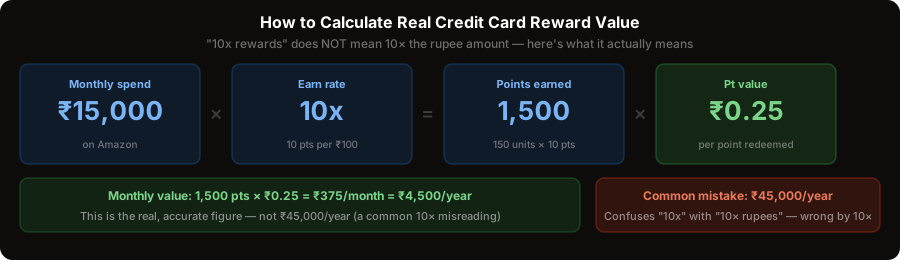 Fig 3: How to calculate real credit card reward value. "10x rewards" means 10 points per ₹100 — not 10× the rupee amount. The correct calculation: ₹15,000/month × 10x = 1,500 pts × ₹0.25 = ₹375/month = ₹4,500/year.
Reward Redemption Ratio The effective value you receive when converting reward points to cash, vouchers, flights, or hotel stays. Example: HDFC Bank points can be worth ₹0.15/point for statement credit but ₹1.00/point for flight bookings via SmartBuy — a 6.7× difference. Always compare redemption options before redeeming — the default "cashback" option often has the lowest value. See premium credit card rewards explained.
RuPay India's domestic payment network developed by NPCI. RuPay credit cards are the only cards currently linkable to UPI for credit card rewards on UPI transactions. Growing acceptance globally through co-brand agreements with Discover and JCB networks.
S
Secured Credit Card A credit card backed by a fixed deposit (FD) as collateral. Credit limit = 80–90% of FD value. No CIBIL score or income proof required — the starting point for credit building from zero. Issued by HDFC Bank, SBI Card, Axis Bank, ICICI Bank, and Kotak Mahindra Bank. The FD continues earning interest (5–7% p.a.) throughout.
Soft Inquiry (Soft Pull) A credit report check with zero CIBIL score impact — used when you check your own score (via cibil.com, CRED, BankBazaar, your bank app) or when banks pre-screen for pre-approved offers. Contrast with hard inquiries (credit applications) which reduce your score.
Statement Balance The total amount billed in your current billing cycle, as shown on your monthly statement. Paying the full statement balance by the due date avoids all interest charges and preserves your grace period for next month. Never confuse this with the minimum due.
Statement Date The date each month when your billing cycle closes and your credit card statement is generated. On this date: (1) your balance is frozen and reported to TransUnion CIBIL as your credit utilisation, (2) your billing period ends, and (3) the due date countdown begins (typically 15–21 days later). Critical: your utilisation is measured on the statement date, not after your payment — pay down your balance before the statement date if utilisation is above 30%.
T–Z
Tokenisation An RBI-mandated security system where your actual 16-digit card number is replaced by a unique token for online and mobile payments. When you save a card on Amazon, Swiggy, or any app, the app stores the token — not your real card number. If the app is breached, fraudsters get a useless token. Tokenisation has been mandatory for Indian card networks since October 2022. You may see a "generate token" step when saving a card on a new platform.
Transaction Limit The maximum allowed per individual transaction. Can be set by the bank (daily POS/online limits) or by the cardholder through the banking app. Setting low limits on international transactions reduces fraud exposure without affecting domestic usage.
V-KYC (Video KYC) Video-based identity verification for credit card applications — a live 10–15 minute video call replacing branch visits. Available at HDFC Bank, Axis Bank, ICICI Bank, SBI Card, and most major Indian card issuers.
Virtual Card A temporary card number generated in your bank's app or netbanking for online transactions. Same credit limit as your physical card but different number, expiry, and CVV — so if stolen from a website, it cannot be reused. Available from HDFC Bank, Axis Bank, and ICICI Bank. Best practice: use virtual cards for all online shopping.
Welcome Benefit A reward for new cardholders — typically within 30–90 days of first use. Common forms: reward points, travel vouchers, milestone bonuses, or complimentary memberships. Always calculate the true ₹ value of welcome benefits before applying — a restricted-use voucher is not equivalent to cashback, and welcome benefits change frequently. Verify current offers on the issuer's official page.
Zero Liability RBI's consumer protection provision: if credit card fraud is reported within 3 working days and the fraud was not due to the cardholder's negligence (OTP/PIN/CVV not shared), the cardholder bears zero financial liability and is eligible for a full refund subject to bank investigation. Banks must resolve within 90 days. Report as soon as possible — delays in reporting reduce likelihood and speed of recovery. See credit card fraud in India — full guide.
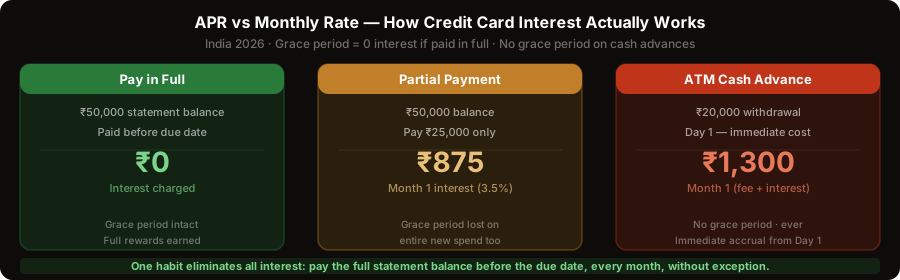 Fig 4: How credit card interest actually works across three scenarios. Full payment = ₹0 interest. Partial payment = full APR on remaining balance plus grace period lost on new spend. Cash advance = immediate interest from Day 1 with no grace period, ever.
Frequently Asked Questions
The grace period is the 15–21 day interest-free window after your statement date. Combined with the billing cycle, you get 30–51 days of free credit on purchases. It's only available if you paid your previous month's full statement balance. Carrying any balance forward eliminates the grace period and triggers immediate interest on all transactions.
Credit utilisation is the percentage of your total credit limit currently in use — (balance ÷ credit limit) × 100. It accounts for 30% of your CIBIL score — as significant as payment history. Keep it below 30% at all times. Above 50% meaningfully damages your score even if you pay in full every month.
APR is the Annual Percentage Rate — the annualised interest rate charged when you carry a balance. In India, credit card APR ranges from 36% to 52.8% per year. HDFC Bank and Axis Bank charge 36–42%. This is the most expensive mainstream borrowing rate in India. The only complete defence is paying the full statement balance every month.
A hard inquiry is triggered by credit applications (credit cards, loans) and reduces your CIBIL score by 5–15 points, staying on your report for 2 years. A soft inquiry — checking your own score via CIBIL, CRED, BankBazaar, or your bank's app — has zero score impact. Only apply for credit when you're confident you qualify.
Also read:
- Credit card interest rates in India 2026 — APR, compounding, and the minimum payment trap explained
- What is a CIBIL score and how every credit card decision affects it
- Best credit cards in India 2026 — full comparison across all categories
- 10 credit card mistakes that destroy Indian finances — with the real ₹ cost of each
More from the journal
Credit & Loans