
What Is a Credit Score in India and How Does Your Credit Card Usage Impact Your CIBIL Score?
What is a CIBIL score in India and how does credit card usage affect it? Learn the 5 scoring factors, how to improve your CIBIL score fast, and the real ₹22 lakh cost of a poor score. Updated April 2026.
Priya Nair4 May 202617 min read
Table of Contents
- Build Your CIBIL Score Fast — Quick Checklist
- Why Your CIBIL Score Matters — The ₹22 Lakh Example
- Credit Score Ranges in India
- The 5 Factors That Build or Destroy Your Score
- 5 Common CIBIL Score Mistakes
- 6 Credit Card Habits That Build Your Score Fastest
- Improvement Timeline + Rahul's Case Study
- Build Your Score with the Right Credit Card
- How to Check Your CIBIL Score Free
- Frequently Asked Questions
Key Takeaway:
A CIBIL score is a 3-digit number (300–900) that shows how likely you are to repay credit. In India, 750+ is considered good and qualifies you for the best credit cards and loan rates. Your credit card impacts your score mainly through payment history (approx. 35% weightage) and credit utilisation (approx. 30% weightage) — pay in full on time and keep card usage below 30% of your limit to improve it fastest.
Quick answer: A credit score (CIBIL score) is a 3-digit number between 300 and 900 that represents your creditworthiness based on your borrowing and repayment behaviour — generated by TransUnion CIBIL and used by all major Indian banks and lenders.
Build Your CIBIL Score Fast — Quick Checklist
- Pay 100% of your credit card bill on time, every month — not the minimum, the full balance
- Keep credit utilisation below 30% (below 10% is ideal) — across all cards combined
- Never miss a payment — even one missed payment drops your score 50–100 points and stays 7 years
- Don't apply for multiple cards in a short window — each application is a hard CIBIL inquiry (−5 to −15 points)
- Keep your oldest credit card active — even with one small purchase every 6 months
- Check your CIBIL report annually at cibil.com — errors can suppress your score by 50–150 points silently
- Make a mid-cycle payment before your statement date if utilisation is high — CIBIL sees your balance on statement date, not due date
The two actions that move the needle fastest: (1) pay in full on time, and (2) reduce utilisation before statement date. Everything else is secondary.
Why Your CIBIL Score Is One of the Most Valuable Numbers in Your Financial Life
India has four licensed credit bureaus — CIBIL TransUnion (most widely used), Experian India, Equifax India, and CRIF High Mark. Every loan, credit card, and credit inquiry associated with your PAN card is reported to these bureaus. Banks pull your credit score whenever you apply for any credit product.
The financial cost of a poor CIBIL score — in real rupees:
On a ₹50 lakh home loan over 20 years:
| CIBIL Score | Typical Interest Rate | Monthly EMI | Total Interest Paid |
|---|---|---|---|
| 750+ | 8.5% | ₹43,391 | ₹54.1 lakh |
| 700–749 | 9.5% | ₹46,607 | ₹61.9 lakh |
| 650–699 | 10.5% | ₹49,919 | ₹69.8 lakh |
| Below 650 | Loan likely rejected | — | — |
The difference between a 750 and a 680 CIBIL score on a ₹50L home loan: ₹22 lakh in extra interest over 20 years. Your CIBIL score is one of the highest-ROI financial metrics you can improve.
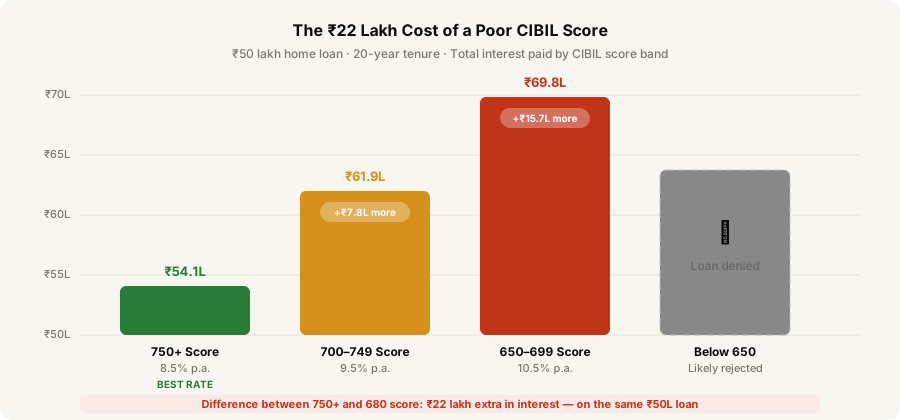
Fig 1: The ₹22 lakh cost of a poor CIBIL score — same ₹50L loan, same 20-year tenure, different interest rates based purely on creditworthiness.
Credit Score Ranges in India — What Each Means
| CIBIL Score | Rating | What It Unlocks |
|---|---|---|
| 800–900 | Exceptional | Best rates on all products; ultra-premium cards (HDFC Infinia Metal, Amex Platinum) |
| 750–800 | Very Good | Most premium cards; best home loan and personal loan rates |
| 700–750 | Good | Mid-tier cards (Axis Bank Ace, SBI SimplyCLICK, Amazon Pay ICICI); standard rates |
| 650–700 | Fair | Entry-level cards (Kotak 811 DreamDifferent); higher loan interest |
| 600–650 | Poor | Very limited options; most applications rejected |
| 300–600 | Very Poor | Secured cards against FD only; loans require collateral |
| NH / −1 | No History | No credit file yet — start with a secured card against FD or an add-on card on a family member's account |
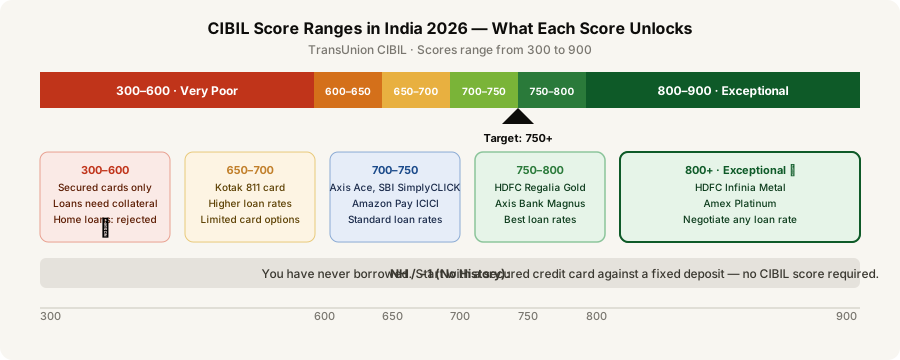
Fig 2: CIBIL score ranges in India 2026. Target 750+ to unlock premium credit cards and the best home loan interest rates. NH means no credit history — start with a secured card.
The 5 Factors That Build (or Destroy) Your CIBIL Score
Note: TransUnion CIBIL does not publicly disclose the exact weightage of each factor. The approximate percentages below are based on widely cited industry estimates and are consistent with how CIBIL's scoring methodology has been described in published guidance.
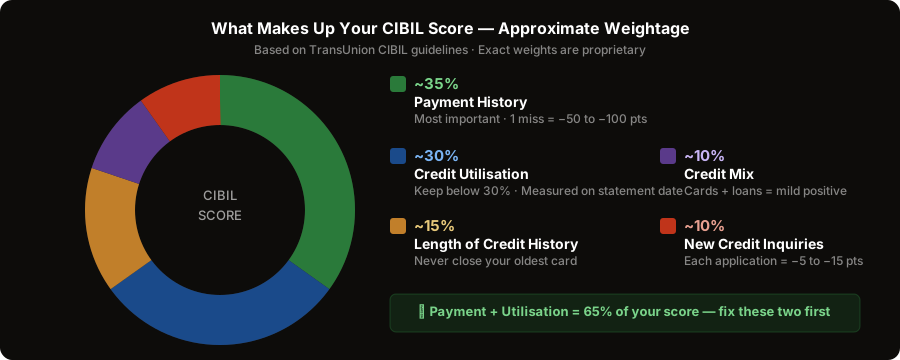
Fig 3: The five factors that make up your CIBIL score. Payment history and credit utilisation together account for approximately 65% of your score — fix these two first.
Factor 1: Payment History — ~35% weightage (Most Important)
One missed payment can drop your score by 50–100 points and stays on your report for 7 years.
Every on-time credit card payment is a positive data point. Every late or missed payment is a negative mark. Being 30 days late is bad. Being 90+ days late triggers a "DPD" (Days Past Due) notation that significantly damages your profile.
The fix: Set up NACH autopay for at least the minimum due on every card. This prevents a missed payment from being reported, even if you can't pay the full balance that month.
Factor 2: Credit Utilisation — ~30% weightage (Second Most Important)
Credit utilisation = (Current balance ÷ Total credit limit) × 100
This is the factor most people underestimate. High utilisation damages your score even if you pay in full every month — because banks report your balance on the statement date, before you've made the payment.
| Utilisation % | Score Impact |
|---|---|
| Below 10% | Excellent — strong positive signal |
| 10–30% | Good — neutral to positive |
| 30–50% | Moderate negative impact |
| 50–75% | Significant negative impact |
| Above 75% | Severe — major red flag to all lenders |
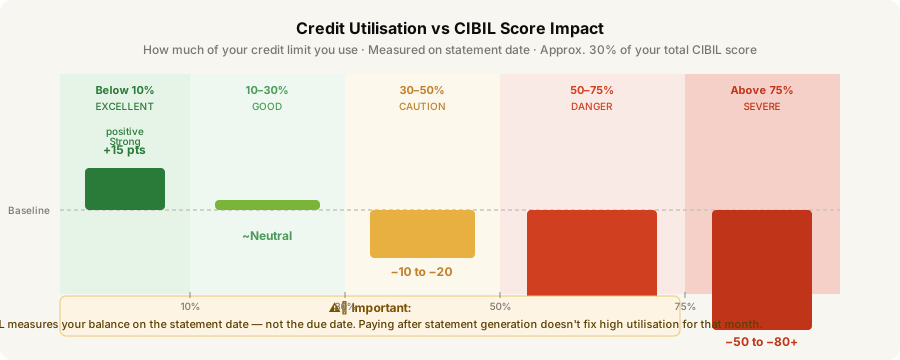
Fig 4: Credit utilisation vs CIBIL score impact. The green zone (below 30%) is where you want to stay. Note: CIBIL measures your balance on the statement date, not the due date.
Hidden damage scenario: Your credit limit is ₹1,00,000. You spend ₹70,000 in a month and pay it in full on the due date. CIBIL saw 70% utilisation on the statement date. Your score still took a hit — despite zero interest paid.
The fix: Make a mid-cycle payment before your statement date to reduce the reported balance. Or request a credit limit increase from your bank (soft inquiry — no score impact) to lower your utilisation ratio without changing spending.
Statement date vs due date — the most misunderstood detail: CIBIL sees your balance on the statement date — not the due date. Paying your full bill on the 20th doesn't fix a 75% utilisation that was reported on the 1st. Make mid-cycle payments before the statement date if you want to improve your reported utilisation this month.
Factor 3: Length of Credit History — ~15% weightage
The older your credit accounts, the better. CIBIL looks at both the age of your oldest account and the average age across all accounts.
Critical rule: Never close your oldest credit card — even if you don't use it. A closed card reduces your average account age and eliminates its credit limit from your total, increasing your utilisation ratio. If the card has an annual fee, call your bank and request a downgrade to a no-fee variant of the same card family. This preserves the account age and history.
Factor 4: Credit Mix — ~10% weightage
CIBIL rewards having both revolving credit (credit cards) and instalment credit (home loans, car loans, personal loans). If you only have credit cards, adding a small instalment loan — or vice versa — is a mild positive.
Never take a loan just to improve your credit mix. But understand that a diverse credit profile signals broader financial maturity to lenders.
Factor 5: New Credit Inquiries — ~10% weightage
Every credit card or loan application creates a hard inquiry (−5 to −15 points). Multiple inquiries in a short window signal financial distress to lenders.
Soft inquiries — checking your own score via CIBIL, CRED, or BankBazaar — have zero score impact.
Rule: Apply for no more than one credit product every 3–6 months. Space applications strategically. Check your score and eligibility before applying.
5 Common CIBIL Score Mistakes to Avoid
Most CIBIL score damage in India comes from the same five patterns — repeated by millions of cardholders who don't realise the cost until they apply for a loan or premium card.
| Mistake | CIBIL Damage | The Fix |
|---|---|---|
| Paying only the minimum due | Indirect — keeps balance high, worsens utilisation | Set autopay for full statement amount |
| Maxing out credit limit every month | −50 to −100 points from high utilisation | Keep usage below 30% of limit |
| Applying for multiple cards at once | −15 to −60 points from multiple hard inquiries | One application at a time, 3–6 months apart |
| Closing old credit cards | −20 to −80 points from reduced account age + higher utilisation | Downgrade to no-fee variant instead of closing |
| Ignoring errors on credit report | Up to −150 points from incorrect negative marks | Check cibil.com annually and dispute errors |
The single most common and most expensive mistake: Carrying a high balance on the statement date. Most Indian cardholders who are confused about why their score isn't improving despite on-time payments have a utilisation problem, not a payment history problem.
The 6 Credit Card Habits That Build Your CIBIL Score Fastest
Habit 1: Pay the Full Statement Balance Every Month
Not the minimum. Not "most of it." The full statement balance — every month, without exception. This is the single most powerful CIBIL-building action available. It records a positive payment, keeps utilisation at zero at cycle start, and avoids 36–42% APR interest.
Habit 2: Keep Credit Utilisation Below 30% at All Times
Set a mental spending ceiling: if your limit is ₹1,00,000, treat ₹30,000 as your monthly cap. If you regularly exceed this, either request a limit increase (soft inquiry) or get a second card to distribute spending.
Habit 3: Never Close Your Oldest Credit Card
Your first credit card is your most valuable CIBIL asset — not for rewards, but for the account age. Keep it open and active with one small purchase every 6 months.
Habit 4: Space Credit Applications 3–6 Months Apart
Each application is a hard inquiry. Never apply for multiple cards simultaneously. The pattern of multiple hard inquiries is itself a negative signal — independent of the score drop from each individual inquiry.
Habit 5: Monitor Your Credit Report for Errors Annually
CIBIL reports contain errors more often than most people know — incorrect late payment records, duplicate entries, or accounts that aren't yours. Errors can suppress your score by 50–150 points silently. Check your free annual report at cibil.com and dispute any inaccuracies through CIBIL's online dispute portal.
Habit 6: Become an Authorised User on an Old, Clean Family Card
If a parent or spouse has a credit card with 5+ years of clean history, being added as an authorised user (add-on cardholder) can help in some cases — depending on how the issuing bank reports add-on cardholder data to CIBIL. Reporting practices vary across Indian banks, so this approach isn't guaranteed to reflect uniformly on the secondary cardholder's CIBIL report. Check with your specific bank before relying on this as your primary credit-building strategy.
CIBIL Score Improvement Timeline — Realistic Expectations
| Starting Situation | Target | Realistic Timeline |
|---|---|---|
| NH (no history), secured card start | 700 | 6–12 months |
| Score of 600, no recent missed payments | 700 | 3–6 months |
| Score of 600, recent missed payments | 700 | 12–18 months |
| Score of 700, reduce utilisation | 750 | 1–3 months |
| Score of 750, consistent good habits | 800 | 12–24 months |
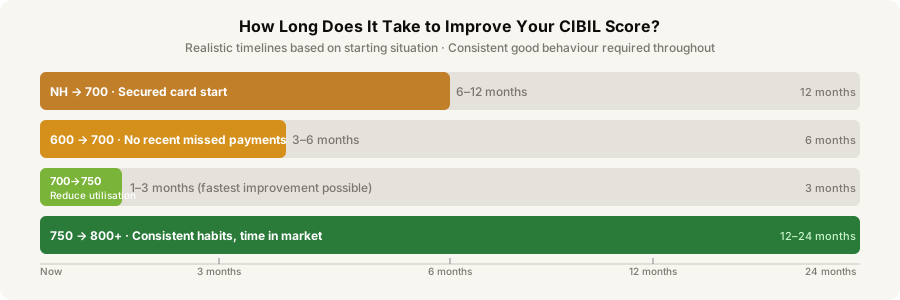
Fig 6: CIBIL score improvement timelines. The fastest single improvement (700 to 750) comes from reducing utilisation — achievable in 1–3 months. Building from NH to 700 takes 6–12 months of consistent secured card usage.
Real-World Example: 680 to 735 in 45 Days
Rahul, a 31-year-old software engineer in Bengaluru, had a CIBIL score of 680 — stuck because his credit card balance was consistently at 65% of his ₹1,00,000 limit. He'd been paying in full every month, so payment history wasn't the issue. The culprit was utilisation.
What he did: Made a ₹45,000 mid-cycle payment 5 days before his statement date, bringing his reported balance from ₹65,000 down to ₹20,000 — a utilisation of 20%.
Result: Within one billing cycle (45 days), his CIBIL score rose from 680 to 735 — without opening any new accounts, without closing anything, and without taking any new credit.
The lesson: If your score is stuck despite on-time payments, check your statement-date balance. Utilisation is often the invisible drag that payment history improvements can't fix on their own.
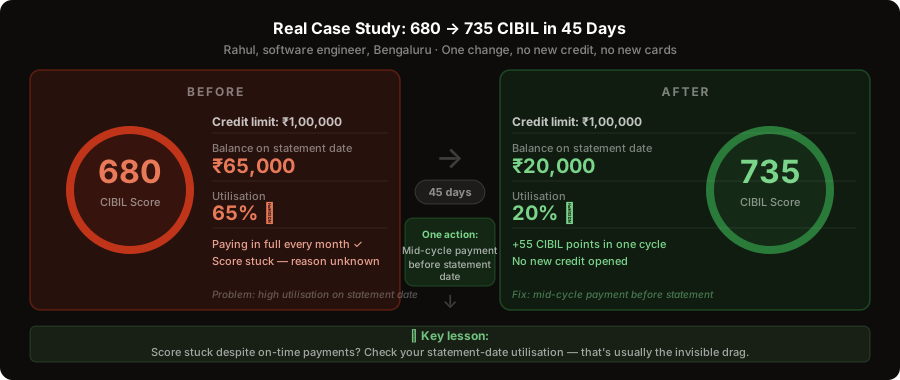
Fig 5: Real case study — 680 to 735 CIBIL in 45 days. One mid-cycle payment before the statement date reduced utilisation from 65% to 20%. No new credit, no new cards.
Build Your CIBIL Score with the Right Credit Card
Not all credit cards help your CIBIL score equally. The ideal card for someone building or rebuilding credit should: report to all 4 credit bureaus, offer easy approval at 650–700 CIBIL score, have a reasonably high credit limit (higher limit = lower utilisation at the same spend level), and have zero or low annual fee so you can hold it long-term without closing it.
How to Check Your CIBIL Score for Free in India
- cibil.com — one free full report per year (official CIBIL TransUnion source)
- CRED app — free monthly soft check, no score impact
- BankBazaar — free score with product context
- Paytm — free TransUnion score check
- Your bank's app — HDFC Bank, Axis Bank, ICICI Bank all show CIBIL score free in-app
Always use soft inquiry methods for monitoring. Hard inquiries (loan/card applications) reduce your score. Soft inquiries never do.
Who Should NOT Ignore Their CIBIL Score
Anyone planning to apply for a home loan in the next 12–24 months — a 50-point improvement now saves ₹10–₹22 lakh in interest over the loan tenure. Anyone with credit card debt they're carrying month-to-month — interest is compounding at 36–42% APR while score damage accumulates. First-time credit card applicants — understanding your NH score status prevents wasted hard inquiries on cards you can't yet qualify for.
Frequently Asked Questions
Most banks approve entry-level credit cards at a CIBIL score of 650+, but 700+ meaningfully improves approval chances and unlocks better card options. A CIBIL score of 750+ is required for most premium credit cards. Secured credit cards against fixed deposits are available at any CIBIL score — including 0 or NH (no history).
Most banks and housing finance companies require a minimum CIBIL score of 700 for home loan approval, with 750+ securing the best interest rates. The difference between a 750 and 680 CIBIL score on a ₹50 lakh home loan is approximately ₹22 lakh in additional interest over 20 years. It is worth improving your CIBIL score before applying for a home loan.
A CIBIL score of 750 or above is considered good in India and qualifies you for most credit cards and the best loan interest rates. A score of 800+ is excellent and provides access to ultra-premium cards like the HDFC Infinia Metal Credit Card and maximum negotiating leverage on loan terms.
Significantly — in both directions. Paying your full credit card balance on time every month is the fastest way to build a strong CIBIL score. Missing a payment or maxing out your credit limit can drop your score by 50–150 points within one reporting cycle. Credit utilisation (30% of your score) is affected even when you pay in full, if your balance is high on the statement date.
No. Checking your own score via cibil.com, CRED, BankBazaar, or your bank's app is a soft inquiry and has zero score impact. Only hard inquiries — triggered by actual credit applications — reduce your score.
Missed payments stay on your CIBIL credit report for 7 years from the date of the event. The score impact diminishes over time as the negative mark ages, but it does not disappear until the 7-year mark.
Below 30% for a neutral-to-positive impact. Below 10% is ideal and signals excellent credit management. Above 50% begins meaningfully damaging your score even if you pay the full balance every month.
Yes — if utilisation is the dominant negative factor. Paying down balances before your statement date can produce a noticeable improvement within 30–45 days, as in the Rahul example above. Payment history improvements and account age improvements take significantly longer — months to years.
From NH (no history) status, it typically takes 6–12 months to generate a first CIBIL score of 650–700 using a secured credit card against a fixed deposit. Reaching 750 from zero takes 18–24 months of consistent on-time payments and low utilisation.
Yes, significantly — especially if it's your oldest card. Closing a credit card reduces your average account age and eliminates its credit limit from your total (which increases your utilisation ratio). The damage is typically 20–80 CIBIL points and can take 12–24 months to recover. Instead of closing: downgrade to a no-fee variant of the same card to preserve the account history without the fee obligation.
Disclaimer: Credit scoring models are proprietary and subject to change. Data based on publicly available CIBIL TransUnion Score Guide 2026 and RBI Guidelines on Credit Information Companies. Always consult a certified financial planner for personalised credit advice.
Last updated: April 29, 2026
More from the journal
Credit & Loans