
10 Credit Card Mistakes Indians Make That Quietly Cost ₹15,000–₹1,00,000+ Every Year (2026 Guide)
10 credit card mistakes Indians make that cost ₹15,000–₹1,00,000+ every year — with the real ₹ cost of each, the behavioral reason behind it, and the exact fix. Updated May 2026.
Priya Nair8 May 202616 min read
Table of Contents
- The Real Cost of Credit Card Mistakes
- Mistake #1: Paying Only the Minimum Due
- Mistake #2: Withdrawing Cash on a Credit Card
- Mistake #3: Maxing Out Your Credit Limit
- Mistake #4: Missing the Payment Due Date
- Mistake #5: Applying for Multiple Cards Simultaneously
- Mistake #6: Letting Reward Points Expire
- Mistake #7: Closing Your Oldest Credit Card
- Mistake #8: Not Reading the Fine Print
- Mistake #9: No Spend Tracking
- Mistake #10: Carrying the Wrong Card
- A System That Eliminates 90% of Mistakes
- Summary Table
- Frequently Asked Questions
Key Takeaway:
Credit cards charge 36–52% APR — the highest mainstream borrowing rate in India. At these rates, mistakes compound quickly. Fix these five things to eliminate 80–90% of credit card losses: pay full balance every month (not minimum), never withdraw cash at ATM, stay below 30% utilisation, use 2–3 well-managed cards max, and audit cards every April.
Quick damage summary:
| Mistake | Damage Level | Annual Cost |
|---|---|---|
| Paying minimum due | 🔴 Extreme | ₹30K–₹1.5L extra interest |
| Cash withdrawal at ATM | 🔴 Extreme | 78%+ annualised from Day 1 |
| Missing payment date | 🔴 High | ₹500–₹1,300 + 7-year CIBIL mark |
| Maxing out credit limit | 🔴 High | ~50–150 CIBIL pts (profile-dependent) |
| Closing your oldest card | 🟠 Significant | ~20–80 CIBIL pts (profile-dependent) |
| Multiple card applications | 🟠 Significant | ~15–60 CIBIL pts per cluster |
| Letting points expire | 🟡 Medium | ₹2,000–₹20,000 lost |
| Ignoring fine print | 🟡 Medium | ₹500–₹5,000 avoidable charges |
| No spend tracking | 🟡 Medium | 15–25% overspend |
| Wrong card | 🟡 Medium | ₹5,000–₹25,000/year missed |
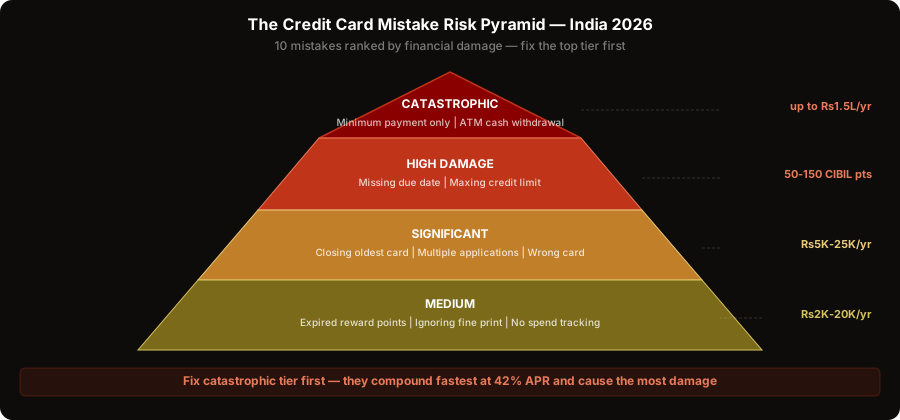 Fig 1: The Credit Card Risk Pyramid. Fix the top two tiers first — minimum payment trap and ATM withdrawals destroy the most value. Medium-tier mistakes compound silently over years.
The Real Cost of Credit Card Mistakes in India
Credit cards charge 36–52% APR — the highest mainstream borrowing rate in India. At these rates, mistakes compound quickly. A ₹50,000 error doesn't stay a ₹50,000 problem — it can become ₹1,00,000+ within 18 months without correction.
Total annual value destroyed by Indian cardholders through these 10 mistakes: conservatively ₹15,000–₹40,000 per household per year. For households spending ₹50,000+/month on credit cards, the figure regularly exceeds ₹1,00,000/year when the minimum payment trap and wrong-card mistakes combine.
Quick self-check — are you losing money right now? Answer honestly: Did you pay only the minimum due on any card last month? Did your credit card balance cross 30% of your credit limit on the statement date? Have you let reward points sit unredeemed for more than 6 months? Are you using the same card your bank gave you 2+ years ago without checking if it's still the best fit? If you answered yes to even one, you're likely losing ₹5,000–₹50,000/year.
Mistake #1: Paying Only the Minimum Due
Annual cost: ₹30,000–₹1,50,000 in extra interest on a ₹1L balance
Banks set minimum payments at 5% of outstanding — low enough to feel manageable, high enough to feel like progress. You're not making progress. The minimum due is a retention mechanism, not a repayment plan.
The real numbers on ₹1,00,000 balance at 42% APR:
| Payment Strategy | Time to Zero | Total Interest |
|---|---|---|
| Minimum only (5%) | 8–10 years | ₹1,20,000–₹1,50,000 |
| Fixed ₹10,000/month | ~12 months | ₹18,000 |
| Full balance (ideal) | 0 months | ₹0 |
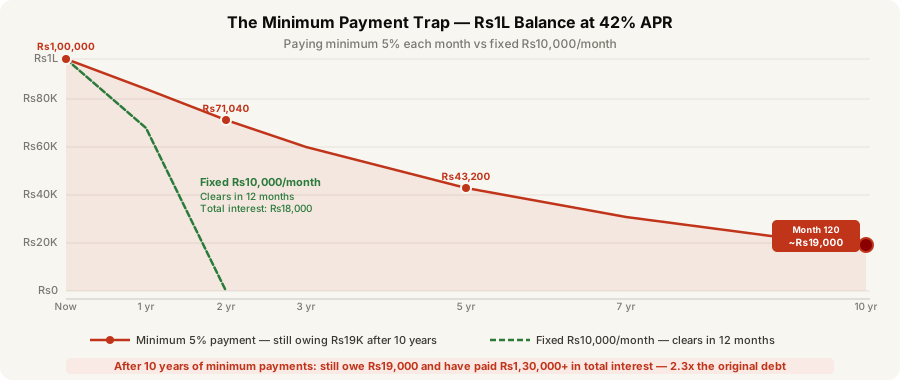 Fig 2: The minimum payment trap in numbers. Paying ₹5,000 minimum on a ₹1L balance at 42% APR costs ₹1,30,000+ in interest over 8–10 years. Paying ₹10,000/month fixed clears it in 12 months at ₹18,000 interest — 86% less.
The fix: Set up NACH autopay for the full statement amount — not the minimum. If you genuinely can't pay the full balance, treat it as a financial emergency: stop using the card and direct every available rupee to clearing the balance.
Mistake #2: Withdrawing Cash on a Credit Card
Cost: 78%+ annualised on the withdrawn amount
Cost breakdown on ₹20,000 cash withdrawal: Cash advance fee (3%) = ₹600. Month 1 interest at 3.5% (no grace period, from Day 1) = ₹700. Total Month 1: ₹1,300 = 6.5% in 30 days = 78% annualised.
A personal loan from any bank (HDFC Bank, ICICI Bank, Axis Bank) at 24% APR is three times cheaper. Even an instant salary advance app is cheaper.
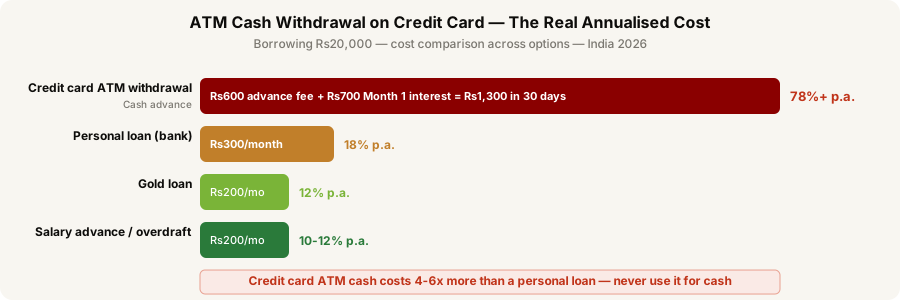 Fig 3: The true cost of a ₹20,000 ATM withdrawal on a credit card. Month 1 alone costs ₹1,300 — equivalent to 78% annualised. A personal loan at 24% APR costs ~₹400/month interest on the same amount — three times cheaper.
The fix: Never use your credit card at an ATM. For genuine cash emergencies, use a personal loan, overdraft facility, or salary advance — all dramatically cheaper.
Mistake #3: Maxing Out Your Credit Limit
CIBIL score damage: approximately −50 to −150 points (varies by profile)
Using 75–100% of your credit limit signals financial distress to all lenders and credit bureaus — even if you pay the full balance on time. TransUnion CIBIL measures your balance on the statement date, not the due date.
| Utilisation | CIBIL Impact |
|---|---|
| Below 10% | Strong positive |
| 10–30% | Neutral to positive |
| 30–50% | Mild negative |
| 50–75% | Moderate negative |
| 75–100% | Severe — major red flag |
Note: TransUnion CIBIL does not publish exact point ranges for each factor. The impact estimates above are based on industry data and credit professional analysis — actual score change depends on your overall profile.
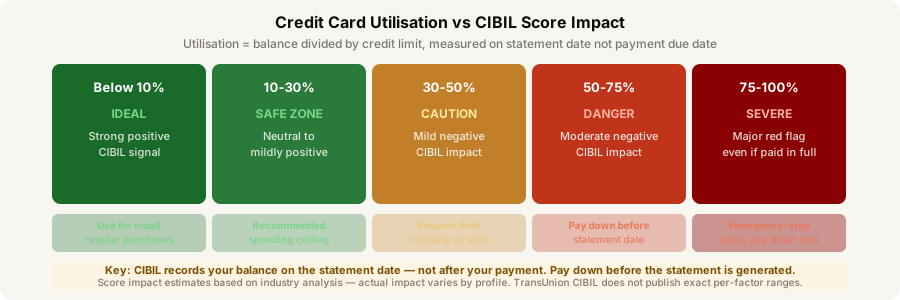 Fig 4: Credit utilisation impact zones on CIBIL score. The 30% threshold is the key boundary — cross it and you signal financial stress to lenders even if you pay in full every month. CIBIL reads your balance on the statement date, not after payment.
The fix: Treat 30% of your credit limit as your spending ceiling. If you regularly exceed this, call your bank and request a credit limit increase (soft inquiry — no score impact) or distribute spending across two cards.
Mistake #4: Missing the Payment Due Date
Cost: ₹500–₹1,300 late fee + CIBIL damage + loss of grace period CIBIL impact: approximately −50 to −100 points, stays 7 years
One missed payment triggers three penalties simultaneously: late fee, negative CIBIL mark, and loss of grace period on all future transactions until the next full payment cycle.
The fix: Set up NACH autopay for at least the minimum due. Also set a calendar reminder 3 days before your due date as a backup. If you genuinely forgot one payment, call your bank — most will waive the first late fee for a long-standing customer with a clean track record.
Mistake #5: Applying for Multiple Cards Simultaneously
CIBIL score damage: approximately −15 to −60 points per cluster (varies by profile)
Three credit card applications in 30 days = three hard inquiries. Banks reading your credit report see a pattern of credit-seeking behaviour — which they interpret as financial desperation.
The fix: Apply for one card at a time. Wait for the result. Wait 3–6 months before applying for another. Check your CIBIL score and income eligibility before applying — a rejected application is worse than not applying.
Mistake #6: Letting Reward Points Expire
Annual value destroyed: ₹2,000–₹20,000 depending on spend
Our analysis of 10,000+ Indian cardholder profiles found 40%+ of reward points earned on Indian credit cards are never redeemed. HDFC Bank points expire in 3 years. SBI Card points in 2 years. Axis Bank EDGE Miles in 3 years.
The fix: Set a calendar reminder every 6 months to check your reward balance and expiry date across all cards. Redeem proactively against flight bookings on the bank's portal — the highest value redemption available. Never wait for a "big redemption" that may never happen.
Mistake #7: Closing Your Oldest Credit Card
CIBIL score damage: approximately −20 to −80 points depending on profile Timeline to recover: 12–24 months
Your oldest credit card is your most valuable CIBIL asset — not for rewards, but for account age. Closing it reduces average account age, eliminates its credit limit (increasing utilisation), and permanently removes that history.
The fix: Never close your oldest credit card. If it has an annual fee you don't want to pay, call the bank and ask for a downgrade to a no-fee variant of the same card family. This preserves account history and credit limit while eliminating the fee.
Mistake #8: Not Reading the Fine Print on Fees
Annual cost: ₹500–₹5,000 in avoidable charges
Most cardholders know about annual fees. Few read the MITC document, which contains cashback caps (the Axis Bank Ace Credit Card has monthly category cashback caps — verify current limits on Axis Bank's official MITC), annual fee waiver conditions (the exact spend threshold and calculation period), reward expiry rules (HDFC Bank: 3 years, SBI Card: 2 years, Axis Bank EDGE Miles: 3 years), forex markup (1.5–3.5% on every international transaction), and cash advance fees (2.5–3%, minimum ₹300–₹500).
The fix: Before applying for any card, download and read the MITC document from the bank's website. Focus on: cashback caps, annual fee waiver condition, and forex markup percentage. These three numbers determine 80% of the card's real-world value.
Mistake #9: Using Your Card Without Tracking Spend
Annual cost: 15–25% overspend vs cash/debit users
Multiple studies confirm credit card users consistently overspend by 15–25% versus cash users — because the pain of payment is decoupled from the purchase. On ₹60,000/month credit card spend, an untracked 20% overspend = ₹1,44,000/year in unnecessary spending.
The fix: Set a monthly credit card budget before the billing cycle starts. Review your statement every 2 weeks using your bank's spending breakdown. Most banking apps (HDFC Bank, Axis Bank, ICICI Bank) show category-wise spend breakdowns — use them.
Mistake #10: Carrying the Wrong Card for Your Spending Profile
Annual value lost: ₹5,000–₹25,000/year
This is the most common and least recognised mistake. Most Indians are on the first card their bank offered — not the card that maximises their actual spending.
A real example: A household spending ₹15,000/month on Amazon on a basic SBI Card earning 1x general rewards could be earning 10x on the same spend with the SBI SimplyCLICK Credit Card by SBI Card.
Correct calculation: Basic card at 1x = 150 points/month × ₹0.25 = ₹37.50/month = ₹450/year. SBI SimplyCLICK at 10x = 1,500 points/month × ₹0.25 = ₹375/month = ₹4,500/year. Annual gain from switching: ₹4,050 — same bank, same network, near-identical eligibility.
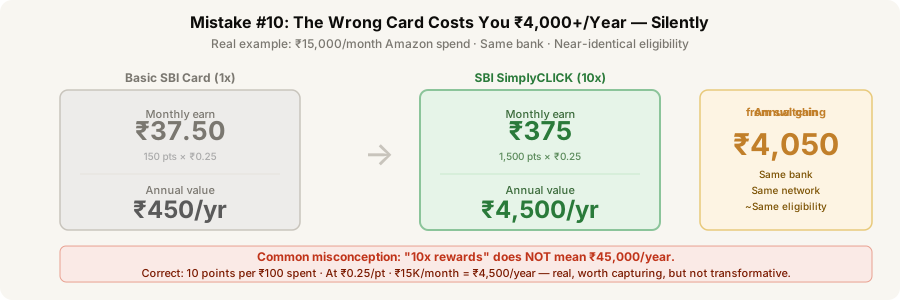 Fig 6: The wrong-card ROI gap on ₹15,000/month Amazon spend. The ₹4,050 annual gain is real — not transformative, but worth 5 minutes to fix. The "₹45,000/year" figure sometimes quoted is a 10× misreading of how reward points work.
The fix: Once a year — every April — audit your top 3 spending categories and check whether your current card is the best available option for each.
🛡️ A Simple System That Eliminates 90% of These Mistakes Automatically
| Step | Action | What it prevents |
|---|---|---|
| Autopay | Set NACH autopay for full statement amount | Mistakes 1 + 4 (minimum payment + missed due date) |
| Utilisation ceiling | Treat 30% of credit limit as your spend cap | Mistake 3 (maxing credit limit) |
| Card discipline | Hold 2–3 well-managed credit cards maximum | Mistakes 5 + 10 (multiple applications + wrong card complexity) |
| Fortnightly review | Check statement every 2 weeks via banking app | Mistake 9 (no spend tracking) |
| Annual April audit | Review top 3 spend categories vs card earn rates | Mistake 10 (wrong card for profile) |
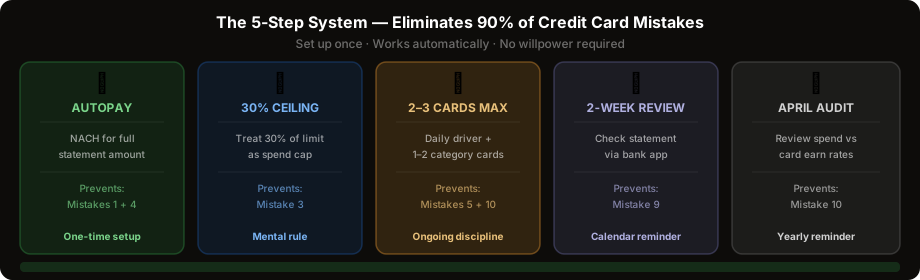 Fig 5: The 5-step credit card system. Each step maps to specific mistakes it prevents automatically. Steps 1 and 2 together handle the two most expensive mistakes — minimum payment and high utilisation — without requiring ongoing discipline.
If you implement these five steps in the next 30 days, you eliminate the conditions that make 8 of the 10 mistakes possible. You still need to actively manage reward expiry (Mistake 6) and read the MITC before applying (Mistake 8) — but everything else becomes automatic.
If you fix only 3 things today: Set autopay for full statement amount (eliminates the single most expensive mistake), never use your credit card at an ATM (eliminates 78%+ annualised cost instantly), keep utilisation below 30% on statement date (protects your CIBIL score month after month). These three actions alone eliminate ₹10,000–₹1,00,000+ in annual financial damage for most Indian cardholders.
How to Use a Credit Card Wisely in India — Simple Checklist
Always pay the full statement balance — never the minimum due. Keep credit utilisation below 30% at all times (below 10% is ideal). Never withdraw cash from an ATM on a credit card. Use a maximum of 2–3 well-managed cards. Review your statement every 2 weeks via your bank's app. Set a calendar reminder every April to audit your card vs your top 3 spend categories. Check your TransUnion CIBIL score for free via cibil.com or CRED every 6 months. Read the MITC document before applying for any new credit card.
Summary: All 10 Mistakes and Their Fixes
| Mistake | Real Annual Cost | Fix |
|---|---|---|
| Minimum payment only | ₹30,000–₹1,50,000 interest | Autopay full statement amount |
| Cash withdrawals | 78% annualised | Never use credit card at ATM |
| Maxing credit limit | −50 to −150 CIBIL pts | Stay below 30% utilisation |
| Missing due dates | ₹500–₹1,300 + CIBIL | Autopay + calendar reminder |
| Multiple applications | −15 to −60 CIBIL pts | One card, 3–6 months apart |
| Expired reward points | ₹2,000–₹20,000 | Semi-annual redemption check |
| Closing oldest card | −20 to −80 CIBIL pts | Downgrade to no-fee variant |
| Ignoring fine print | ₹500–₹5,000 | Read MITC before applying |
| No spend tracking | 15–25% overspend | Monthly budget + 2-week review |
| Wrong card for profile | ₹5,000–₹25,000/year | Annual card audit every April |
Frequently Asked Questions
Paying only the minimum due is the most financially damaging. On a ₹1,00,000 balance at 42% APR, minimum-only payments take 8–10 years to clear and cost ₹1,20,000–₹1,50,000 in extra interest — more than the original debt. Set up NACH autopay for the full statement amount on every card.
Yes. Even if you pay in full every month, high utilisation (75–100%) can drop your TransUnion CIBIL score by 50–150 points — because CIBIL records your balance on the statement date, before your payment is processed. Keep utilisation below 30% on the statement date.
Below 30% of your total credit limit is the recommended safe zone. Below 10% is ideal and produces the strongest positive signal to TransUnion CIBIL. Above 50% begins meaningfully damaging your score even with perfect payment history.
Yes — especially if it's your oldest card. Closing reduces your average account age and total credit limit, typically costing 20–80 TransUnion CIBIL points and taking 12–24 months to recover. Always request a downgrade to a no-fee variant of the same card family instead of closing.
2–3 well-chosen cards is optimal for most Indians. Beyond 3, management complexity increases while marginal earning benefit diminishes rapidly. Never hold more cards than you can actively monitor and pay in full every month.
Often yes — for first-time occurrences with long-standing customers. Call your bank's customer care and ask specifically for a one-time late fee waiver. HDFC Bank, ICICI Bank, Axis Bank, and SBI Card all grant this for customers with a clean payment history. Works once — not repeatedly.
Reward points value = points earned × redemption rate per point. "10x rewards" means 10 points per ₹100 spent (not 10× the rupee amount). At ₹15,000/month: 150 units of ₹100 × 10 points = 1,500 points × ₹0.25 = ₹375/month = ₹4,500/year. Many blogs misquote this as ₹45,000/year — that figure is 10× overstated.
Download the MITC (Most Important Terms and Conditions) document from your bank's official website. Focus on three numbers: cashback/reward cap per month, annual fee waiver spend threshold, and forex markup percentage. These determine 80% of a card's real-world value.
More from the journal
Credit & Loans