Credit Card Interest Rates Explained: APR, Minimum Payment Trap & How to Escape Debt in India 2026
Credit card interest rates in India 2026 explained — APR, compounding, the minimum payment trap with real ₹ calculations, and four strategies to escape debt. Includes credit card vs personal loan comparison.
Priya Nair4 May 202617 min read
Table of Contents
- Why Credit Card Interest Is the Most Expensive Debt in India
- Credit Card Charges — The Complete Breakdown
- How Credit Card Interest Is Calculated
- The Minimum Payment Trap
- Four Strategies to Escape Credit Card Debt
- Credit Card vs Personal Loan Interest
- Is Credit Card Interest Legal in India?
- The Only Way to Pay ₹0 in Interest
- Monthly Interest Reference Table
- Frequently Asked Questions
Key Takeaway:
Credit card interest rates in India range from 36% to 52.8% APR — the highest-cost mainstream unsecured credit product available. The minimum payment trap is one of the most expensive financial traps Indian cardholders fall into: paying only the minimum due on a ₹1,00,000 balance at 42% APR takes 8–10 years to clear and costs ₹1,20,000–₹1,50,000 in additional interest — more than the original debt. There is only one guaranteed way to pay ₹0 in credit card interest: pay the full statement balance before the due date every single month.
Quick answer: When you don't pay your full credit card bill, Indian banks charge approximately 3–4% per month (36–52% annually) on your outstanding balance. Interest is calculated from the original transaction date, not the due date, and compounds monthly — meaning you pay interest on the previous month's interest. Paying only the minimum due triggers full interest and can keep you in debt for 8–10 years on a single ₹1 lakh balance.
Why Credit Card Interest Is the Most Expensive Debt in India
| Loan Type | Typical Interest Rate 2026 | Monthly Cost on ₹1L |
|---|---|---|
| Home loan | 8.5–10.5% p.a. | ₹708–₹875 |
| Car loan | 9–12% p.a. | ₹750–₹1,000 |
| Personal loan | 12–24% p.a. | ₹1,000–₹2,000 |
| Gold loan | 9–18% p.a. | ₹750–₹1,500 |
| Credit card (carrying balance) | 36–52.8% p.a. | ₹3,000–₹4,400 |
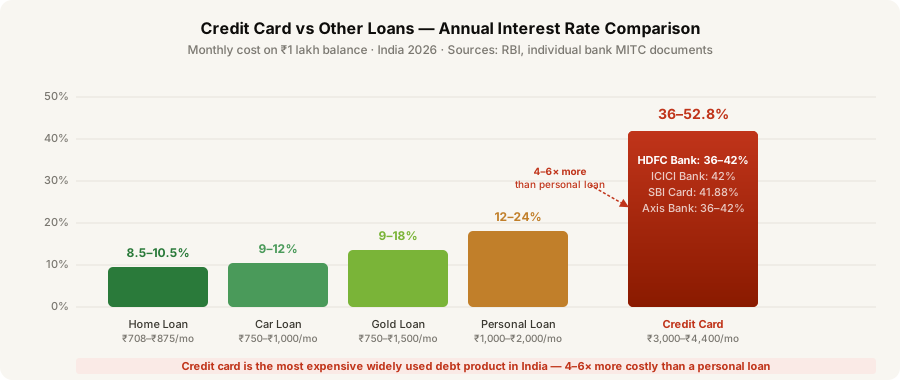
Fig 1: Credit card interest at 36–52.8% APR is 4–6× more expensive than a personal loan and 10× more than a home loan. Source: RBI, individual bank MITC documents.
A credit card is an excellent payment instrument when you pay in full every month. It becomes the most expensive mainstream debt you can take when you carry a balance.
Mental model: Credit card debt is like running on a treadmill set at 3.5% incline every month. If you don't run faster than the incline (pay more than the interest), you never actually move forward — you just exhaust yourself staying in place.
Credit Card Charges in India — The Complete Breakdown
1. Annual Percentage Rate (APR)
APR is the annualised interest rate on your outstanding balance when you don't pay in full. Indian banks typically quote a monthly rate in their documents — always multiply by 12 to understand the true annual cost.
| Bank | Monthly Rate | Annual APR |
|---|---|---|
| HDFC Bank | 3.0–3.5% | 36–42% |
| Axis Bank | 3.0–3.5% | 36–42% |
| ICICI Bank | 3.5% | 42% |
| SBI Card | 3.49% | 41.88% |
| Kotak Mahindra Bank | 3.5% | 42% |
| Some retail/entry cards | 4.4% | 52.8% |
RBI note: As of 2025, the Reserve Bank of India (RBI) mandates standardised APR disclosure in all credit card communications and requires fair practice guidelines under its Master Circular on Credit Card Operations. However, it currently does not impose a strict upper rate cap — banks including HDFC Bank, ICICI Bank, Axis Bank, and SBI Card continue to charge up to 52.8% APR legally, provided they disclose it clearly in the MITC.
How Credit Card Interest Is Calculated — The Formula
Step 1: Find your monthly rate
Monthly rate = APR ÷ 12. Example: 42% ÷ 12 = 3.5% per month.
Step 2: Calculate monthly interest
Monthly interest = Outstanding balance × Monthly rate. Example: ₹50,000 × 3.5% = ₹1,750/month.
Step 3: Understand compounding
The compound formula is A = P × (1 + r)^n, where P = principal (starting balance), r = monthly interest rate (e.g., 0.035 for 3.5%), and n = number of months.
Example: ₹1,00,000 at 3.5%/month for 12 months: A = 1,00,000 × (1.035)^12 = ₹1,51,107.
This formula shows exactly why a ₹1 lakh untouched balance becomes ₹1.51 lakh in just 12 months — and ₹3.44 lakh in 36 months.
Why Credit Card Interest Feels So Brutal — It Compounds Monthly
- Month 1: You owe ₹1,00,000. Interest = ₹3,500 (3.5%). Balance = ₹1,03,500.
- Month 2: Interest is calculated on ₹1,03,500 — not the original ₹1,00,000. Interest = ₹3,622.
- Month 3: Interest on ₹1,07,122. Interest = ₹3,749.
Each month, you pay interest on the previous month's interest. That's compounding — and at 3.5%/month, it compounds fast.
₹1,00,000 untouched at 42% APR: Month 6 → ₹1,22,987. Month 12 → ₹1,51,107. Month 24 → ₹2,28,333. Month 36 → ₹3,44,785.
A ₹1 lakh balance you never pay becomes ₹3.4 lakh in 3 years — purely through compounding.
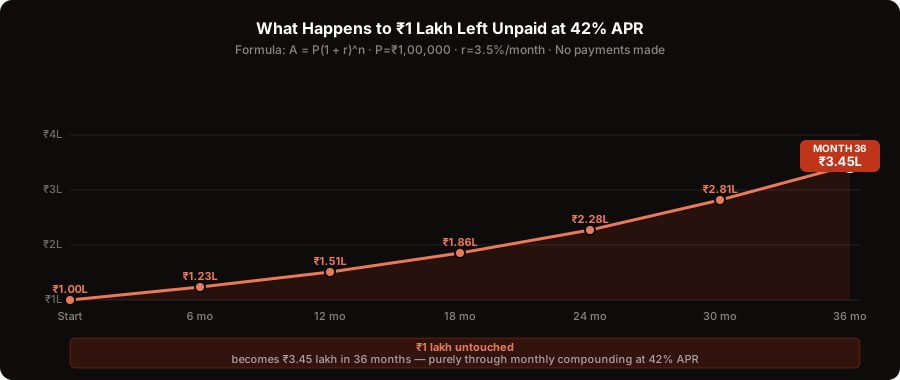
Fig 2: ₹1 lakh untouched at 42% APR — the compounding curve. Month 12: ₹1.51L. Month 24: ₹2.28L. Month 36: ₹3.45L. No payments assumed.
2. The Grace Period (Your Most Valuable Credit Card Feature)
The grace period is the interest-free window between your statement date and due date — typically 15–21 days. Combined with the billing cycle, effective cardholders get 30–51 days of completely free credit on every purchase.
How it works: Billing cycle runs for 30 days. Statement is generated showing all transactions. Due date is 15–21 days later. Pay the full statement balance by the due date → zero interest charged.
The critical catch: The grace period is only available if you paid your previous month's bill in full. If you carried any balance forward, interest accrues from the transaction date on all purchases — including new ones — with no grace period until you fully clear the outstanding.
Reframe: If you always pay in full, your credit card is a 0% interest product that earns you cashback on every purchase. The high APR only applies to people who borrow through it — which you never have to do.
3. Finance Charges
When you don't pay in full, interest is calculated from each transaction's original date — not the due date. This is called a finance charge or interest charge.
Real calculation example — ₹50,000 balance, pay only minimum (₹2,500): Remaining balance: ₹47,500. Monthly interest (3.5%): ₹1,662. You paid ₹2,500 but your balance reduced by only ₹838. The other ₹1,662 went to interest.
4. Cash Advance — The Most Expensive Transaction on Any Credit Card
Withdrawing cash from an ATM using a credit card is one of the worst financial decisions available to an Indian consumer.
Cost breakdown on ₹20,000 cash withdrawal:
| Charge | Amount |
|---|---|
| Cash advance fee | ₹600 (3% — minimum ₹300–₹500) |
| Interest — Month 1 (3.5%, no grace period, from Day 1) | ₹700 |
| Total Month 1 cost | ₹1,300 |
| Annualised effective rate | 78%+ |
Even a personal loan at 24% APR is three times cheaper than a credit card cash advance. Never withdraw cash on a credit card unless it is a genuine emergency with no other option.
5. Late Payment Fees by Issuing Bank
| Outstanding Balance | HDFC Bank Fee | SBI Card Fee | ICICI Bank Fee |
|---|---|---|---|
| Up to ₹500 | ₹100 | ₹100 | ₹100 |
| ₹501–₹5,000 | ₹500 | ₹400 | ₹500 |
| ₹5,001–₹10,000 | ₹600 | ₹750 | ₹750 |
| ₹10,001–₹25,000 | ₹800 | ₹950 | ₹1,000 |
| Above ₹25,000 | ₹1,100 | ₹1,100 | ₹1,200 |
Late payment also triggers: loss of grace period, negative CIBIL mark (lasts 7 years), and potential interest rate review on the account.
The Minimum Payment Trap — The Numbers That Should Alarm Every Indian Cardholder
This is the most dangerous financial pattern on Indian credit cards.
Starting balance: ₹1,00,000 | APR: 42% (3.5%/month) | Minimum payment: 5% of balance
| Month | Opening Balance | Interest (3.5%) | Min Payment | Closing Balance |
|---|---|---|---|---|
| 1 | ₹1,00,000 | ₹3,500 | ₹5,000 | ₹98,500 |
| 2 | ₹98,500 | ₹3,448 | ₹4,925 | ₹97,023 |
| 3 | ₹97,023 | ₹3,396 | ₹4,851 | ₹95,568 |
| 6 | ₹91,200 | ₹3,192 | ₹4,560 | ₹89,832 |
| 12 | ₹84,139 | ₹2,945 | ₹4,207 | ₹82,877 |
| 24 | ₹71,040 | ₹2,486 | ₹3,552 | ₹69,974 |
After paying the minimum for 24 months: You've paid approximately ₹1,14,000 total — but still owe ₹70,000. After 2 years of consistent payments, you've paid more than the original ₹1 lakh — and still owe 70% of it.
Where your minimum payment actually goes (Month 1):
| Portion | Amount | % of Payment |
|---|---|---|
| Goes to interest | ₹3,500 | 70% |
| Actually reduces your debt | ₹1,500 | 30% |
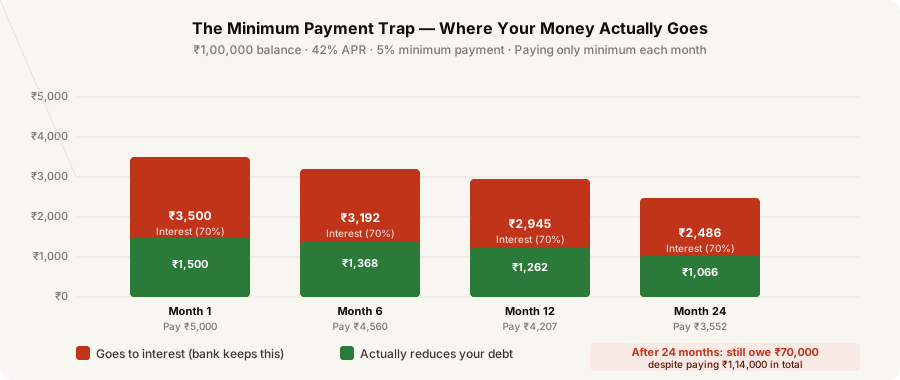
Fig 3: The minimum payment trap. At every point, 70% of your payment goes to interest — not debt reduction. After 24 months you've paid ₹1.14 lakh but still owe ₹70,000.
Time to zero at minimum payment only: 8–10 years. Total interest paid: ₹1,20,000–₹1,50,000 on a ₹1,00,000 original debt.
Behavioural insight: Banks deliberately design the minimum due to feel small — ₹5,000 on a ₹1 lakh balance sounds manageable. That's exactly what keeps you in debt the longest and generates the most interest revenue for the bank. The minimum due is not a repayment plan. It's a retention mechanism.
Quick decision rule based on your outstanding balance:
| Your Outstanding | Best Action | Why |
|---|---|---|
| Below ₹50,000 | Aggressive payoff — Avalanche method | Achievable in 6–12 months with discipline |
| ₹50,000–₹2,00,000 | EMI conversion (call your bank today) | Cuts interest from 42% to 12–18% immediately |
| Above ₹2,00,000 | Personal loan balance transfer | Saves ₹30,000–₹70,000/year in interest |
Four Strategies to Escape Credit Card Debt
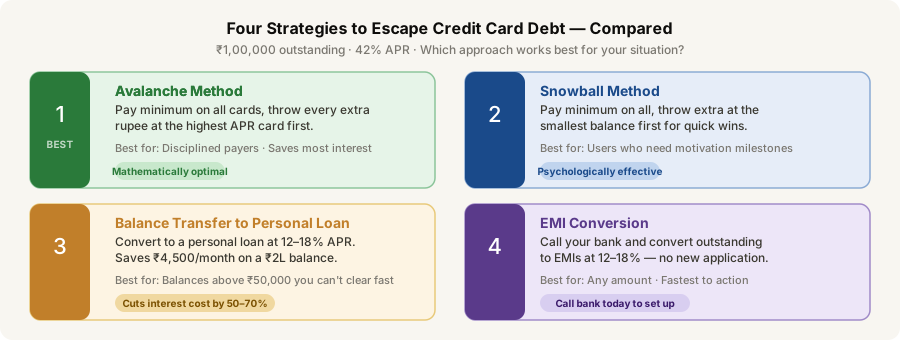
Fig 4: Four escape strategies compared. All four work — choose based on your balance size, discipline level, and how quickly you need to see progress.
Strategy 1: The Avalanche Method (Mathematically Optimal)
Pay the minimum due on every card to maintain CIBIL standing, then direct every extra rupee to the card with the highest APR first. Once cleared, roll that payment to the next-highest APR card.
Why it works: Eliminates the highest-cost debt first, minimising total interest paid. Best for people who can stay disciplined without quick wins.
Strategy 2: The Snowball Method (Psychologically Effective)
Pay minimums on all cards, then target the smallest balance first with all extra funds. Use each cleared card as momentum for the next.
Why it works: Quick wins maintain motivation. Takes longer than Avalanche but has a higher completion rate for people who need visible progress.
Strategy 3: Balance Transfer to Personal Loan
Most Indian banks offer balance transfer of credit card outstanding to a personal loan at 12–18% APR — dramatically lower than 36–52% credit card APR.
Real savings example: Credit card balance of ₹2,00,000 at 42% APR → ₹7,000/month interest. Personal loan at 15% APR → ₹2,500/month interest. Monthly savings: ₹4,500. Contact your bank's customer care and ask specifically for "credit card outstanding to personal loan balance transfer."
Strategy 4: EMI Conversion
Most Indian banks (HDFC Bank, ICICI Bank, Axis Bank, SBI Card) allow converting existing outstanding balances to EMIs at 12–18% interest — far below the revolving APR. Call the bank's customer care and ask for "credit card outstanding balance to EMI conversion."
Credit Card vs Personal Loan Interest — Which Is Cheaper?
The answer is almost always: personal loan is dramatically cheaper.
| Debt Type | Typical APR | Monthly Interest on ₹2L | Annual Interest Cost |
|---|---|---|---|
| Credit card (revolving) | 36–52% | ₹6,000–₹8,667 | ₹72,000–₹1,04,000 |
| Personal loan (bank) | 12–18% | ₹2,000–₹3,000 | ₹24,000–₹36,000 |
| Personal loan (NBFC) | 18–24% | ₹3,000–₹4,000 | ₹36,000–₹48,000 |
| Balance transfer EMI (bank) | 12–18% | ₹2,000–₹3,000 | ₹24,000–₹36,000 |
If you have credit card debt above ₹50,000 that you cannot clear in the next 30 days, converting it to a personal loan or bank EMI is almost certainly the right financial decision. The interest saving is typically ₹30,000–₹70,000 per year on a ₹2 lakh balance.
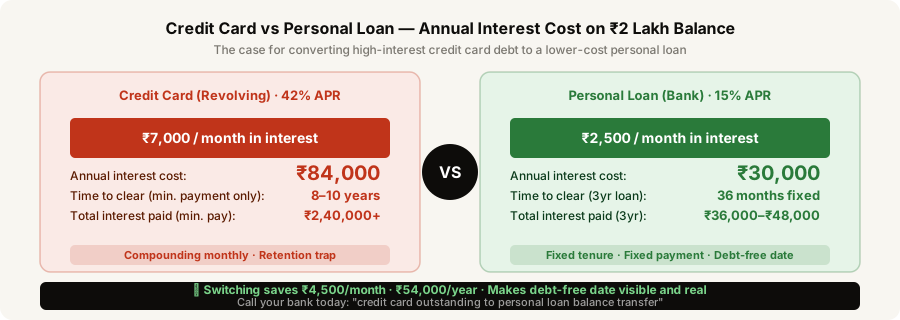
Fig 5: Credit card vs personal loan on ₹2 lakh outstanding. Switching saves ₹4,500/month — and gives you a fixed debt-free date instead of an open-ended spiral.
When NOT to Take a Personal Loan to Pay Credit Card Debt
The personal loan route has one critical pre-condition: you must stop adding to your credit card balance. Without this, you end up with both a personal loan and a new growing credit card balance — worse than before.
Don't take a personal loan to clear credit card debt if: you haven't identified and fixed the spending behaviour that created the debt; the personal loan tenure is 5+ years; your bank charges high prepayment penalties (above 3%); or you plan to continue using the same credit card at its full limit after clearing it.
Is Credit Card Interest Legal in India?
Yes — fully legal, and fully disclosed. The Reserve Bank of India (RBI) regulates credit card interest rates through its Master Circular on Credit Card Operations (updated 2025). Banks must disclose APR in all card documents and marketing material. The MITC document must state the exact monthly and annual interest rate. RBI currently does not impose a maximum rate cap — banks set their own rates within fair practice guidelines.
So while 42–52% APR feels predatory, it is entirely within the legal framework set by India's banking regulator. Your only protection is understanding it and paying in full.
The Only Reliable Way to Pay ₹0 in Credit Card Interest
There is only one reliable way: pay the full statement balance before the due date, every single month.
Set up NACH autopay for the full statement amount — not the minimum due — through your bank's netbanking. With full-amount autopay active, you will pay ₹0 in interest regardless of how much you spend on a 36–52% APR product. Every cashback and reward point earned becomes pure profit.
One action that prevents most credit card debt: When you receive your statement, if you cannot pay it in full, stop using the card immediately until the balance is cleared. Never add new purchases to an existing balance you're carrying.
How Much Interest Will I Pay on My Credit Card?
| Monthly Balance Carried | APR | Monthly Interest | Annual Interest Cost |
|---|---|---|---|
| ₹25,000 | 42% | ₹875 | ₹10,500 |
| ₹50,000 | 42% | ₹1,750 | ₹21,000 |
| ₹1,00,000 | 42% | ₹3,500 | ₹42,000 |
| ₹2,00,000 | 42% | ₹7,000 | ₹84,000 |
| ₹50,000 | 36% | ₹1,500 | ₹18,000 |
| ₹50,000 | 52.8% | ₹2,200 | ₹26,400 |
The most important number in this table: ₹1,00,000 at 42% APR costs ₹3,500 every single month just to stand still. That's ₹42,000 a year buying you nothing but the privilege of still owing ₹1 lakh.
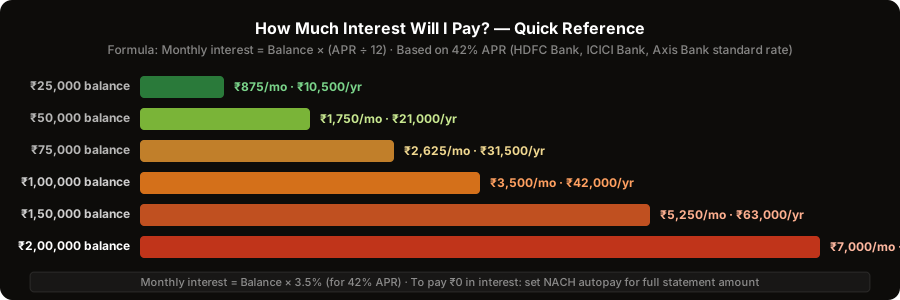
Fig 6: Monthly interest cost at 42% APR by balance size. Use this as a quick reference to understand your exact monthly cost — and the urgency of clearing any carried balance.
Frequently Asked Questions
Credit card interest rates range from 36% to 52.8% APR (3.0–4.4% per month). HDFC Bank and Axis Bank charge 36–42% on most cards. ICICI Bank and SBI Card charge approximately 41.88–42% APR. Entry-level and retail cards can go up to 52.8% APR. Always check your specific card's MITC document for the exact rate.
Credit card debt is fully unsecured — no collateral backs it. Banks price the default risk into the rate. Unlike home loans (backed by property) or gold loans (backed by gold), lenders have nothing to recover if you default. The Reserve Bank of India (RBI) allows banks to set their own rates, provided they disclose them clearly in the MITC, and currently does not cap the maximum rate.
Monthly interest = Outstanding balance × (APR ÷ 12). For a card at 42% APR: 42 ÷ 12 = 3.5%/month. On ₹50,000: ₹50,000 × 3.5% = ₹1,750/month. This compounds monthly using the formula A = P(1+r)^n. Interest accrues from each transaction's original date, not the due date.
Credit card interest compounds monthly. If you carry ₹1,00,000 and make no payments, Month 1 interest is ₹3,500 (3.5%). Month 2 interest is calculated on ₹1,03,500 — so it's ₹3,622. At 3.5%/month, an unpaid ₹1 lakh grows to ₹2.28 lakh in 24 months and ₹3.44 lakh in 36 months.
Paying only the minimum (typically 5% of outstanding) on a ₹1,00,000 balance at 42% APR takes 8–10 years to clear and costs ₹1,20,000–₹1,50,000 in additional interest. In Month 1, 70% of your ₹5,000 minimum payment goes to interest and only 30% reduces your actual debt.
Paying the minimum prevents a late fee and avoids a missed-payment CIBIL mark — but it does not prevent interest charges. The remaining 95% of your balance accrues full APR interest from the transaction date. Minimum due keeps you out of default; it does not keep you out of the interest trap.
Yes. The Reserve Bank of India (RBI) regulates credit card interest through its Master Circular on Credit Card Operations (updated 2025). The RBI mandates APR disclosure in all card documents but currently does not impose a maximum rate cap. So while 42–52% APR feels high, it is fully legal provided it is disclosed.
Yes — up to 52.8% APR is currently permissible under RBI guidelines, provided it is disclosed in the MITC document. Most major Indian banks charge 36–42% APR. Some retail and entry-level co-branded cards go up to 52.8% APR. Always check your specific card's MITC before applying.
There is only one reliable method: pay the full statement balance before the due date every single month. Set up NACH autopay for the full statement amount through your bank's netbanking. As long as you pay in full every cycle, you will pay exactly ₹0 in interest on any credit card regardless of its APR.
Disclaimer: Interest rates and charges are subject to change by issuing banks and RBI guidelines. Always refer to your card's MITC document for current rates.
Last updated: April 29, 2026