
Credit Card Fraud in India 2026: How to Spot It, Report It & Protect Yourself
Credit card fraud in India 2026 — how to spot it, report it, and protect yourself. OTP scams, skimming, phishing, SIM swap explained with fraud helplines for HDFC Bank, ICICI Bank, Axis Bank, SBI Card.
Priya Nair8 May 202618 min read
Table of Contents
- Fraud Happening Right Now? Do These 5 Things First
- The Scale of Credit Card Fraud in India 2026
- How Fraudsters Get Your Information
- What's New in 2026: AI Voice Cloning & WhatsApp Fraud
- Why Intelligent People Still Fall for Fraud
- Signs Your Card May Already Be Compromised
- Safe vs Unsafe — Quick Reference
- The 5 Most Common Fraud Types
- What Happens After You Report Fraud
- 12 Rules to Protect Your Credit Card
- If Fraud Happens: Exact Steps
- Your Rights Under RBI Zero Liability Rules
- Fraud vs Dispute
- Frequently Asked Questions
Key Takeaway:
Most credit card fraud in India doesn't happen due to hacking — it happens because users are convinced to share information themselves. Fraudsters don't need your card. They need your OTP. Report fraud within 3 working days and don't share credentials to qualify for RBI's zero-liability protection. The single most protective rule: never share your OTP with anyone, under any circumstances.
🚨 Fraud Happening Right Now? Do These 5 Things First.
Goal: stop further loss within 5 minutes.
- Open your banking app → disable International + Online transactions — fastest freeze, takes 30 seconds, no call needed
- Call your bank's fraud helpline — block the card, report verbally, get a reference number (keep it)
- File written complaint within 24 hours — app, website, or bank email
- Report to cybercrime.gov.in or call 1930 — creates a legal record immediately
- Do not call anyone back — fraudsters frequently call back posing as the fraud helpdesk
| Bank | 24/7 Fraud Helpline |
|---|---|
| HDFC Bank | 1800 202 6161 / 1860 267 6161 |
| ICICI Bank | 1800 102 4242 |
| Axis Bank | 1800 419 5959 |
| SBI Card | 1800 180 1290 |
| Kotak Mahindra Bank | 1800 209 0000 |
Helplines last verified: April 2026. Verify current numbers on your bank's official website.
Under RBI's zero-liability rules: report within 3 working days + fraud not due to your negligence = eligible for full refund (subject to bank investigation).
The Scale of Credit Card Fraud in India 2026
India processed over 600 crore credit card transactions in 2025–26 (Reserve Bank of India Payment System Report). Fraud was reported in approximately 2.8 lakh cases — a 34% year-on-year increase, driven by sophisticated social engineering, SIM swap attacks, and AI-powered phishing.
Average fraud amount per case: ₹38,000. A significant proportion of fraud victims fail to recover the full amount — primarily due to delayed reporting or having shared sensitive information that legally voids their zero-liability protection under RBI guidelines.
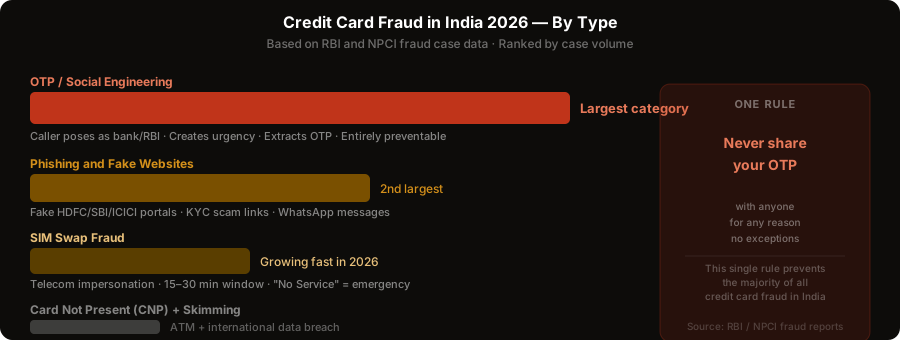 Fig 1: Credit card fraud in India by type. OTP and social engineering fraud accounts for the largest share by case count — and is the only category entirely preventable by a single rule: never share your OTP with anyone.
What your bank will NEVER ask — memorise this: No legitimate representative of HDFC Bank, ICICI Bank, Axis Bank, SBI Card, Kotak Mahindra Bank, the Reserve Bank of India, or NPCI will ever ask for your OTP, your CVV number, your full card number, your net banking password or MPIN, or screen sharing via AnyDesk, TeamViewer, QuickSupport, or any remote access app. If anyone asks for any of these — hang up immediately. It is fraud. No exceptions.
How Fraudsters Get Your Information
A common question after fraud: "How did they know my card details?" The answer is almost never sophisticated hacking.
| Source | What they get | How common |
|---|---|---|
| Data breaches (leaked merchant/app databases) | Card number, name, email, partial DOB | Very common |
| Phishing websites | Card number, CVV, expiry, OTP | Common |
| Malicious apps | Everything on your phone | Growing |
| Social media | Name, DOB, city, phone — enough for SIM swap | Very common |
| Public Wi-Fi interception | Login sessions, unencrypted data | Less common but real |
| Recycled passwords | Access to accounts where card is saved | Common |
The key insight: Fraudsters rarely need your full card details before calling you. They often know your name, phone number, and partial card number — sourced from breaches — and use that partial knowledge to seem legitimate enough to extract the remaining piece (usually your OTP).
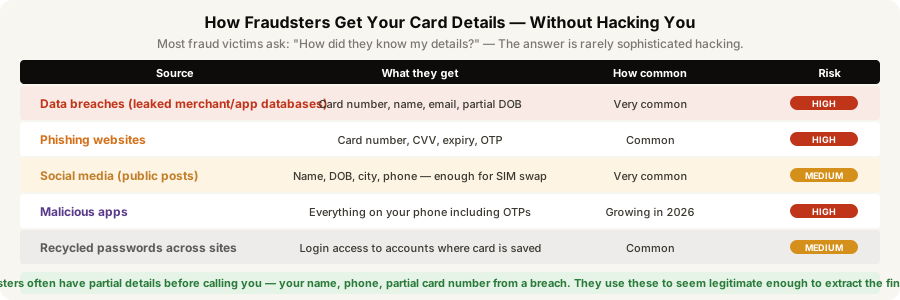 Fig 2: How fraudsters obtain your card details — rarely through hacking. Data breaches and phishing dominate. Knowing your last 4 digits or your name doesn't make a caller legitimate.
The Fraud Landscape in India 2026: What's New
AI Voice Cloning and WhatsApp Impersonation
The most significant fraud evolution in 2025–26 is AI-generated voice cloning. Fraudsters now produce calls that sound indistinguishable from actual bank representatives or even family members, using audio scraped from social media and phone recordings.
Voice cloning scams always push urgency — KYC updates, blocked cards, suspicious transactions. The absolute counter: hang up. Call your bank back using the official number printed on the back of your card — never the number from the incoming call or WhatsApp message. Your bank will not initiate urgent calls requiring immediate action.
WhatsApp Banking Fraud
Fraudsters send WhatsApp messages with official-looking bank letterheads, KYC update requests, or reward redemption links. The messages often include real partial card numbers (obtained from data leaks) to appear legitimate. Indian banks generally do not request sensitive information or initiate transaction approvals through WhatsApp. Any such request should be treated with suspicion — verify directly by calling the official number on the back of your card.
Zero-liability eligibility check: If all three are true, you are generally eligible for RBI zero-liability protection: (1) you did not share your OTP, PIN, CVV, or net banking password, (2) you reported the fraud within 3 working days of discovering it, and (3) the transaction was unauthorised — you did not initiate or approve it.
Why Intelligent People Still Fall for Credit Card Fraud
Understanding why fraud works is more protective than memorising a list of rules.
Urgency disables verification. When someone says "your account will be blocked in 5 minutes," your brain shifts from analytical thinking to reactive action. This is intentional — fraudsters study this. The urgency is the mechanism.
Authority triggers compliance. A caller who says "I'm calling from RBI's Fraud Prevention Cell" triggers deference — even though the Reserve Bank of India has no customer-facing fraud prevention helpline. Authority claims bypass critical evaluation.
Partial information creates false legitimacy. Fraudsters often know your name, partial card number, and recent transaction — obtained from data breaches. This makes them sound real. Knowing your last 4 digits doesn't verify identity.
Fear of loss overrides caution. "₹32,000 has been debited from your account" triggers immediate fear. Fear narrows attention. You stop questioning the caller and start trying to solve the problem they've invented.
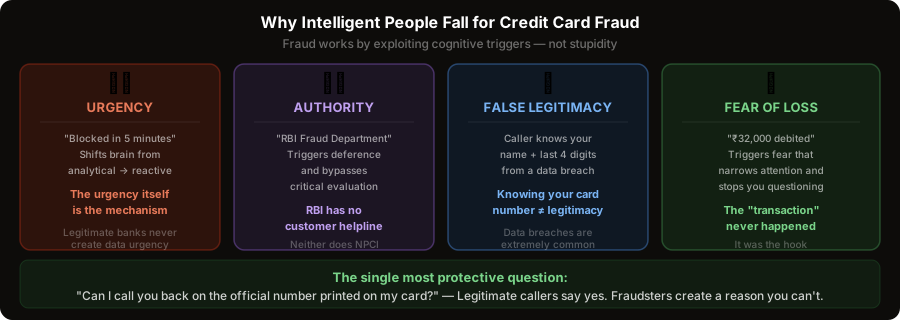 Fig 3: Why intelligent people fall for credit card fraud. Scams work by activating four specific cognitive triggers — recognising the trigger is the defence. The urgency itself is the mechanism.
The single most protective question: "Can I call you back on the official number?" Legitimate callers will say yes. Fraudsters will create a reason why you can't.
Signs Your Credit Card May Already Be Compromised
These signals require immediate action — don't wait for a large unauthorised charge.
| Signal | What it likely means |
|---|---|
| ₹1–₹100 charge from unknown merchant | Fraudsters test cards before large transactions |
| OTP received without your action | Someone is attempting a transaction with your details |
| Transaction declined despite sufficient limit | Card may be flagged or blocked after prior fraud attempt |
| Missing SMS alerts for a day or more | Possible SIM swap in progress |
| Unknown international transaction alert | CNP fraud — your card details are in use abroad |
| Bank calls asking to verify recent transaction | Bank fraud system flagged suspicious activity |
| Unexpected new account on CIBIL report | Identity theft — someone may have opened credit in your name |
Rule: treat a ₹1 unknown charge as a ₹50,000 emergency. Small test charges are the most reliable early warning sign. Check your statement monthly, not just when it feels like something went wrong.
Safe vs Unsafe — Quick Reference
| Situation | Safe Action | Unsafe Action |
|---|---|---|
| Incoming "bank" call | Hang up and call official number | Continuing the call and sharing anything |
| KYC update request | Open bank app manually | Clicking link in SMS or WhatsApp |
| OTP request | Never share with anyone | Sharing "just this once" under urgency |
| Remote access request | Refuse immediately | Installing AnyDesk or TeamViewer |
| International transactions | Keep OFF by default, enable when needed | Always ON |
| Suspicious ₹1 charge | Call fraud helpline immediately | Ignoring and watching |
| "No Service" on phone | Call telecom immediately | Assuming network glitch |
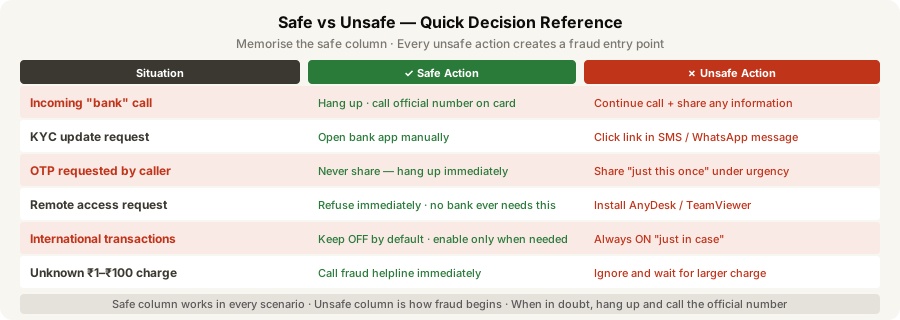 Fig 4: Safe vs unsafe reference for every common fraud scenario. The safe column works in every situation. When in doubt, hang up and call the official number.
The 5 Most Common Credit Card Fraud Types in India
Type 1: OTP / Social Engineering Fraud — Most Common by Case Count
A caller poses as a bank employee, RBI officer, courier company, or telecom provider. They create urgency and convince you to share your OTP, CVV, or net banking password. This is consistently the single largest credit card fraud category by case count in India.
Real scam call example: "Sir, your SBI Card reward points worth ₹4,850 are expiring today. Please confirm your OTP to complete the redemption to your account." — The caller already knows your name and partial card number. The OTP they're asking for is actually for a transaction they're initiating.
Red flags: Caller creates urgency ("act within 5 minutes or card will be blocked"), asks you to download AnyDesk or TeamViewer, claims to be from "RBI Fraud Department" or "NPCI Helpline" (neither contacts customers), knows partial card details.
Type 2: Card Skimming
A device is fitted onto an ATM card slot that copies your magnetic stripe data when you insert your card. A hidden camera captures your PIN.
Protection: Cover the keypad with your palm every single time you enter PIN. Wiggle the card slot before inserting — skimmers are typically loosely attached. Prefer ATMs inside bank branches over standalone kiosks.
Type 3: Phishing and Fake Websites
Fraudsters create pixel-perfect replicas of HDFC Bank, SBI, ICICI Bank, or Amazon payment portals. You receive an SMS or email with a link and enter card details on the fake site.
Real WhatsApp scam example: "Dear HDFC customer, your KYC will expire today. Failure to update within 24 hours will result in account suspension. Update now: [link]"
Protection: Never click financial links in SMS, WhatsApp, or email — type the URL directly. Bookmark official bank websites and use only those bookmarks.
Type 4: SIM Swap Fraud
Fraudsters obtain your personal details (Aadhaar, PAN, address) through data leaks, then visit a telecom store claiming their SIM was lost. With your number in their control, they receive all OTPs.
The biggest mistake: Ignoring "No Service" for hours, assuming it's a network glitch. Fraudsters need only 15–30 minutes with control of your number to drain linked bank accounts. Treat any unexplained loss of mobile service as a financial emergency.
Immediate action: Call your telecom operator's fraud line immediately — Airtel: 121 | Jio: 198 | Vi: 199. Then call your bank simultaneously.
Type 5: Card Not Present (CNP) Fraud
International websites and some Indian platforms don't require OTP verification. If fraudsters obtain your card number, expiry, and CVV through data breaches or phishing, they can transact without any OTP.
Protection: Set international online transaction limit to ₹0 in your bank app when not travelling. Use virtual card numbers for online shopping — available from HDFC Bank, Axis Bank, ICICI Bank in netbanking.
What Happens After You Report Credit Card Fraud?
- Card blocked immediately — your existing card is frozen; transactions stop
- Reference number issued — keep this; you'll need it for every subsequent interaction
- Replacement card dispatched — typically 5–7 working days; some banks offer emergency same-day pickup
- Written complaint filed — within 24 hours; triggers the zero-liability investigation clock
- Temporary credit may appear — some banks provisionally credit the disputed amount during investigation
- Declaration form required — bank may request a signed fraud declaration
- Merchant/network verification — bank contacts the merchant or Visa/Mastercard/Rupay for transaction records
- Final resolution — within 90 working days per RBI guidelines; most straightforward cases resolve in 30–45 days
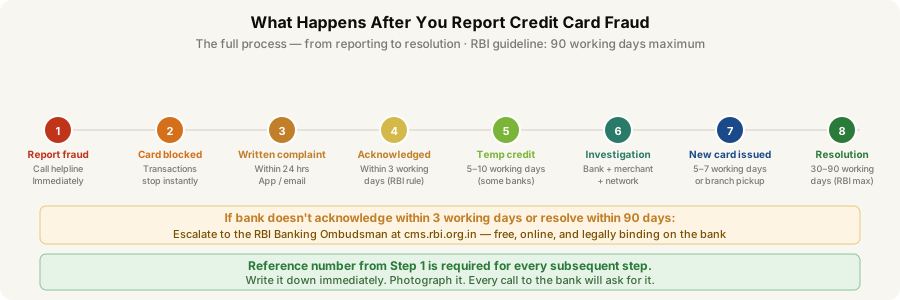 Fig 5: The complete fraud resolution process. Steps 1–3 happen within hours. Step 8 (final resolution) takes 30–90 working days. Keep your reference number — every subsequent step requires it.
If the bank does not acknowledge your complaint within 3 working days or resolve within 90 days, escalate immediately to the Banking Ombudsman at cms.rbi.org.in.
12 Rules to Protect Your Credit Card in 2026
- Never share OTP, CVV, or full card number — with anyone, for any reason
- Enable SMS + email transaction alerts on all cards immediately
- Set international transaction limit to ₹0 unless actively travelling
- Use virtual card numbers for all online shopping (available in netbanking)
- Cover the ATM keypad with your palm every time
- Never save card details on websites — re-enter each transaction
- Check your statement monthly — look for even ₹1–₹100 test charges
- Never click financial links in SMS, WhatsApp, or email
- Enable app-based OTP where available — safer than SMS-based OTP
- Report a lost card immediately — call 24/7 helpline before using the bank app
- Set low tap-to-pay limits in your bank app for contactless transactions
- Check your CIBIL report annually — unexpected new accounts may indicate identity theft
If Fraud Happens: The Exact Steps to Take
Step 1: Call the bank's 24/7 fraud helpline immediately. Report the fraud verbally. Request immediate card block. Get a reference number — every subsequent interaction with the bank will require it.
| Bank | Fraud Helpline | Last verified |
|---|---|---|
| HDFC Bank | 1800 202 6161 / 1860 267 6161 | April 2026 |
| SBI Card | 1800 180 1290 | April 2026 |
| ICICI Bank | 1800 102 4242 | April 2026 |
| Axis Bank | 1800 419 5959 | April 2026 |
| Kotak Mahindra Bank | 1800 209 0000 | April 2026 |
Always verify current helpline numbers on your bank's official website before calling.
Step 2: File written complaint with your bank within 24 hours. Email the bank's official complaint address or submit through the bank's app/website. A written record is essential for your zero liability claim.
Step 3: Report to cybercrime.gov.in or call 1930. File a cybercrime complaint to create a legal record. The national helpline 1930 connects to the Cyber Crime Coordination Centre under the Ministry of Home Affairs.
Step 4: File a police FIR (for frauds above ₹10,000). Visit your local cyber cell with transaction alert SMSes, bank complaint reference number, and any other evidence. For escalation if bank doesn't resolve within 90 days, file with the Banking Ombudsman — free, online, and run by the Reserve Bank of India.
Your Rights Under RBI's Zero Liability Rules
The Reserve Bank of India's framework on customer protection in unauthorised electronic transactions (RBI/2017-18/15, updated 2022) establishes your rights clearly.
| Situation | Your Liability |
|---|---|
| Reported within 3 working days, not your negligence | Zero — eligible for full refund (subject to RBI guidelines and bank investigation) |
| Reported within 4–7 working days | Limited (₹5,000–₹25,000 cap depending on account type) |
| Reported after 7 working days | Bank's board-approved policy applies |
| You shared OTP/PIN/CVV | Partial to full liability |
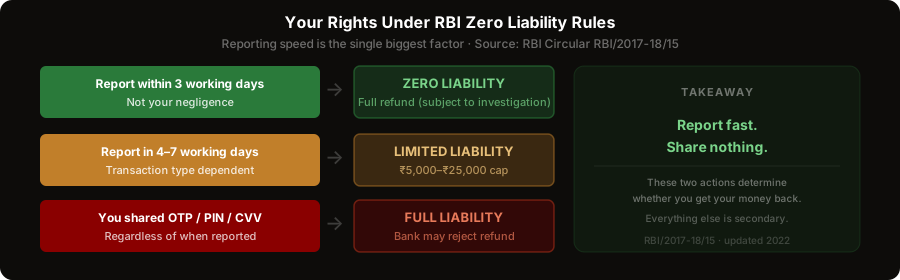 Fig 6: RBI zero-liability framework. Reporting speed is the single biggest factor in whether you recover your money. Sharing your OTP removes zero-liability protection regardless of when you report.
The critical point: If you were socially engineered into sharing your OTP, the bank may argue the fraud was due to your negligence — and they may be legally correct under RBI guidelines. Prevention is dramatically more reliable than recovery.
Fraud vs Dispute — The Difference Most People Miss
Fraud = an unauthorised transaction you did not initiate or approve. Zero liability rules apply.
Dispute = a transaction you authorised but disagree with (wrong amount, merchant didn't deliver, duplicate charge). Governed by chargeback rules — different process, different timeline.
Most cardholders confuse the two and report disputes as fraud, which delays resolution. For disputes: contact the merchant first, then initiate a chargeback through your bank's app. For fraud (unauthorized): call the fraud helpline immediately — do not approach the merchant.
Frequently Asked Questions
Open your banking app and immediately disable international and online transactions. Then call your bank's fraud helpline, file a written complaint within 24 hours, and report to cybercrime.gov.in or call 1930. For frauds above ₹10,000, file an FIR at your local cyber cell. Reporting within 3 working days activates zero-liability protection under RBI regulations.
The risk from NFC/contactless transactions is very low in India. RBI mandates that contactless transactions above ₹5,000 require PIN. Better protection: set a contactless transaction limit in your bank app to ₹2,000–₹3,000 for daily comfort.
Yes — all major Indian banks now offer transaction-level controls in their apps. HDFC Bank, ICICI Bank, and Axis Bank all allow you to disable international, online, and contactless transactions separately and re-enable them instantly. Locking categories you don't use eliminates entire fraud vectors with no inconvenience.
Unauthorized transactions themselves don't directly hurt your TransUnion CIBIL score. However, if fraud results in unpaid dues while the investigation is ongoing, those dues can negatively affect your score. Always pay the undisputed portion of your bill on time during a fraud investigation, and mark the disputed amount as under review with your bank.
Temporary credit may appear in 5–10 working days. Final investigation must resolve within 90 working days per RBI guidelines. Most clear-cut cases resolve in 30–45 days. If the bank misses the 90-day deadline, escalate to the Banking Ombudsman at cms.rbi.org.in.
Yes — if you voluntarily shared your OTP with a fraudster, banks may classify this as customer negligence, reducing or eliminating your zero-liability protection. The RBI zero-liability circular explicitly excludes transactions where the customer contributed to the breach. This is why prevention matters far more than recovery in OTP fraud cases.
OTP and social engineering fraud is the most common type by case count — fraudsters call posing as bank employees or RBI officers and extract OTPs under urgency. AI-generated voice cloning is an emerging 2026 variant. It's entirely preventable: no institution will ever ask for your OTP.
A virtual card number is a temporary number generated in your bank's netbanking — same credit limit, different number and CVV. If stolen, it cannot be reused. HDFC Bank, ICICI Bank, and Axis Bank all offer this. Use it for every online purchase instead of your physical card number.
Log into your bank's app. Under card settings ("Card Controls" on HDFC Bank, "Manage Card" on ICICI Bank, "Card Services" on Axis Bank): set international limits to ₹0 when not travelling, online transaction limits to what you actually use monthly, and contactless limits to ₹2,000–₹5,000. Takes under 3 minutes.